Bacari Etiquette, Ombra And The Venetian Wine Ritual
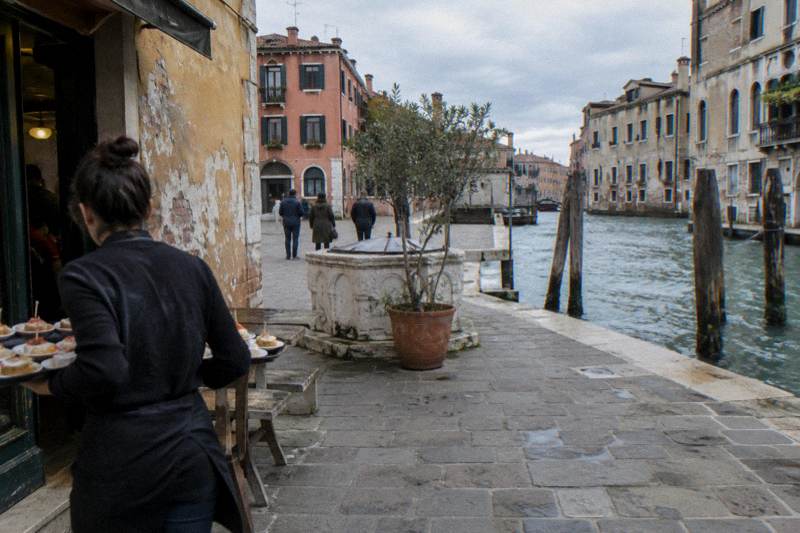
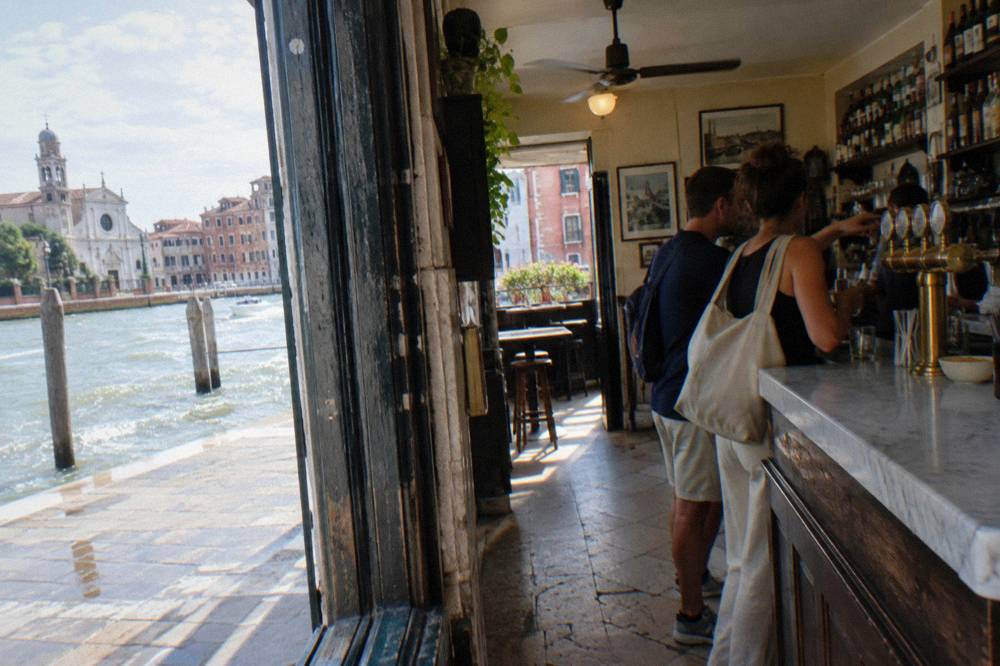
Venice drinks standing up. The bacaro is a small wine bar where locals take an ombra, a small glass of house wine, with a piece of cicchetti, and the whole ritual has rules nobody posts on a sign.
Short answer
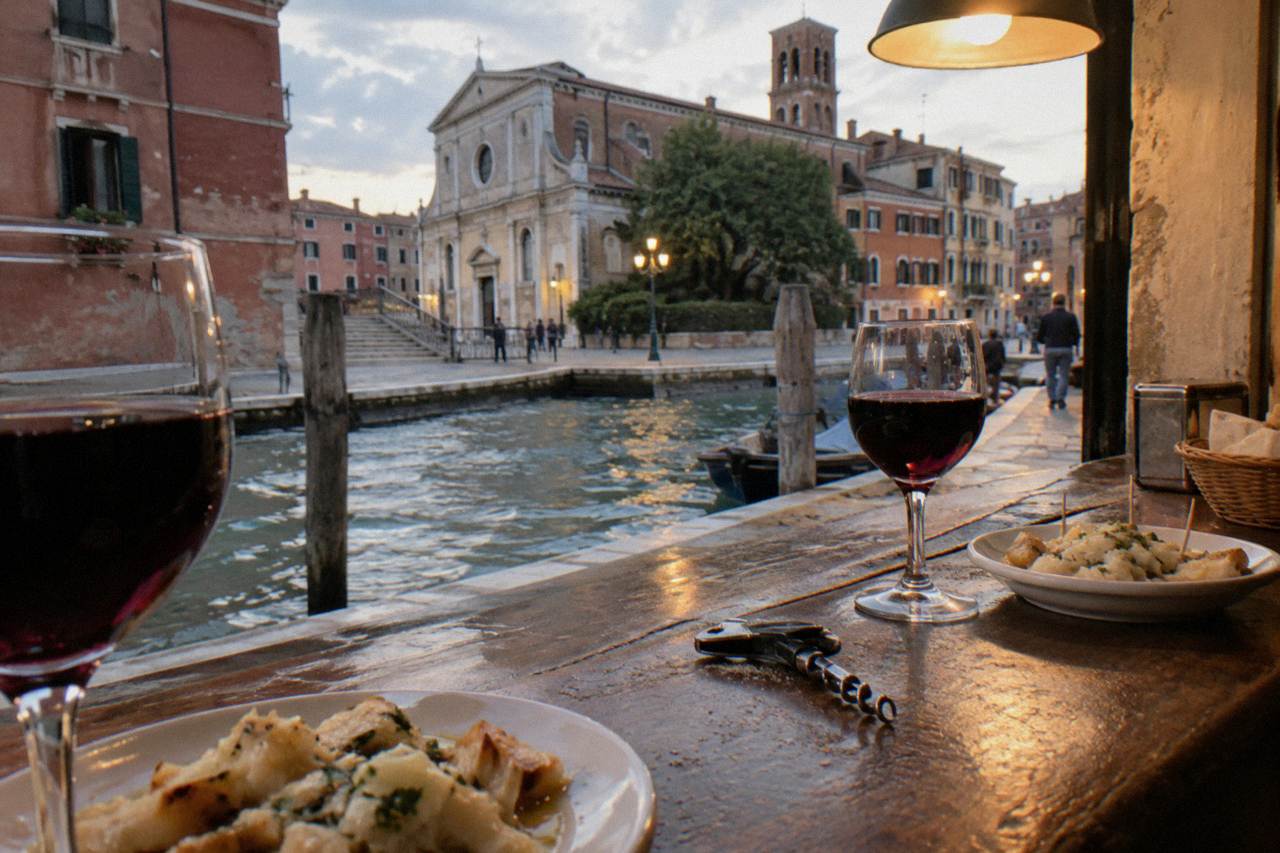
A bacaro crawl means standing at the counter, ordering an ombra of house wine and a piece or two of cicchetti, paying as you go, and moving on. Cicchetti run about EUR 1.50 to 4 a piece and an ombra about EUR 1 to 2.50, as reported. Tipping is optional, coperto rarely applies at the counter, and the rhythm peaks at lunch and aperitivo hour.
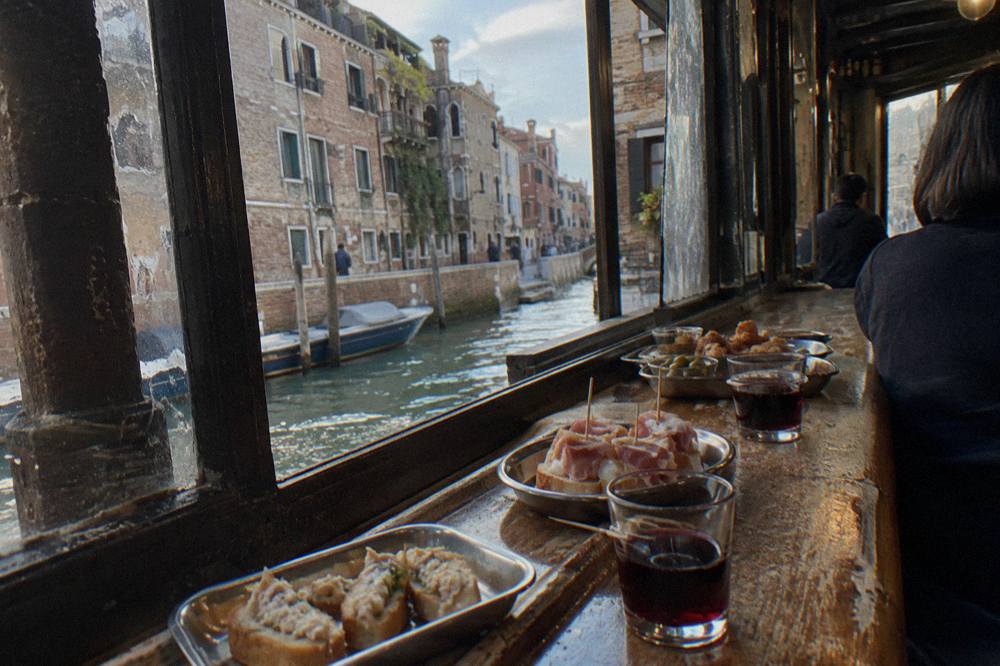
Venice has been drinking standing up for roughly a thousand years, and the bacaro, the small, wood-panelled wine bar found on almost every back canal, is where it happens. There is no menu ritual, no waiter hovering, no table politics. You walk in, look at what is under glass or on the counter, point, and a few minutes later you are holding a small glass of wine and a piece of cicchetti with the whole bar within earshot. It is the most social and the least ceremonial way to eat in Italy, which is exactly why it unsettles first-time visitors.
This page walks through the mechanics: how a crawl works, what an ombra is and how to order one, the unwritten rules of the counter, paying, coperto and tipping, the daily rhythm of lunch and aperitivo, the classic dishes you will meet, and when a guided crawl is worth booking instead of going alone. Everything about prices below is reported local practice, not a promise from any single bar: posted lists at the counter are always the final word. For the food itself, start with how cicchetti works and how to order it, and for the wider wine picture see the companion guide to Venetian wine tasting.
How Does A Bacaro Crawl Actually Work?
A bacaro crawl, or giro di ombre, means visiting three or four small wine bars in sequence, taking one ombra of wine and one or two pieces of cicchetti in each, paying per bar as you go, then walking it off. There is no single bill, no reservation, and no fixed route: each bar is a short, cheap, self-contained stop, and the whole circuit usually takes two to three hours and replaces a sit-down meal.
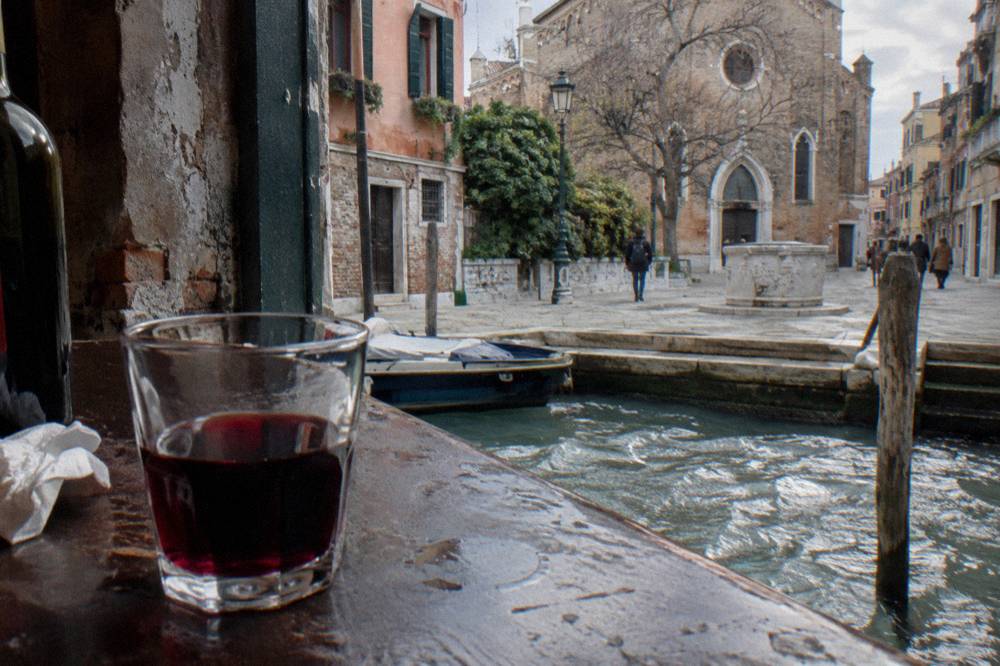
The word bacaro is Venetian dialect, and the bars themselves vary from a few square metres of standing room with barrels for tables to larger places with benches outside. What they share is the format: a counter loaded with cicchetti, a short list of wines by the glass, and prices that make an evening of bar-hopping cost less than one restaurant main. The Venetian name for the circuit, giro d'ombra or giro di ombre, literally means a round of shadows, a reference to the old habit of following the shade through the day, wine in hand.
The crawl is built on movement. Locals rarely settle in one bacaro for the evening; they take one or two stops per bar, chat, finish, and drift to the next. This is why the standing custom matters so much. Sitting at a table in many bacari turns a quick counter stop into a longer, pricier one, and in some places table service is simply not offered at all. Standing also signals that you are there for the wine and the talk, not a restaurant experience.
If the mechanics still feel opaque after reading this page, a guided crawl handles them for you. The three walks below cover the format at different depths and price points, and each listing states exactly what is included before you pay anything.
What Is An Ombra And How Do You Order One?
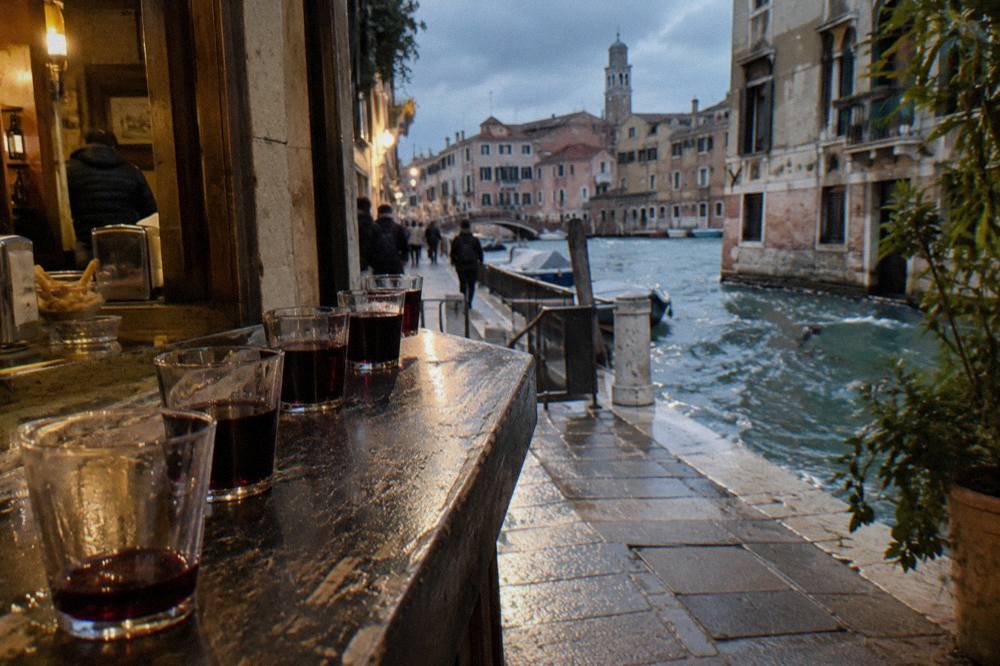
An ombra is a small glass of house wine, roughly 100 ml, traditionally red, that Venetians drink standing at the bacaro counter. You order it by asking for un'ombra, optionally naming the colour, pay the posted price, and drink it in a few sips alongside a piece of cicchetti; reported prices run about EUR 1 to 2.50 a glass in local spots.
The word means shadow in Venetian dialect. Wine sellers once moved with the shade of the campanile in Saint Mark's Square to keep their barrels cool, and the drink kept the name long after the sellers moved indoors. The pour is deliberately small: it is a tasting measure, not a restaurant glass, and drinking it slowly over an hour misses the point. An ombra is consumed in a few minutes, standing, usually with something salty in the other hand.
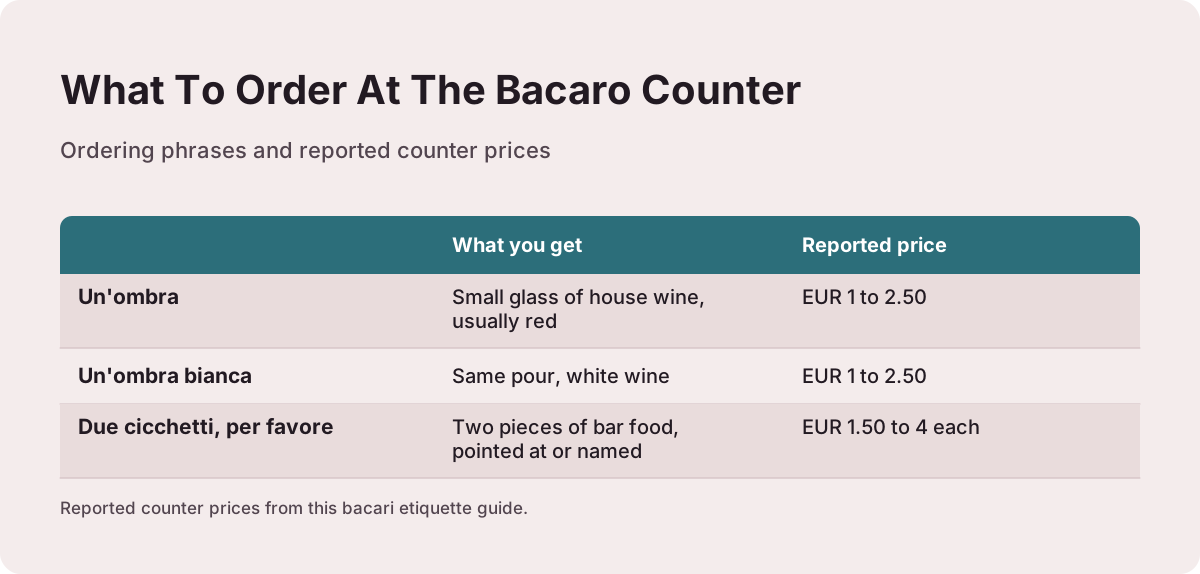
Ordering is the part that freezes visitors, and it should not. At the counter you can simply say un'ombra, or un'ombra rossa for red and un'ombra bianca for white. If you want something specific, the wines on tap or by the glass are usually chalked or listed near the register, and pointing is completely acceptable. Breadsticks or a small plate arrives with the wine in many bars, and the whole transaction takes less than a minute.
Two practical notes. First, the glass rule: a municipal regulation in Venice bans drinking from glass outside the permitted outdoor seating of bars, and bans takeaway sales of drinks in glass containers for consumption in the street, as reported, with fines that have been set between EUR 25 and 500. Finish your ombra inside or at the bar's own benches, and check current rules on the Comune di Venezia site before you assume anything. Second, the spritz is the other counter classic: the local order is often Select rather than the better-known orange aperitif, and the spritz guide covers that ritual in full.
| You say | What you get | Reported price |
|---|---|---|
| Un'ombra | Small glass of house wine, usually red | EUR 1 to 2.50 |
| Un'ombra bianca | Same pour, white wine | EUR 1 to 2.50 |
| Due cicchetti, per favore | Two pieces of bar food, pointed at or named | EUR 1.50 to 4 each |
| Un bicchiere d'acqua | A glass of water | Often free, ask |
Reported prices in this table come from the official Visit Venice guidance on cicchetti culture, which is worth reading in full at visit.venice.it. What any single bar charges on any single day is on its posted list, and prices in tourist-heavy lanes sit above these ranges.
Standing At The Counter: The Unwritten Rules
Standing is the default in a bacaro, and it changes everything: you order at the counter, you pay when you order or on the way out, you keep your voice low, and you do not linger for hours over one glass. The bar is a shared, fast-moving space, and reading the room, where locals are standing, how they are paying, is the entire etiquette in one sentence.
The first rule is physical: belly up to the counter. If there is a queue, it is informal and self-policing, and if the counter is full, locals hold their glass and stand along the wall. Tables, where a bar has them, are a different service with different expectations, and in some bacari the table price is visibly higher than the counter price for the same pour. Ask, or look for the two-tier list, before you sit.
The second rule is pace. A stop is five to fifteen minutes. Venetians finish their ombra, set the glass down or hand it back, and go. Occupying counter space for half an hour with a near-empty glass in a packed bar is the one thing that genuinely annoys staff. If you want a longer sit, that is what the campo benches or a proper osteria are for.
The third is volume. Bacari are small rooms with regulars in them, often mid-conversation with the person behind the counter. A group of six arriving loudly will change the room's temperature immediately. Keep the group tight, order in turn, and if your party is larger than five or six, split across two visits rather than arriving as a wall.
Beyond that, everything else is observation. Watch how the person next to you pays, whether money goes into a hand or a tin, whether you take a receipt. Mimic, and you will pass as a local within two bars. For visitors who would rather have someone modelling all of this on day one, the Venice Bacaro Food Tour, Eat and Drink like a Venetian, is built exactly around this nervousness: a guide walks a small group through several bacari, orders, explains each dish and handles the counter transactions, and the live listing states what is included.
Guided groups in the historic centre are capped at 25 people and loudspeakers are banned, as reported, so even busy walks use headsets and stay within the room's normal volume. That cap is city-wide regulation rather than a courtesy choice, part of Venice's ongoing management of mass tourism, and it is one reason guided crawls blend into a bacaro rather than taking it over.
Paying, Coperto And Tipping In A Bacaro
At the counter you pay per item, either as you order or when you leave, and coperto, the bread-and-cover charge, typically EUR 1 to 4 where applied, is generally avoided by standing rather than sitting. Tipping in bacari is optional and light: rounding up the bill or leaving small change is plenty, and nobody expects a percentage.
Coperto is a legal, disclosed service charge in Italy, listed on the menu, and it belongs to the seated world. In a bacaro, standing at the counter usually sidesteps it entirely, which is one of the quiet economies of the format. Where a bar does charge it, it appears on the receipt, typically EUR 1 to 4 per person where applied, as reported. If you sit at a table, expect it; if you stand, ask if you are unsure. The wider set of guides lives on Venice Food Tours.
Tipping culture at the counter is almost nonexistent, and that is not rudeness, it is the price structure. An ombra at EUR 1.50 does not carry a gratuity economy. Locals sometimes leave the small coins from a rounded note on the counter, particularly for exceptional service or at a regular spot, and that is the ceiling of expectation. A waiter served table meal in a restaurant is a different scenario, covered in detail in the guide to tipping, coperto and restaurant etiquette.
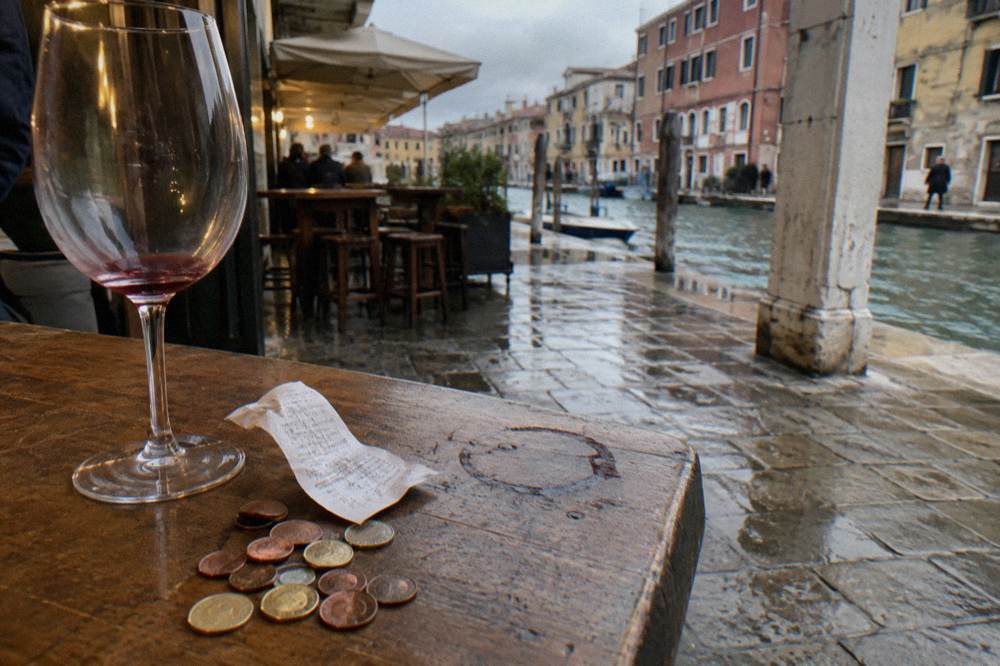
Two payment practicalities. Small cash is still useful in the oldest bacari even though cards are widely accepted now; carrying a few coins and low notes smooths every counter transaction. And keep receipts when you can, since some bars work on a pay-at-the-end honour system and the scontrino is your tally.
The Rhythm Of The Day: Lunch And Aperitivo Hours
The bacaro day has two peaks: the lunchtime stop, roughly midday to early afternoon, when workers take an ombra and cicchetti instead of a full meal, and the evening aperitivo window in the early evening, when bars fill steadily before dinner. Between those peaks the bars are quiet, and late at night many are closed or empty, so timing your crawl matters as much as routing it.
The morning belongs to the markets rather than the bars, and this shapes the whole day. The Rialto produce market runs Monday to Saturday from 7:00 to 20:00 and the fish market Tuesday to Saturday from 7:00 to 14:00, per the official Venezia Unica listings, with both closed Sunday and the fish market closed Monday too. By late morning the market trade spills into the nearest bacari, which is why a midday crawl around Rialto feels the most local: you are standing among people whose working day is built around that rhythm.
The aperitivo window in the early evening is the second peak and the more social one. An ombra or a spritz with colleagues before dinner is a longstanding habit, and bars that were quiet at 16:00 have a crowd by 19:00. If your crawl is as much about atmosphere as food, this is the window to build it around. The evening food walk guide expands on that hour and how the guided versions structure it.
The shape of the whole day, anchored to the verified market hours, looks like this:
| Window | What is happening | Best for a crawl |
|---|---|---|
| Early morning, from 7:00 | Rialto produce market trading, fish market from 7:00 to 14:00 Tuesday to Saturday | Not yet; bars quiet, market first |
| Midday to early afternoon | Market and worker crowd at the counters | The local, low-key crawl |
| Mid-afternoon | Bars quiet between the two peaks | Only if you want empty rooms |
| Early evening, aperitivo hour | Bars fill steadily before dinner | The social, atmospheric crawl |
| Late evening | Many bars thinned out or closed | Sit-down dinner instead |
Both Rialto markets close Sunday, and the fish market also closes Monday, so a Monday or Sunday midday crawl loses the market bustle that makes the Rialto circuit feel local. Plan around those days if the market rhythm is part of the draw.
For travellers who want the evening version handled end to end, the Venice Evening Food Tour, Bites, Drinks & Sit-Down Dinner, runs about two and a half hours and finishes with a seated dinner rather than leaving you to find one, which suits anyone whose crawl has done its job as an appetiser.
A note on what the day does not include: Venice's 2026 day-visitor access fee trial ended on 27 July 2026, and no fee applies to visiting the city now, per the official access-fee portal. The scheme returns in 2027 with dates already listed, amounts not yet published, so check the official access-fee page if your visit falls after that. It never applied to bar-hopping charges, only to day-tripper entry, but it is the question every visitor asks first.
What To Eat: The Classic Cicchetti
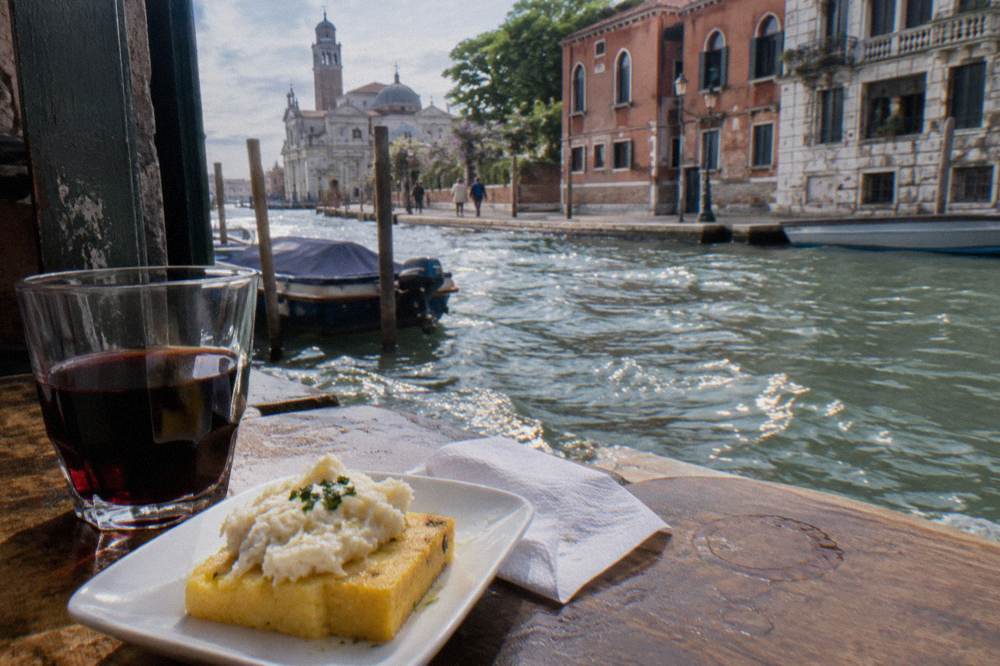
The core cicchetti repertoire is short and stable: baccalà mantecato, whipped salt cod on polenta or bread; sarde in saor, sweet-and-sour sardines with onion and pine nuts; polpette, small fried meatballs; and crostini topped with whatever the bar has that day. Nothing needs translating beyond a point, and one or two pieces per bar is the local pace.
Baccalà mantecato is the dish most closely identified with the bacaro counter, whipped for minutes into a pale, airy cream and served on a round of grilled polenta or a slice of bread. Sarde in saor is its sweet-sour opposite, sardines marinated with softened onions, raisins and pine nuts, a preservation technique from the city's seafaring centuries. Both have their own deep dives here: sarde in saor explained and baccalà and polenta, the Venetian staples.
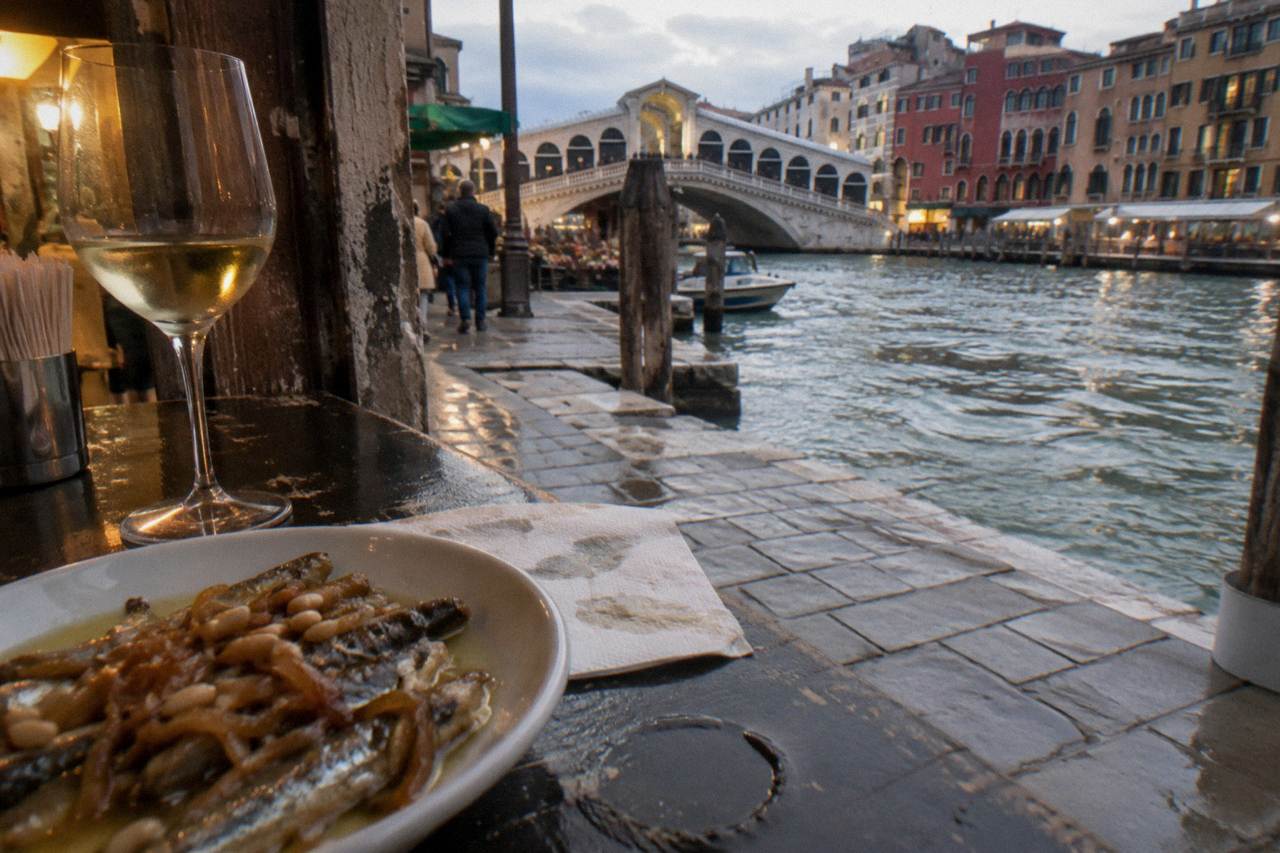
Beyond those two, expect fried things. Polpette in various forms, fried squid or vegetables, and the day's leftover-turned-snack are standard counter currency, and the fryer is often working hardest at lunch. Crostini cover everything else, from lard and anchovy to soft cheeses and cured fish. The reliable move is one known dish and one mystery piece per bar: the crawl format makes every order low-stakes.
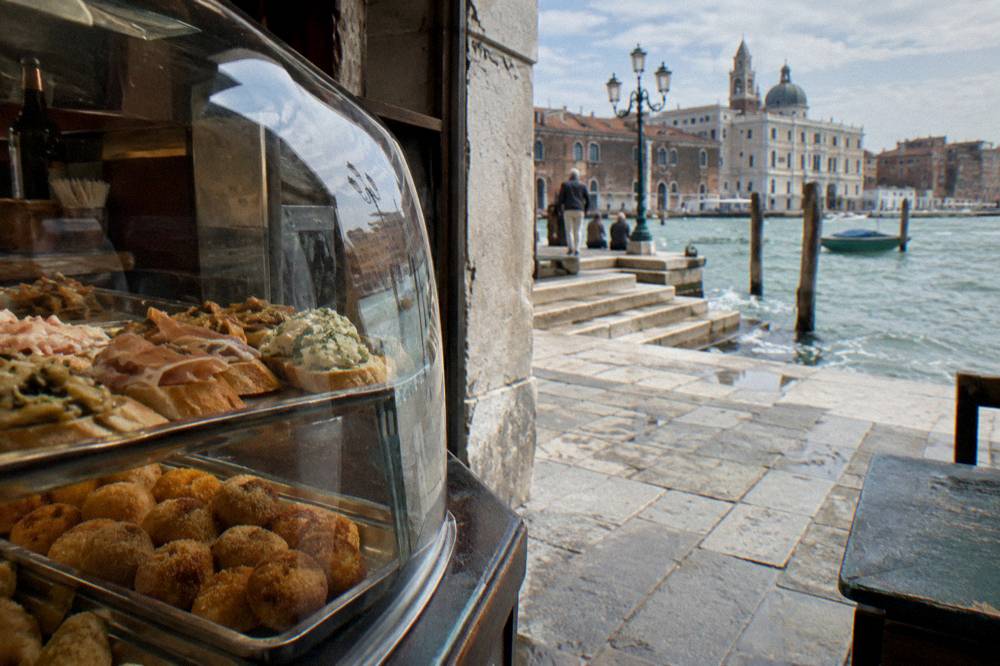
Dietary needs are the one place the point-and-hope method fails. Celiac, vegetarian and vegan options are not guaranteed anywhere, and a listing that does not state a dietary accommodation means it is unstated, not absent: message the operator or ask at the counter before ordering. The vegetarian, vegan and gluten-free guide maps which parts of the repertoire are safe by default and which need a question.
| Cicchetto | What it is | How to order it |
|---|---|---|
| Baccalà mantecato | Whipped salt cod on polenta or bread | Name it, or point at the pale cream |
| Sarde in saor | Sweet-and-sour sardines with onion | Visible under glass, point |
| Polpette | Small fried meatballs, often eaten in one bite | Ask how many, order by count |
| Crostini | Sliced bread with a topping of the day | Point at the tray |
Going Alone Or Booking A Guided Bacaro Crawl
Going alone costs only what you consume, roughly EUR 3 to 6 per bar at reported counter prices, and rewards confidence; a guided crawl adds a per-person fee on the listing but buys several bars in one booking, every dish explained, dietary questions handled, and zero counter anxiety. The right answer depends on whether the ritual itself or the food is the reason you are there.
The solo crawl is genuinely easy once the mechanics above are clear, and it is the more authentic version by definition. Its weaknesses are practical: you will walk past excellent bacari without knowing it, ordering in three bars before lunch takes local knowledge to pace well, and nobody is translating what you are eating. Counter prices keep the downside small, and a bad stop costs a couple of euros.
The guided crawl fixes exactly those gaps. The Bacaro Tour Unblended, a two-hour pure food-focused walk, is the short-format option; the Venice Food Tour, Sunset Cicchetti & Wine Tasting, about three hours, times the circuit to the aperitivo window; and the Venice Bacaro Food Tour, Eat and Drink like a Venetian, at three and a half hours, is the fullest version. Prices and current inclusions for each are on the operator's live listing, and several of these walks offer free cancellation, so booking ahead of your trip rarely locks you in.
The sunset format deserves a specific mention for anyone whose trip has one free evening. Aperitivo hour is when the bars are at their most alive, and a walk timed into that window delivers the ritual at its social peak rather than its quiet midday one. Check availability on the sunset listing if that is the shape of your day.
One honest caveat on both paths: group sizes, stop lists and dish counts on guided walks are as stated on each booking page, and they vary by operator and season. Read the inclusions line before paying, and if a detail that matters to you, a dietary need, a start point, a language, is not on the page, message the operator first. The same goes for solo crawlers deciding between a market morning and an aperitivo evening: this site's neighborhood food guide to Cannaregio, Dorsoduro and San Polo is the route-planning companion to this etiquette guide.
Common Questions About Bacari Etiquette
Do You Tip In A Bacaro In Venice?
Tipping is optional and light. At the counter, rounding up the bill or leaving small change is the full expectation, and a percentage tip is not part of the culture. Coperto, typically EUR 1 to 4 where applied, is a seated-restaurant charge that standing at the counter usually avoids.
What Does Ordering An Ombra Mean?
You are asking for a small glass, roughly 100 ml, of house wine, traditionally red. Say un'ombra, or un'ombra rossa or un'ombra bianca for the colour, pay the posted price of about EUR 1 to 2.50 as reported, and drink it standing in a few sips with a piece of cicchetti.
Is It Rude To Sit At A Table In A Bacaro?
It is not rude, but it is a different transaction. Tables often carry table service and sometimes a higher price or a coperto of EUR 1 to 4, while the counter keeps everything informal and cheap. If the bar has both, check whether prices differ before you sit.
How Many Bacari Should You Visit On A Crawl?
Three or four bars is the classic circuit, with one ombra and one or two pieces of cicchetti in each, taking two to three hours and replacing a meal. Fewer stops feel like a snack; many more turn into a long night, and most guided crawls are built around a similar count.
When Is The Best Time Of Day For A Bacaro Crawl?
Two windows: the lunchtime stop around midday to early afternoon, when the market and worker crowd is out, and the aperitivo hour in the early evening, when bars fill before dinner. Mid-afternoon is the quiet gap, and many bars thin out or close late at night.
Can You Do A Bacaro Crawl With Dietary Restrictions?
Yes, with preparation. The classic repertoire includes fried and fish-heavy items, and listings that do not state vegetarian, vegan or gluten-free options mean unstated, not unavailable. Ask at the counter or message a tour operator before booking, and see the site's dietary guide for what is safe by default.