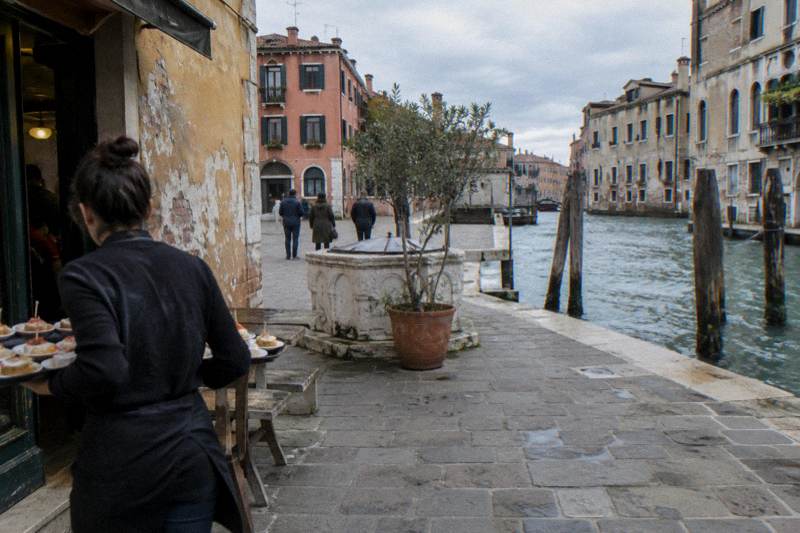
What Is Cicchetti And How To Order It
Cicchetti are the small, cheap snacks Venetians eat standing at bacaro counters, usually with a small glass of house wine. This guide explains the dishes, the counter ritual, reported prices, and how many to order.
Short answer
Cicchetti are small snacks sold by the piece at Venetian bacari, typically reported at EUR 1.50 to 4 each, eaten standing at the counter with an ombra of house wine at around EUR 1 to 2.50. Order two to four pieces per person per bar, pay at the counter, and move on to the next bacaro.
What Exactly Is Cicchetti?
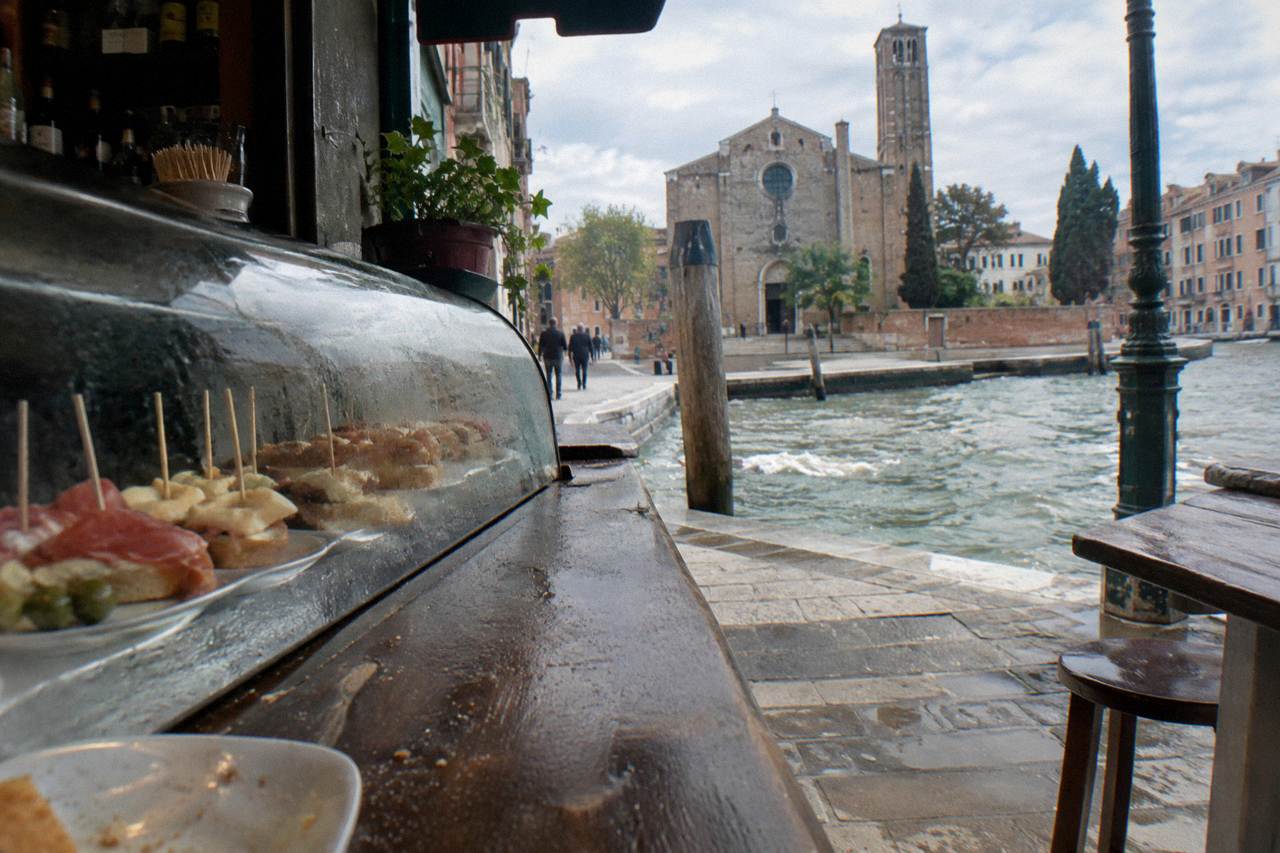
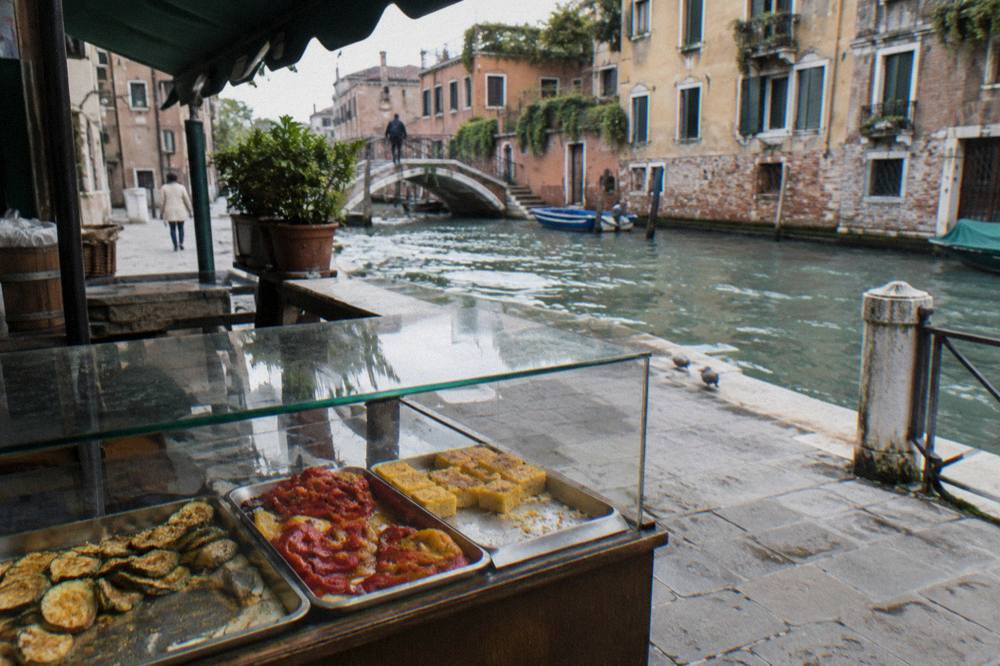
Cicchetti (pronounced chi-KET-tee) are small, single-bite or few-bite snacks that Venetian wine bars, called bacari, sell by the piece at the counter. They are the lagoon city's own version of tapas, covering fried seafood, crostini with spreads, polpette (meatballs), baccalà mantecato (whipped salt cod on polenta) and sarde in saor (sweet-and-sour sardines). You eat them standing at the counter with a small glass of house wine, and there is no table-service ceremony.
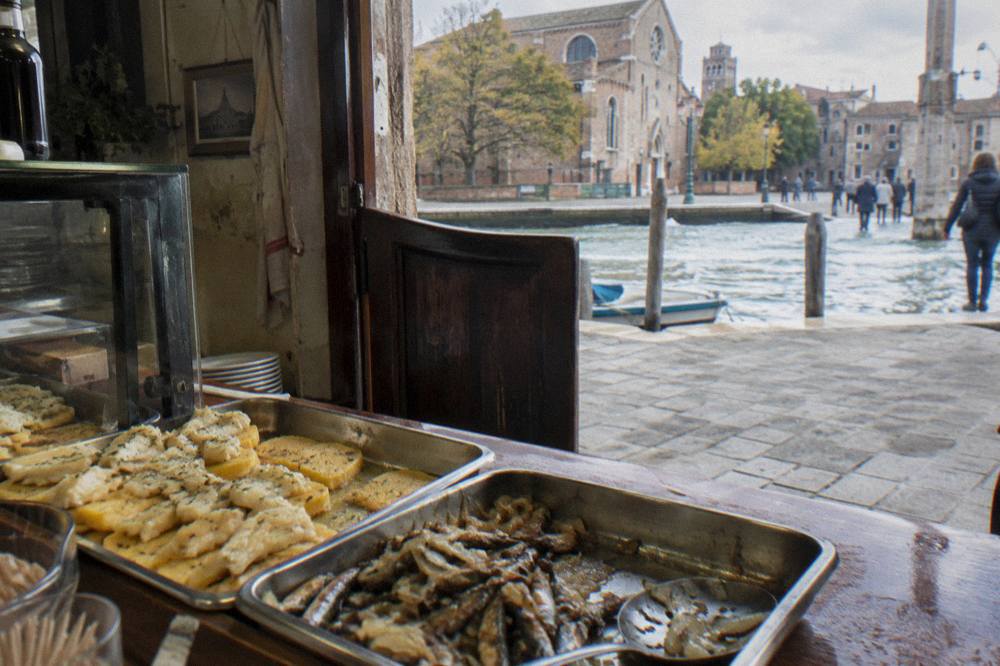
The word itself is Venetian dialect, and it covers a wide family of things rather than one dish. A piece of fried baccalà counts. So does a wedge of polenta with a squid-ink sauce, a half roll stuffed with cured fish, or a hard-boiled egg anchored with an anchovy. What unites them is the format: made in batches, displayed on the counter or in a glass case, priced by the piece, and meant to be eaten in two or three bites alongside a drink. Bars set their own posted prices, and there is no fixed city tariff, so the posted list at the counter is the authority.
The typical cost is genuinely low for a city with Venice's reputation. Reported prices put a piece of cicchetti at about EUR 1.50 to 4 at the counter, with simpler items at the low end and more elaborate ones at the top, according to the official Visit Venice tourism site. An ombra, the small roughly 100 ml glass of house wine that traditionally goes with the food, is reported at about EUR 1 to 2.50 in local spots. Those figures are reported ranges from 2026 sources, not guarantees; individual bars vary, and tourist-oriented counters charge more.
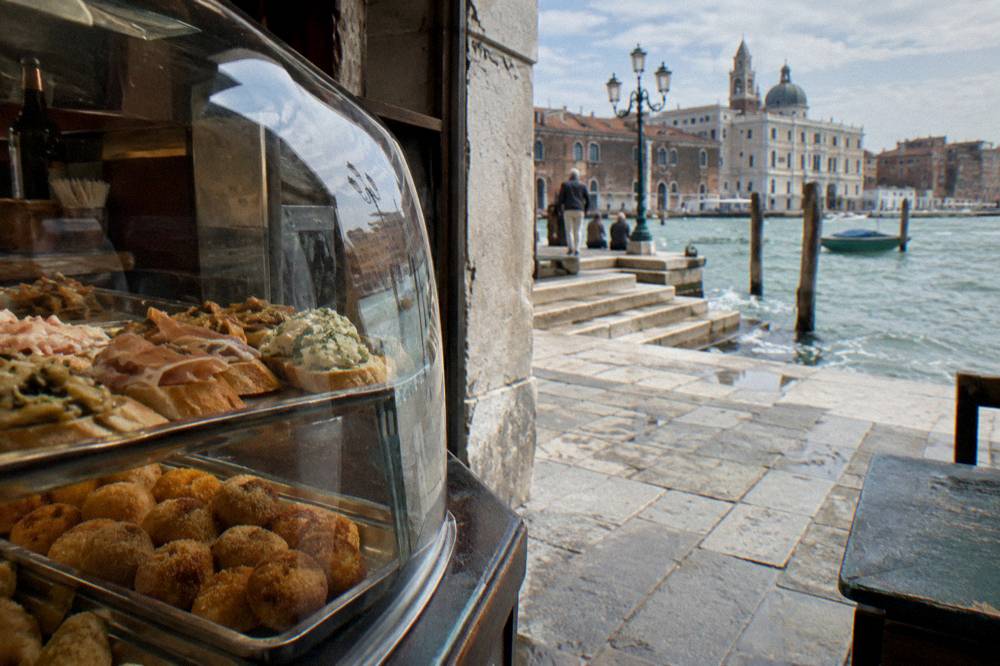
The habit has a rhythm of its own. Venetians traditionally make an evening giro d'ombra, a slow circuit of two or three bacari, taking a snack and a small wine at each and moving on. It is closer to a pub crawl with good food than to a restaurant dinner. Done that way, three bars and a few pieces each becomes a full evening's meal without ever sitting at a table.
For a fuller walk through the bars themselves, see the companion guide to the best cicchetti bars in Venice, and for the drinking customs around the food, the guide to bacari etiquette and the ombra ritual.
How Does The Bacaro Counter Ritual Actually Work?
You walk in, study the trays behind the glass, order at the counter by pointing or naming the dish, and eat standing at the counter or at a shelf along the wall, paying at the bar when you order or when you finish. There is no host and no menu handed to you; the display is the menu, and drinks, usually an ombra of house wine, are ordered in the same breath as the food.
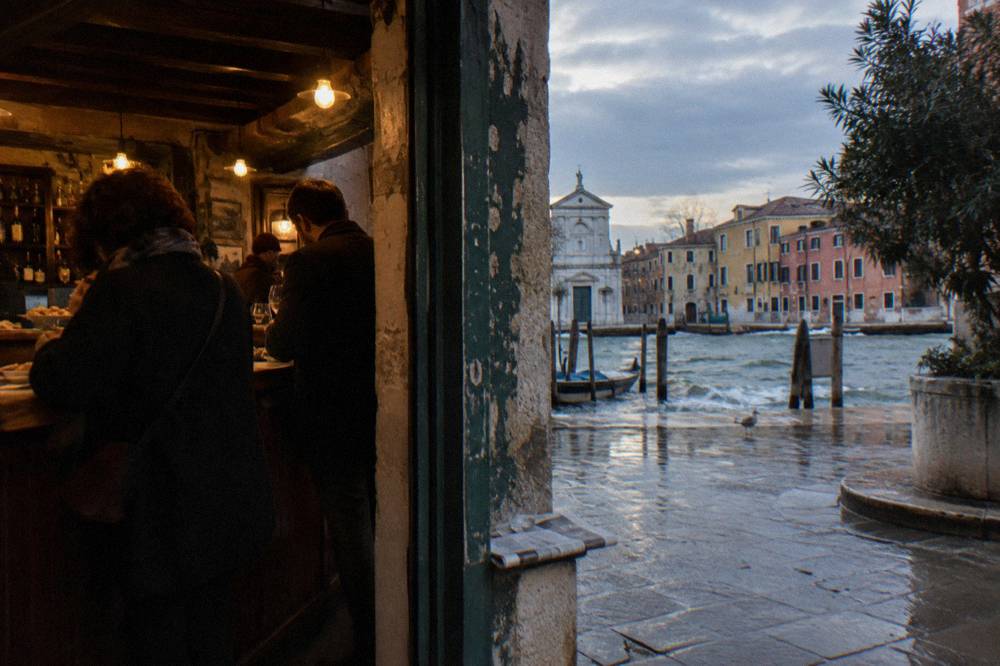
A few practical points make the first visit smoother. Standing at the counter, rather than taking a table, is both the tradition and the cheaper route: where a coperto, a per-person cover charge, applies at all, it is reported at EUR 1 to 4 and is often avoided by eating at the counter, since the charge is disclosed on menus rather than applied universally. Tipping in the standing cicchetti context is optional and modest; rounding up or leaving a small amount for exceptional service is appreciated, but virtually nothing is expected when you are standing with a snack and a small wine. The 2026 reporting on Venice tipping practice found no recent changes to either custom.
Ordering language is minimal. "Cosa avete?" asks what they have. Naming a dish and holding up fingers for the count is perfectly acceptable and universal. "Un'ombra rossa" gets you a small glass of red house wine; "un'ombra bianca" the white. A spritz is on offer almost everywhere, and the guide to spritz in Venice and the local way to drink it covers that side of the counter. Bars set posted prices and no city tariff governs them, so check the list rather than assuming.
One rule worth knowing before you carry your glass outside: Venice's municipal regulation prohibits drinking from glass containers outside permitted outdoor seating areas, and bans takeaway sales of alcohol in glass for public consumption, with reported fines of EUR 25 to 500 under the city's public-space rules. In practice that means the ombra stays inside the bacaro or in its sanctioned outdoor seating. The regulation is reported from the city's own rules document; check current rules on the official Comune di Venezia site before your visit.
For travellers who would rather have the ordering done for them on a first night, a guided crawl is one route:
The three walks above each run a guided version of the circuit this guide describes, with a local leading the counter orders. The Eat Like a Local walk runs about 3 hours in a small group, the Venice Bacaro Food Tour about 3 hours 30 minutes, and Taste Venice Like a Local about 2.5 hours; prices and current availability are on each booking page. Check availability on the operator's page if a guided first night appeals.
How Many Cicchetti Should You Order, And What Does It Cost?
Plan on two to four cicchetti per person at each bacaro, plus one ombra per stop, and count on two or three bars for a full evening meal; at roughly EUR 1.50 to 4 per piece and EUR 1 to 2.50 per ombra, even a two-bar evening of three pieces and two wines each stays modest by Venetian dining standards.
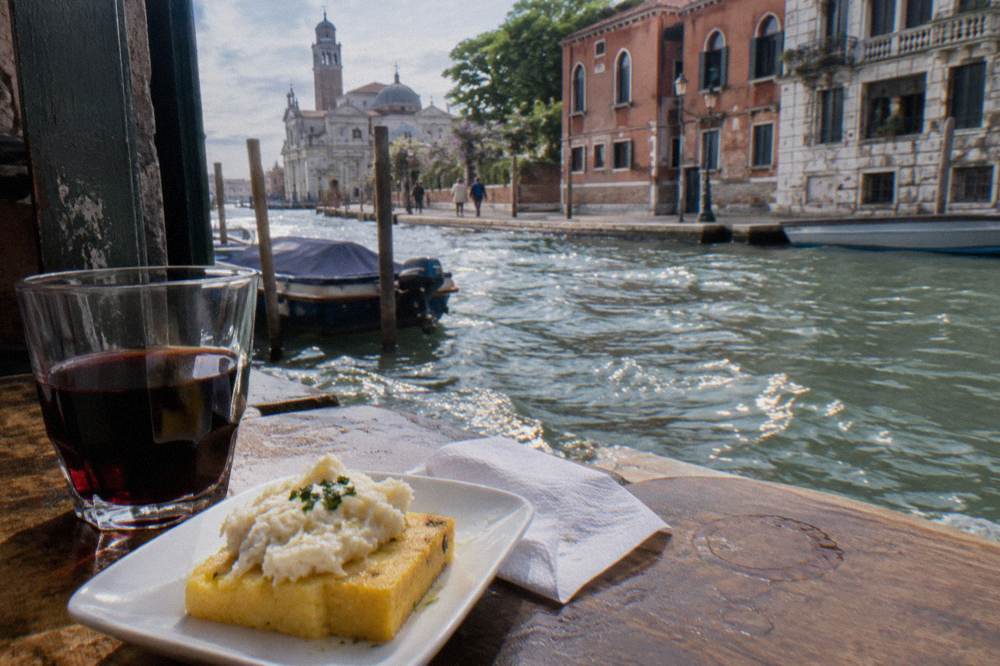
The counting matters because nothing arrives as a plate. Each piece is ordered and counted individually, and the bar keeps a running tally, sometimes chalked up, sometimes just remembered. Ordering in pairs or threes as you go, rather than all at once, lets you see what actually looks good that day, since the selection changes with the market and the season. A tray emptied of one thing may be refilled with something else entirely twenty minutes later.
| Item at the counter | What it is | Reported price range |
|---|---|---|
| Cicchetto (simple) | Crostini, polpette, fried vegetables, a half roll | about EUR 1.50 to 2.50 |
| Cicchetto (elaborate) | Fried fish, baccalà mantecato, seafood on polenta | about EUR 2.50 to 4 |
| Ombra of house wine | Small roughly 100 ml glass, red or white | about EUR 1 to 2.50 |
| Coperto, where applied | Per-person cover charge, disclosed on the menu | reported EUR 1 to 4 |
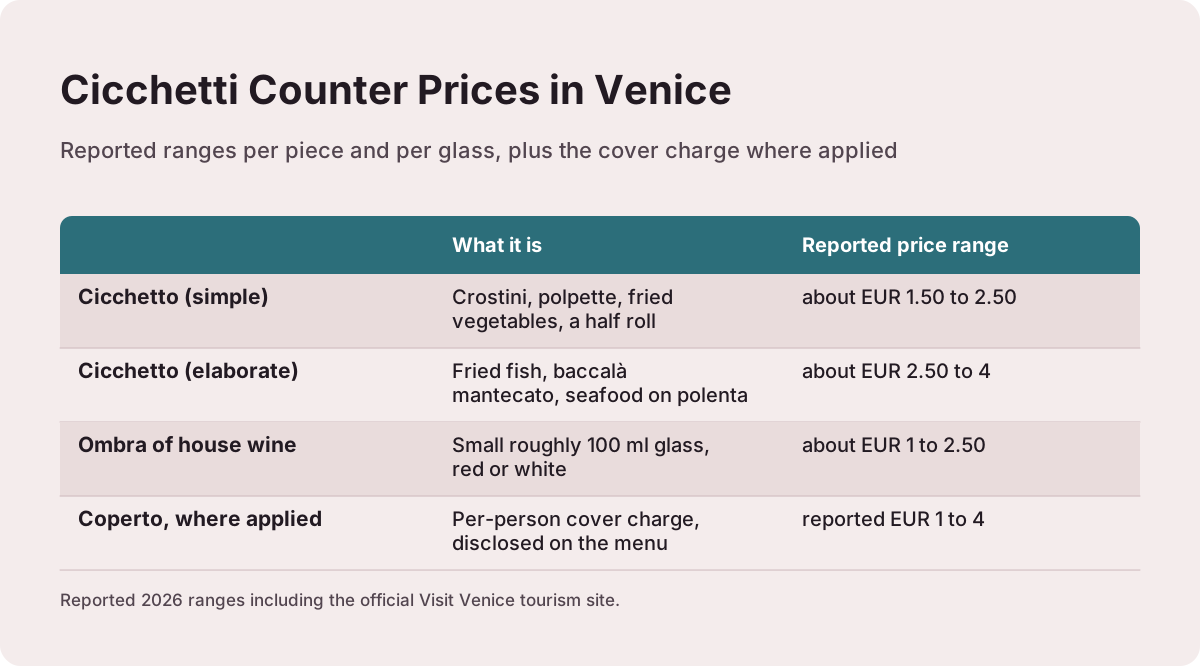
Two cautions on those numbers. First, they are reported ranges from 2026 sources including the official Visit Venice cicchetti page, and bars in heavily touristed lanes sit above them; the posted list at the counter is the only real price. Second, never assume a dish is available. What is on the counter depends on the day, the season, and the market, and no bar can be promised to have a given dish on a given afternoon. The companion guide to Venice food by season explains what appears when.
If counting pieces in Italian at a busy counter sounds like the awkward part of the evening, the Eat Like a Local 3-hour small-group tasting tour was built for exactly that moment: a guide leads the orders, the tastings are pre-arranged, and you learn the ritual by watching it done. Check availability on the booking page.
What Is An Ombra, And Why Does It Come With The Food?
An ombra is a small glass of house wine, about 100 ml, and it comes with the food because it is the traditional partner to cicchetti at the counter, ordered simply as un'ombra, rossa for red or bianca for white; the name is Venetian for shadow, recalling when wine sellers followed the campanile's shade in Saint Mark's Square, at roughly EUR 1 to 2.50 in local bacari.
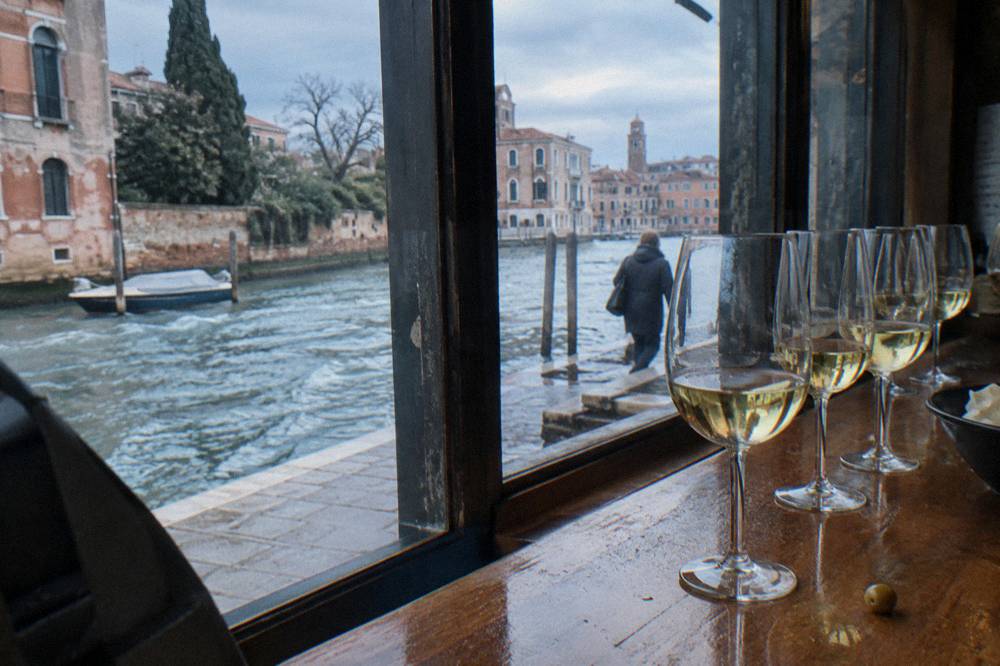
The ombra is small on purpose. It exists to be drunk in a few sips alongside one or two pieces of food, finished before the group moves to the next bar. A giro d'ombra across three stops means three small glasses, not three full ones. House wines are typically uncomplicated Veneto pours: a light red, a crisp white, sometimes a Prosecco. The deeper background on the region's wines, from Prosecco to Soave to Raboso, is in the guide to Veneto wines worth knowing.
You are not obliged to drink wine. A spritz is the other classic counter order, and still water, beer, or a soft drink are all normal requests. But ordering an ombra is the signal that you are doing the ritual rather than just grabbing a snack, and it is usually the cheapest drink on the list. If wine tasting itself is the goal rather than the accompaniment, the guide to Venice wine tasting from ombra to cellars maps that side of the city.
One pairing note that surprises visitors: the wines are simple, and that is the point. An ombra is not a sommelier's pour. It is table wine at standing-room prices, matched to fried food and salt cod in a setting where nobody lingers over the glass. The full index of guides sits on Venice Food Tours.
Which Cicchetti Dishes Will You Actually See?
The classics you can reliably expect are baccalà mantecato, sarde in saor, polpette, crostini, and fried seafood, while seasonal items like moleche, or soft-shell crabs, appear only in their short windows. Since what sits on any counter depends on the market and the day, treat this list as your vocabulary rather than a guaranteed board at any single bar.
| Dish | What it is | When you typically see it |
|---|---|---|
| Baccalà mantecato | Salt cod whipped with oil, served on polenta or bread | Year-round staple |
| Sarde in saor | Sardines in sweet-and-sour onion with raisins and pine nuts | Year-round staple |
| Polpette | Small fried meatballs, often mixed meat | Year-round staple |
| Crostini | Small bread slices with spreads, from liver to cheese | Year-round staple |
| Fried seafood | Small fish, squid, or vegetables in batter | Most of the year |
| Moleche | Soft-shell crabs, fried | Spring and autumn windows only |
Each of these has its own story, and two of them are worth a deeper read before you order: the guide to baccalà mantecato and polenta and the one on sarde in saor, Venice's sweet-and-sour sardines. The short version is that both are preservation dishes, invented in a lagoon city that needed fish to survive without refrigeration, and both remain the backbone of most cicchetti counters.
For travellers with dietary limits, a caution: individual listings for guided walks do not always state vegetarian, vegan or gluten-free options, and the same uncertainty applies at the counter. Fried items share oil, bread is everywhere, and polenta is not always separated from battered food. The guide to vegetarian, vegan and gluten-free eating in Venice covers the terrain, and for guided walks the advice is to message the operator before booking rather than assume.
What Mistakes Should First-Timers Avoid?
The main errors are sitting at a table when you could stand at the counter, ordering everything at once instead of in rounds, hunting one famous bar across the city, and expecting a set menu or a fixed price. None of these ruin an evening, but each one costs money, time, or the point of the exercise, which is a slow, cheap, sociable circuit rather than a destination restaurant visit. The counter is learnable, and the fixes are small.
The table-versus-counter choice is the biggest money decision. Sitting down can bring a coperto, reported at EUR 1 to 4 per person where applied and disclosed on the menu, plus table service; standing at the counter usually avoids both. Standing also puts you where the food is, since the display cases are at the bar. In the busiest bars at aperitivo hour the counter is crowded, and that crowding is normal, not a sign you picked wrong.
The single-bar mistake is the other common one. The giro, the circuit, is the format, and one bacaro is one course. Two or three bars within a short walk of each other, a couple of pieces and an ombra at each, is the intended shape of the evening. The Rialto area has the densest cluster, and the Rialto Market guide maps that neighbourhood, though the produce market keeps Monday-to-Saturday hours of 7:00 to 20:00 and the fish market Tuesday-to-Saturday 7:00 to 14:00, so a market-and-counter day needs morning timing.
| Common mistake | What it costs you | The fix |
|---|---|---|
| Sitting at a table instead of standing | A coperto of reported EUR 1 to 4 where applied, plus table service | Order and eat at the counter |
| Ordering everything at once | You lock in pieces before seeing the full day's trays | Order in rounds of two or three |
| Hunting one famous bar across the city | Long walks between stops, no giro rhythm | Pick two or three bars close together |
| Expecting a fixed menu or price | Confusion at the counter; posted lists differ by bar | Read the posted list, ask "Cosa avete?" |
| Assuming a dish is available | Disappointment when the tray is empty or closed | Order from what is on display that day |
A final reassurance for anyone worried about the rules of the room: Venetians are used to visitors at the counter, the transaction is short, and pointing is a complete ordering method. The genuinely awkward moments, knowing which bars welcome stand-and-eat trade and how many tastings to commit to, are the ones a guide removes.
The Venice Bacaro Food Tour, Eat and Drink like a Venetian, runs about 3 hours 30 minutes and builds the whole evening around this counter circuit, with the stops chosen in advance. Check availability on the booking page.
Taste Venice Like a Local covers food, wine and spritz in about 2.5 hours, a shorter version of the same idea for a first evening in the city. Check availability if timing is tight.
When Does A Guided Cicchetti Crawl Make Sense?
A guided cicchetti crawl makes sense when you are new to the ritual, short on time, travelling with a group that wants the logistics handled, or eating with dietary needs that must be negotiated in advance. The counter can be learned alone in one evening, but a walk compresses that learning into a single outing; on a second or third visit, going yourself is half the pleasure and costs only counter prices.
Guided groups are also subject to a city rule worth knowing: Venice caps guided tour groups at 25 people in the historic centre and the lagoon islands and bans loudspeakers, as reported from the regulation in force since 2024, so guides use headsets. That cap shapes every licensed walk in the city, whatever the format.
For the value question in detail, the guide to what a Venice food walk costs and what is included breaks down the formats, and the comparison of a food walk versus a cooking class helps if you are choosing between them. If your instinct is that learning the ritual from a local on night one is worth it, the walks below are the three that fit the cicchetti-and-ombra format best.
The Eat Like a Local 3-hour small-group tasting tour is the most reviewed of the walks described on Venice Food Tours and fits the classic format: a small group, a local guide, and a circuit of tastings. Check availability on the booking page, since small-group formats fill first.
One planning note for day-trippers: the 2026 day-visitor access fee trial ended, and per the official city page no fee applies from 27 July 2026, so visiting currently needs no payment or exemption; the fee is listed to return in 2027 on published dates, with amounts not yet announced. Check the official Venezia Unica access-fee page before a 2027 trip.
Common Questions About Cicchetti In Venice
What Exactly Is Cicchetti?
Cicchetti are small snacks sold by the piece at Venetian wine bars called bacari, eaten standing at the counter with a small glass of house wine. Typical dishes include baccalà mantecato, sarde in saor, polpette and crostini. Reported prices run about EUR 1.50 to 4 a piece, with posted lists at each bar.
How Do You Order Cicchetti At A Bacaro?
Walk in, look at the display trays, and order at the counter by pointing or naming the dish, holding up fingers for the count. Order a drink in the same breath, usually un'ombra of house wine. Pay at the counter, eat standing, and move on to the next bar when ready.
How Many Cicchetti Should You Order Per Person?
A common working plan is two to four pieces per person per bar, with one ombra at each stop, across two or three bacari, which locals treat as a full evening meal. Order in rounds rather than all at once, since the selection changes through the day.
What Does An Ombra Cost In Venice?
An ombra, a small roughly 100 ml glass of house wine, is reported at about EUR 1 to 2.50 in local bacari, with higher prices in tourist-oriented spots. It is usually the cheapest drink on the counter list and the traditional pairing for cicchetti.
Is A Coperto Charged When Eating Cicchetti?
A coperto of EUR 1 to 4 per person is reported where a bar applies it, disclosed on the menu, and standing at the counter usually avoids it. Tipping in the standing cicchetti context is optional; rounding up is appreciated but virtually nothing is expected.
Do You Need A Guided Tour To Eat Cicchetti?
No, the counter ritual is learnable alone in one evening. A guided crawl helps first-timers by choosing the stops, handling the orders and negotiating dietary needs in advance. Guided groups in the historic centre are capped at 25 people as reported under city rules.