Venetian Sweets And Pastries: Fritole, Baicoli And Bussola
Fritole, baicoli and bussola are the three sweets that define Venetian pastry tradition: a Carnival fritter, a ship's biscuit, and a Burano butter ring. Here is what each one is, when to eat it, and how to plan a day around them.
Short answer
Fritole are sweet fried fritters tied to Carnival, baicoli are thin dry biscuits invented for long sea voyages, and bussola are rich egg-yolk butter biscuits from Burano. Cicchetti run about EUR 1.50 to 4 a piece at the counter, and no day-visitor access fee applies as of 27 July 2026.
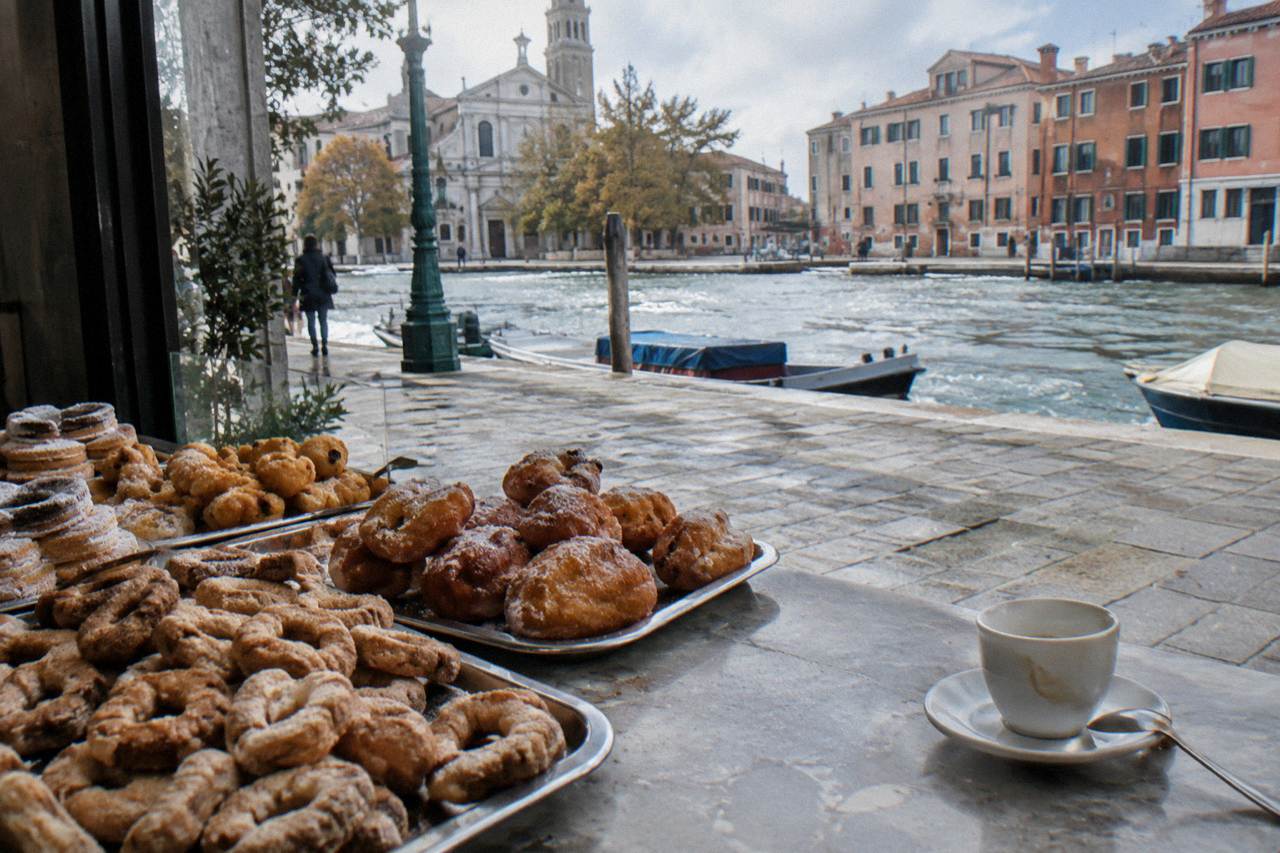
Fritole disappear after Carnival. Baicoli hold for months in a tin. Bussola come out of Burano bakery ovens, still warm some mornings if the timing works out. Between them, these three sweets cover roughly five centuries of Venetian pastry tradition, and each one tells you something about what this city actually was: a maritime power that needed biscuits to survive a six-week voyage, a Catholic port that feasted hard before Lent, and a fishing island with more eggs than flour.
The confusion for visitors is that none of these are the desserts a first-time visitor expects. Venice is not a cake city in the French or Viennese sense. Its pastry tradition is small, dry, fried or boozy, built for standing up, for dipping, for carrying on a boat. Once you understand that logic, the counters in the pastry shops start making sense, and so does the seasonal calendar: fritole in the weeks before Lent, zaleti and bussola year-round, galani appearing alongside the fritters in the same window.
This guide walks through each sweet, what it is made of, when Venetians actually eat it, and how to string several stops into a single day. It also covers where a guided sweet walk fits, and what the access-fee and market-timing facts mean for your planning, all reported from official sources.
What Are Fritole, The Carnival Fritters Of Venice?
Fritole, or fritole venexiane, are sweet yeast fritters studded with pine nuts and raisins, fried in lard or oil and dusted with sugar, and they are the official sweet of Venetian Carnival, appearing in pastry shops and street stalls from roughly early January until Shrove Tuesday, then vanishing almost completely for the rest of the year.
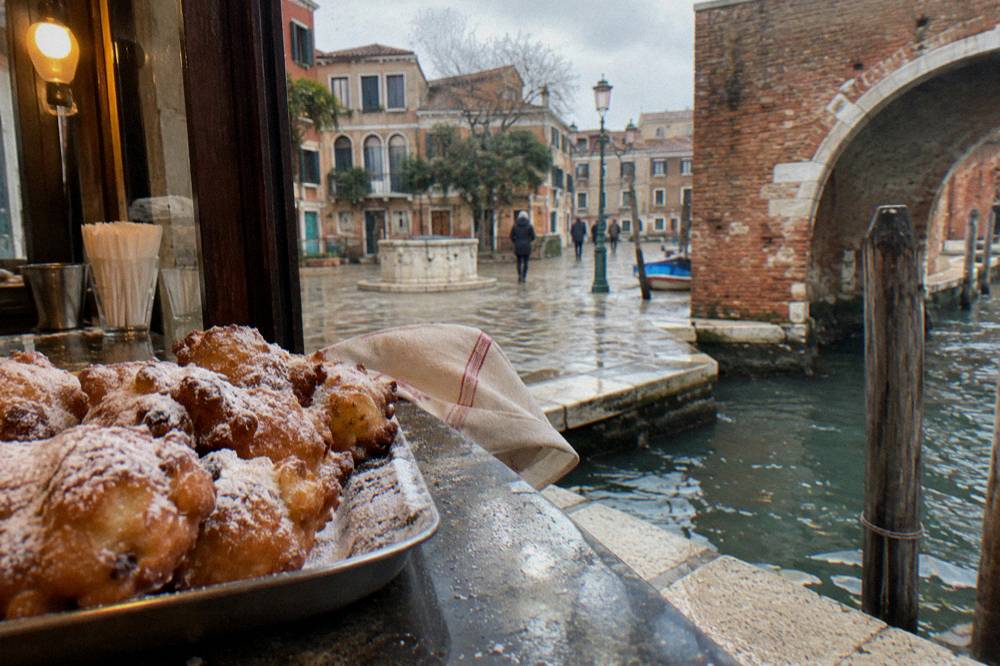
The recipe is old enough that a guild of fritoleri, professional fritter makers, controlled their production in the city for centuries, working from stalls rather than shops. That street origin survives: during Carnival, fritole are as likely to come from a wooden booth in a campo as from a glass display case. The dough is enriched with eggs and grappa or marsala, the raisins are softened before folding in, and the finished fritter should be palm-sized, irregular, and faintly boozy.
The timing is the trap. Carnival moves with Easter, so the fritole season moves too: some years it starts just after New Year, other years not until late January, and it always ends abruptly on Shrove Tuesday. A visitor in June asking for fritole will mostly be offered galani instead, the thin crispy fried ribbons of the same season, or nothing fried at all. If fritole are a priority, plan the trip between January and Carnival, and accept that the exact weeks shift year to year.
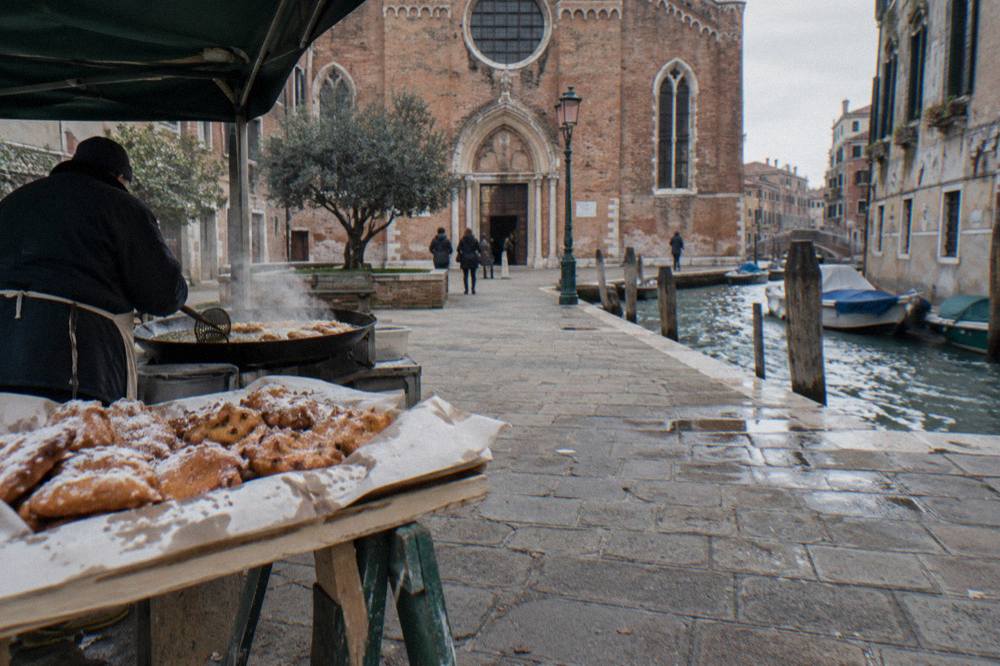
What pairs with a fritole is not coffee-house ritual but standing and eating while it is still warm. They lose their appeal within hours. This is one sweet where buying from the stall that fries in front of you beats buying from the shop with the nicer box.
For readers planning a wider eating strategy around snacks and counters, the guide to what is cicchetti and how to order it explains the savoury half of the standing food culture, and reported prices for counter food run about EUR 1.50 to 4 per piece at traditional bacari, per the official Venice visitor site.
What Are Baicoli, Venice's Ship Biscuits?
Baicoli are thin, dry, faintly sweet biscuits shaped like small flat ovals, invented in Venice as a preservation food for long sea voyages, and they are eaten today mostly dipped in coffee, hot chocolate or sweet wine, because on their own they are deliberately dry and almost plain.
The name is Venetian dialect, a diminutive thought to refer to the small sea bass of the lagoon, and the biscuit's whole design follows from its naval job: twice-baked, low in moisture, stable for weeks. Sailors leaving Venice for the eastern Mediterranean carried them; the luxury version of the same logic was to dip them in hot chocolate, which is how the city's historic cafés came to serve them. That is still the best way to eat one.
Modern pastry shops sell baicoli in paper-wrapped stacks year-round, and they are one of the few Venetian sweets that travels well, which is why they show up in gift tins more than any other local biscuit. Treat them as a breakfast or merenda item rather than a dessert. A couple of baicoli with a cappuccino standing at a counter is a genuinely local mid-morning stop, not a tourist performance.
The contrast with fritole is the point: one is a fresh, fried, seasonal indulgence; the other is a dry, durable, everyday staple. A pastry-first day in Venice works well when it mixes the two rhythms, a warm fried thing early, a dry dipped thing mid-morning, and something richer later. If you are building that kind of day, the how many days in Venice food-first itinerary shows how pastry stops slot between market visits and bacaro crawls.
For travellers who would rather have someone else sequence the stops, a guided option exists. The Sweet Stroll Through Venice tour moves between pastry shops, chocolate and gelato over about 2 hours; its review pool is small, so no rating claim is made here, and price and inclusions are on the listing.
A sweet-only walk is not the only way in.
What Is Bussola, Burano's Butter Biscuit?
Bussola are ring-shaped or S-shaped butter biscuits from Burano, made from a rich egg-yolk dough with a long shelf life, traditionally baked for fishermen and at Easter, and they are the signature sweet of the lagoon's lace island, sold in its bakeries and brought back to Venice by the boatload.
The Venetian tourism authority documents bussola, also written bussolai or esse di Burano for the S-shaped version, as a traditional Burano product: a rich egg-yolk dough, historically tied to Easter and to the island's fishermen, valued precisely because it keeps. The same family of biscuits includes the Burano donut-shaped variant and the smaller S shapes, all from the same dough.
Two practical facts shape a bussola stop. First, Burano is a ferry ride away, about 25 minutes on line 12 from Fondamente Nove, with daytime intervals around 20 minutes at peak times as reported in the autumn 2026 timetables. Second, the island pairs the biscuit with its other food claim, risotto di gò, a lagoon goby risotto, so a Burano day can be a full lunch-plus-dessert day rather than a quick snack run.
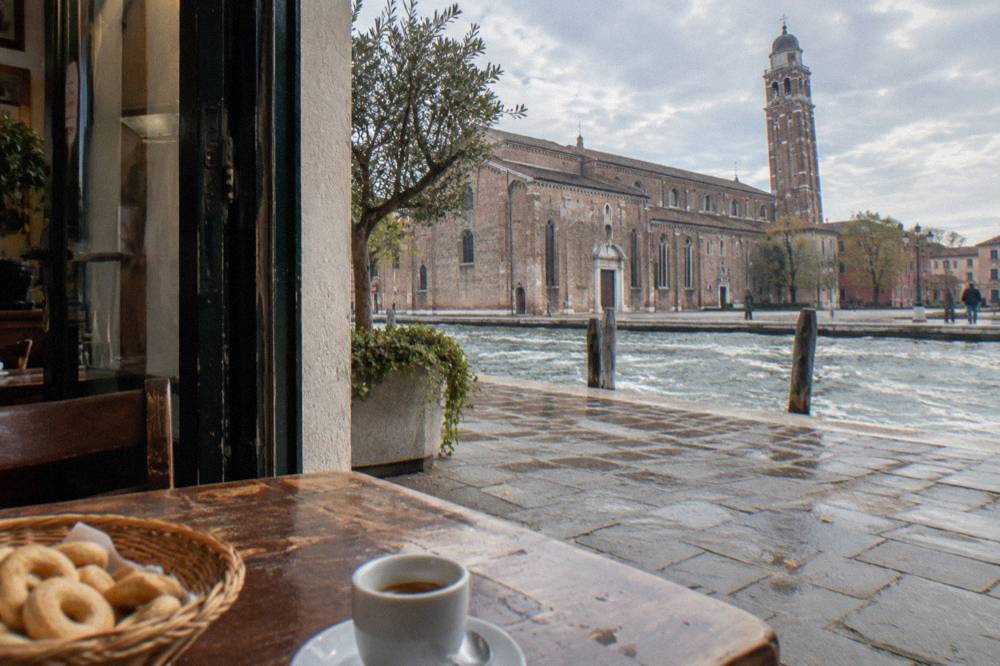
Eating bussola well means accepting its texture: dense, crumbly, not sweet in the modern pastry sense. Locals dip them in coffee or sweet wine. If you want the fuller island food picture, including the biscuits in context, the Burano and Murano day trip with food stops covers the crossing, the specialties and the timing.
Back in the historic centre, the Eat Like a Local small-group tasting walk is the savoury counterpart to a sweet morning: about 3 hours of counters and tastings with a local guide, with the current price and full inclusions on its booking page.
Which Other Venetian Sweets Should You Know?
Beyond the big three, the counter staples to recognise are zaleti, polenta-flour cakes with raisins and grappa; galani or crostoli, the paper-thin Carnival fried ribbons; and fave dei morti, small almond biscuits eaten around All Saints' Day in early November, each tied to its own season or moment of the Venetian year.
Zaleti are the everyday workhorse. The name comes from the Venetian word for yellow, and the batter mixes white polenta flour with wheat flour, raisins and sometimes pine nuts, baked flat like small lozenges. They sit in pastry cases year-round and are the least seasonal item on this list, which makes them the reliable fallback when fritole are out of season.
Galani share the Carnival window with fritole. They are the crisp alternative: rolled thin, cut into ribbons, fried and sugared. Where a fritole is soft and rich, a galano is dry and shattering, and shops that sell one sell the other in the same weeks.
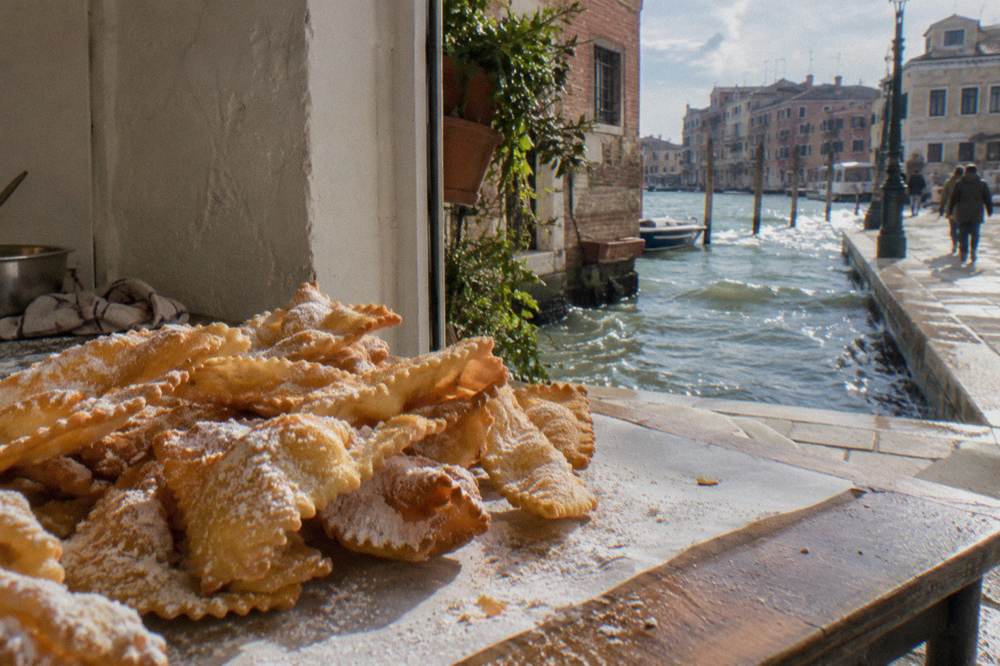
The seasonal calendar matters more in Venice than in most cities, because the pastry shops actually change their windows. The Venice food by season guide explains the full annual cycle, from winter fried sweets to spring vegetables and back.
| Sweet | What it is | Peak season | Best eaten |
|---|---|---|---|
| Fritole | Fried yeast fritter with raisins and pine nuts | January to Shrove Tuesday | Warm, standing, same day |
| Galani | Thin fried sugared ribbons | Carnival weeks | Fresh, same day |
| Baicoli | Dry twice-baked oval biscuits | Year-round | Dipped in coffee or hot chocolate |
| Bussola | Burano butter and egg-yolk rings | Year-round, Easter tradition | Dipped in coffee or sweet wine |
| Zaleti | Polenta-flour cakes with raisins | Year-round | With a glass of wine, mid-afternoon |
| Fave dei morti | Small almond biscuits | Early November, All Saints' | Any time, keeps well |
No bakery is named here as the best, deliberately: rankings of individual pastry shops are not verifiable from the sources behind this site. What is verifiable is the pattern, and the pattern is that the good counters are the ones frying or baking on site, with short queues of locals at the bar.
How Do You Build A Pastry-First Day In Venice?
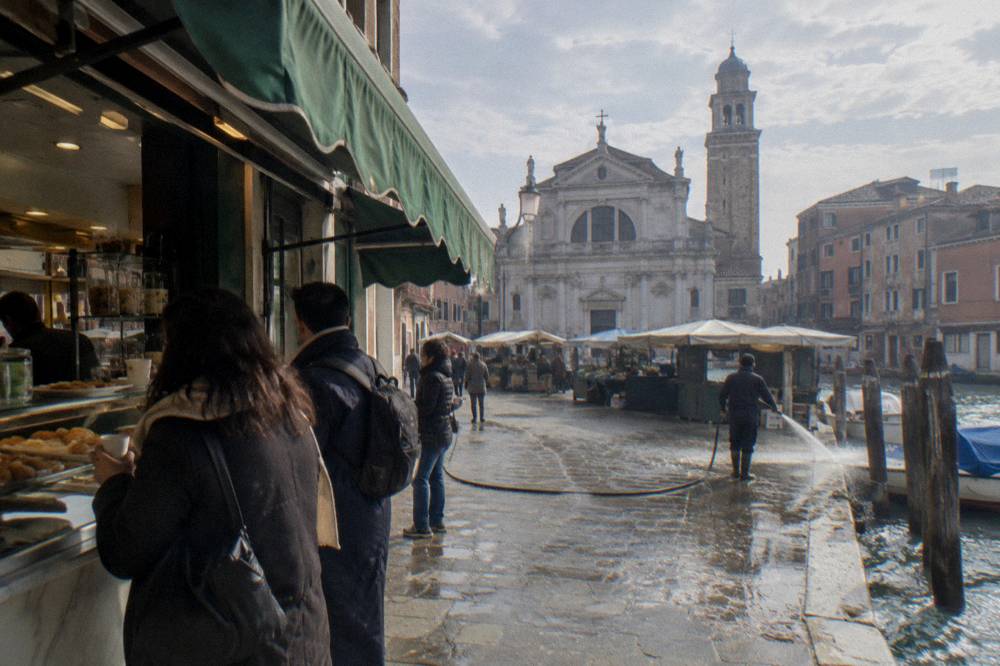
A realistic sweets day runs one anchor stop per neighbourhood: a morning fritole or zaleti stop near your accommodation, a mid-morning baicoli-and-coffee stand-up break, an afternoon gelato or chocolate pause, and, if you commit the day to it, a ferry to Burano for bussola after a risotto lunch, all tied together on foot and by vaporetto.
Timing rules the plan. The Rialto produce market runs Monday to Saturday from 7:00 to 20:00 and the fish market Tuesday to Saturday from 7:00 to 14:00, both closed Sunday, per the official Venice tourism site; a sweets day that starts at Rialto gets the morning market energy and a pastry stop in San Polo or Cannaregio on the walk out. In the other direction, Burano needs the ferry, so an island sweets run is best started by mid-morning to allow for the crossing, lunch, and the return.
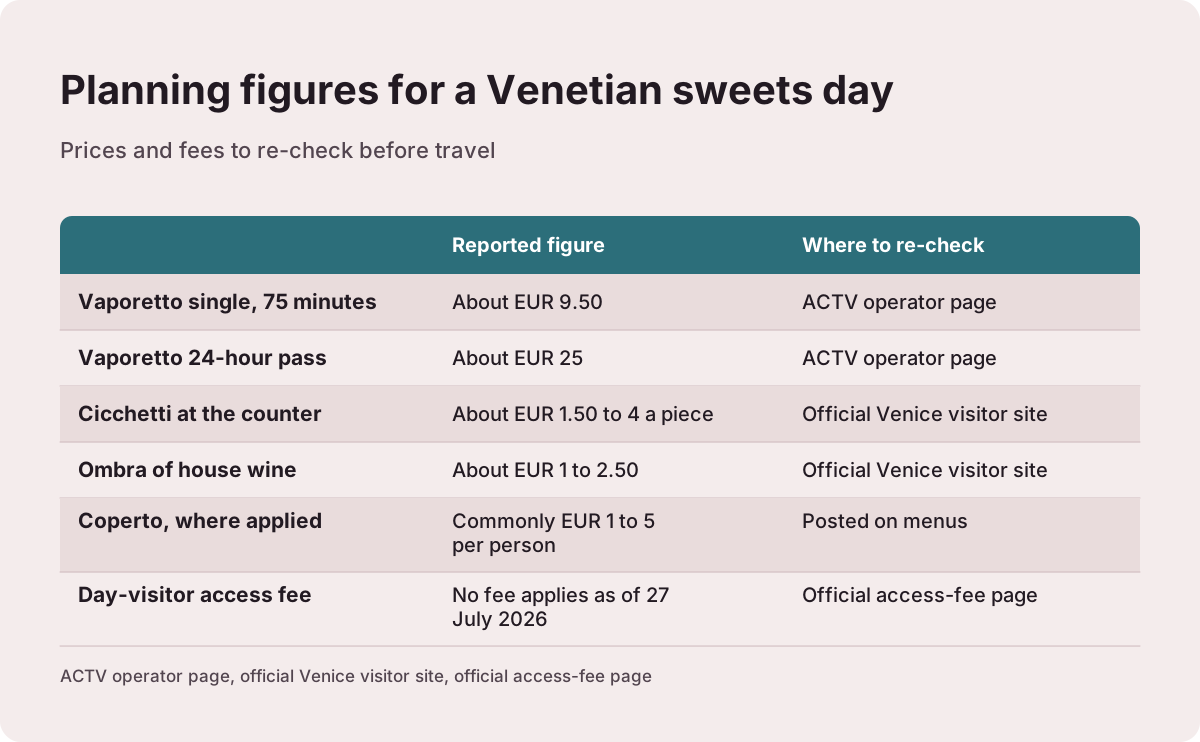
A few planning figures, all reported and worth re-checking before travel: a single 75-minute vaporetto ticket is about EUR 9.50 and a 24-hour pass about EUR 25, per the ACTV operator page; standing cicchetti run about EUR 1.50 to 4 a piece and a small ombra of house wine EUR 1 to 2.50, per the official visitor site, where you can check the current cicchetti price notes. Guided groups in the historic centre are capped at 25 people and loudspeakers are banned, as reported, so guides use headsets, which is worth knowing when comparing walk formats.
| Planning item | Reported figure | Where to re-check |
|---|---|---|
| Vaporetto single, 75 minutes | About EUR 9.50 | ACTV operator page |
| Vaporetto 24-hour pass | About EUR 25 | ACTV operator page |
| Cicchetti at the counter | About EUR 1.50 to 4 a piece | Official Venice visitor site |
| Ombra of house wine | About EUR 1 to 2.50 | Official Venice visitor site |
| Coperto, where applied | Commonly EUR 1 to 5 per person | Posted on menus |
| Day-visitor access fee | No fee applies as of 27 July 2026 | Official access-fee page |
For travellers who want the pastry leg of the day handled, this is where Venice Food Tours fits in: the sweet-themed walk covers the pastry-shop-and-gelato stretch so you can spend your own time on the Burano leg. Cost expectations for guided walks generally are laid out in what a Venice food walk costs.
The sweet stroll runs about 2 hours and moves between pastries, chocolate and gelato with a guide who handles the ordering. Price, meeting point and what is included are on the booking page, and free-cancellation terms, where offered, are shown there too.
When Is The Best Time Of Year For Venetian Sweets?
Carnival season, roughly January through Shrove Tuesday, is the best time for fried sweets because fritole and galani are only made then; early November brings fave dei morti; and the rest of the year belongs to the durable biscuits, baicoli, bussola and zaleti, so the honest answer depends on whether you want the seasonal fried things or the year-round dipped things.
If fried sweets are the goal, the trip dates must follow the liturgical calendar rather than the weather forecast. Shrove Tuesday falls in February or March, and the weeks before it are the only window. The city is busy during Carnival weekend itself, so visitors who want fritole without peak crowds aim for mid-January or the first Carnival weekdays.
Off-season travellers lose nothing structural. Baicoli, bussola and zaleti are permanent, and November brings two quiet bonuses: the fave dei morti in the first days of the month, and the start of the radicchio season that carries the savoury side of the tables. The best time to visit Venice guide works through the trade-offs month by month.
One planning fact that has changed recently: the 2026 day-visitor access-fee trial ended, and as of 27 July 2026 no fee applies, so day visits need no payment or exemption, per the official access-fee page. The fee is expected to return in 2027 with dates already listed and amounts not yet published, so check that page if travelling next year.
Whatever the month, a savoury walk balances the sugar. The street food tasting tour above pairs market stops with a local guide's counter picks over about 2.5 hours; current price and inclusions are on its listing.
Sweet Walk Or Do-It-Yourself: Which Suits You?
A guided sweet walk suits first-time visitors, anyone who wants tastings pre-arranged across pastry, chocolate and gelato stops, and travellers short on planning time; doing it yourself suits repeat visitors, Carnival-season visitors chasing one specific seasonal sweet, and anyone willing to walk between neighbourhoods with a shortlist, since the DIY version costs only what you buy at each counter.
The guided version buys sequencing and context. A guide decides which counter, orders in Italian, explains what is Carnival-only and what is year-round, and keeps the group inside the 25-person cap that city rules impose on guided walks. The DIY version buys freedom: linger at the ferry, wait for a warm tray, skip the chocolate stop. Neither is objectively better; the decision rides on how much of the day you want to spend finding your own way between counters.
| Format | Best for | What you handle yourself |
|---|---|---|
| Guided sweet walk | First visits, tastings pre-arranged across pastry, chocolate and gelato | Nothing but showing up at the meeting point |
| Guided savoury walk | Visitors who want market and counter context alongside the sugar | Nothing but showing up at the meeting point |
| Do-it-yourself pastry day | Repeat visitors chasing one seasonal sweet | Shortlist of counters, ordering, walking routes, ferry timing |
| Burano day trip | Visitors who want bussola at the source with a risotto lunch | Ferry tickets, crossing time, bakery timing |
For a fuller comparison of guided versus independent formats, food walk or cooking class in Venice walks through the trade-offs, and the Venetian sweets and pastries traditions angle from locals'-eye reporting adds the neighbourhood view.
What Should You Taste First, And What Can You Skip?
Taste fritole first if you are in season, because it is the one sweet you cannot get at any other time of year; taste bussola second if you are crossing to Burano anyway; baicoli third as the dip-and-coffee ritual; and skip nothing on this list for being unfashionable, because none of them are, but skip any fried sweet sitting under glass at room temperature in the afternoon.
The ordering logic is scarcity. A zaleti is available the week after you leave; a fritole is not. Beyond the three anchors, let the season decide: galani alongside the fritters in Carnival, fave dei morti in the first November days, gelato in summer as its own category, which the sweet stroll tour also folds in.
A closing note on rules that touch a sweets day: standing at the counter usually avoids the coperto cover charge that sit-down service can add, reported at commonly EUR 1 to 5 per person where applied, and Venice's municipal rules restrict drinking from glass containers and takeaway alcohol in public spaces, with fines reported at EUR 25 to 500, so a coffee-dipped biscuit at the bar is both the local and the simpler choice. Check current rules on the Comune di Venezia site alongside your planning.
Build the day around one fried thing, one dipped thing and one island thing if the ferry fits. That is the whole structure of Venetian pastry, three sweets deep.
Common Questions About Venetian Sweets
What Are Fritole?
Fritole are Venetian Carnival fritters: sweet fried yeast dough with raisins, pine nuts and often grappa, dusted with sugar. They are made only in the weeks before Shrove Tuesday, then vanish from the counters until the following season.
What Are Baicoli?
Baicoli are thin, dry, twice-baked biscuits created as preservation food for Venice's long sea voyages. They are nearly plain on their own and are meant to be dipped in coffee, hot chocolate or sweet wine.
What Is Bussola From Burano?
Bussola are ring-shaped or S-shaped butter biscuits from Burano, made with a rich egg-yolk dough that keeps well. They are traditionally tied to Easter and to the island's fishermen and are sold in Burano's bakeries year-round.
When Can You Eat Fritole In Venice?
Only during Carnival season, roughly from early January to Shrove Tuesday. The exact weeks shift each year with Easter, and fried sweets are best eaten warm on the day they are made.
Which Other Sweets Is Venice Known For?
Zaleti, polenta-flour cakes with raisins; galani, thin fried Carnival ribbons; fave dei morti, almond biscuits eaten around All Saints' Day in early November; plus gelato and chocolate traditions layered on top.