Vegetarian, Vegan And Gluten-Free Food In Venice
Venetian cooking leans hard on fish, but the city's bacari counters, markets and home kitchens hold plenty that is plant-based by default. Here is what vegetarians and vegans can genuinely eat, what gluten-free travelers need to watch, and the questions to ask a tour operator before booking.
Short answer
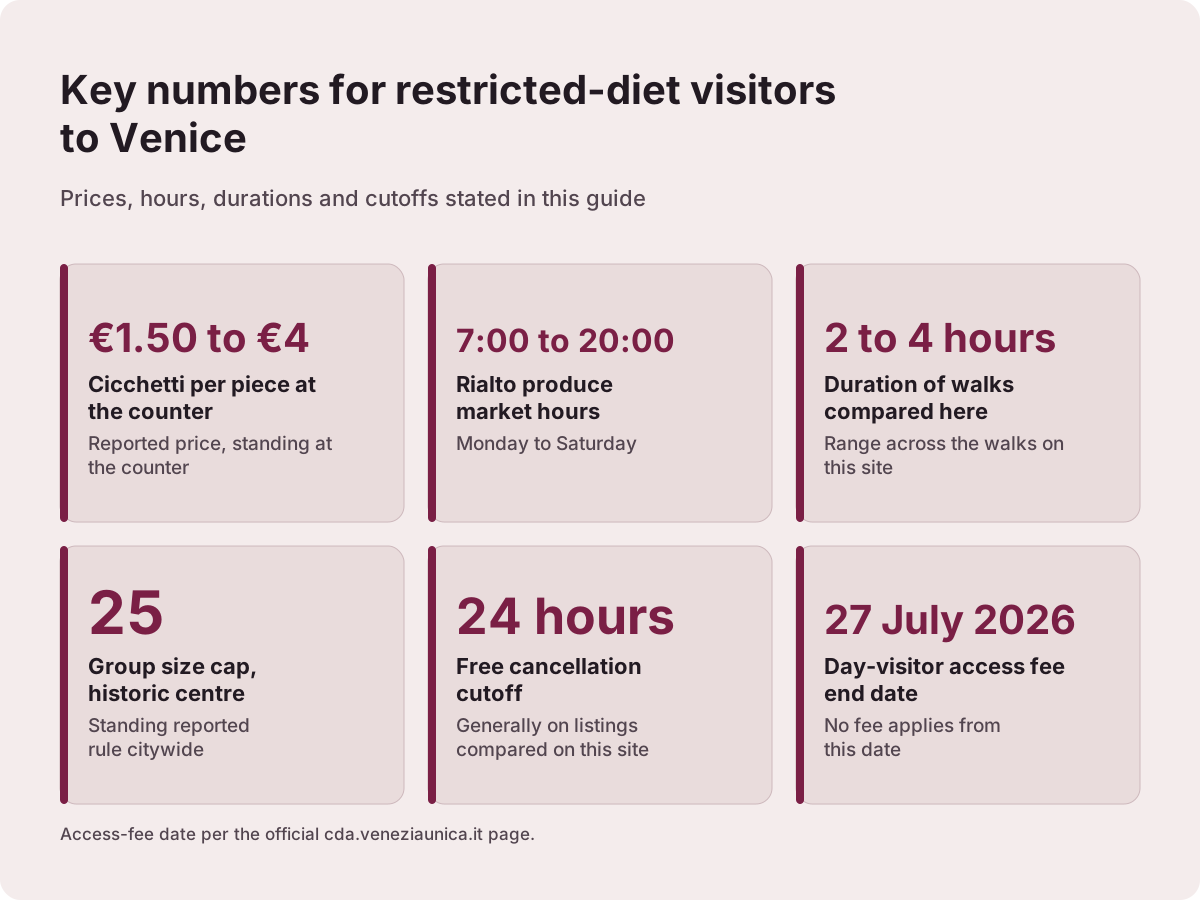
Venice is seafood-led but workable for vegetarians: vegetable cicchetti typically cost a reported €1.50 to €4 a piece at the counter, and dishes like baccalà mantecato aside, many bacaro staples are vegetables, cheese and polenta. No food walk listed here is described as vegetarian, vegan or gluten-free, so message the operator before booking.
Venice runs on fish. The Rialto Pescheria opens before dawn, sardines, cuttlefish and lagoon goby move across its slabs, and half the city's most famous plates, from sarde in saor to risotto di gò, are built on seafood. That is the honest starting point for any vegetarian, vegan or gluten-free traveler. The second honest point is better news: the everyday snack culture of the bacaro, the small bars where Venetians stand and eat, is full of vegetables, legumes, cheese and fried things that have nothing to do with the fish market. The diet question in Venice is rarely whether plant-based food exists. It is whether you can find it reliably, and whether a guided tasting walk can bend around your restriction.
This guide covers both sides: what to eat on your own, and how to check that a paid food experience will actually feed you before you hand over money. On the second point the rule is simple and strict. No tasting walk described in this article is listed as vegetarian, vegan or gluten-free, so treat every one of them as unconfirmed until you have messaged the operator and received a yes. An operator who cannot accommodate you will usually say so, and it is far cheaper to learn that before booking than at the first counter.
Is Venice Actually Hard For Vegetarians And Vegans?
Venetian restaurant cooking is seafood-led, which makes sit-down menus the weak spot, but the bacaro counter is naturally strong for vegetarians and partly workable for vegans. Vegetable cicchetti, polenta, cheese and legume dishes are typical bacaro staples, at a reported €1.50 to €4 a piece standing at the counter. Vegans eat well but narrowly; gluten-free travelers face a fried-food city where cross-contact is the norm, not the exception.
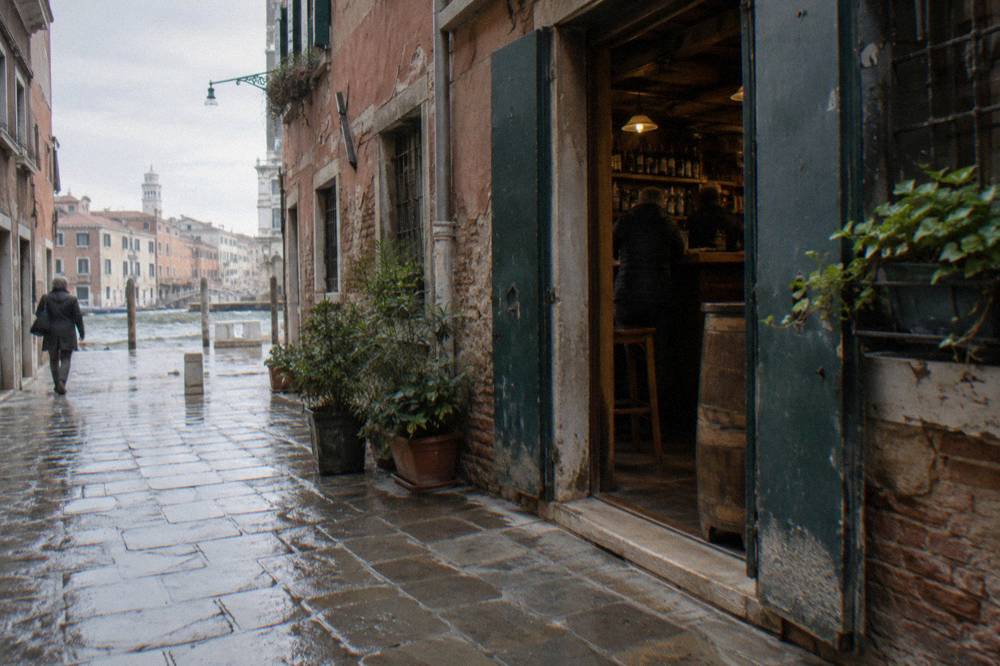
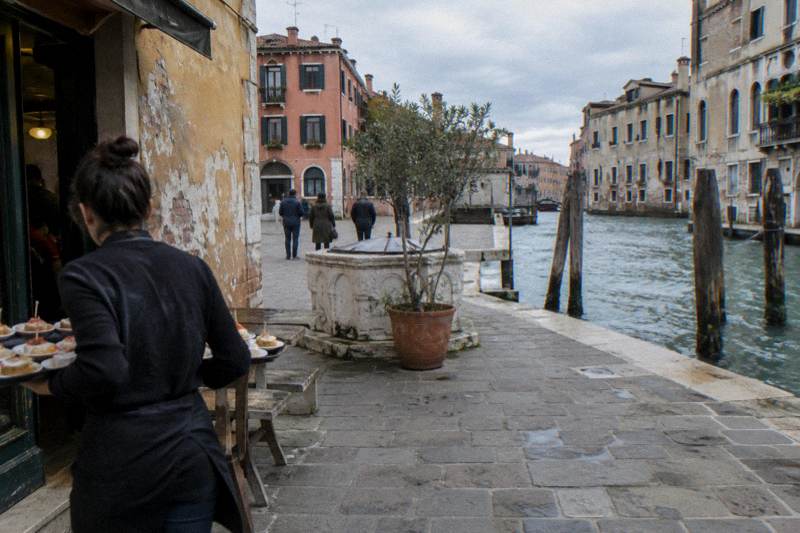
Start with the structure of the cuisine rather than individual dishes. Venetian home cooking grew out of poverty and lagoon produce: beans, radicchio, artichokes, pumpkins and greens all have long local histories, and many survive on bacaro counters today. The famous seafood reputation sits on top of that vegetable base, it does not replace it. A vegetarian who orders by walking the counter and pointing, rather than reading a restaurant menu translated for tourists, will generally eat better and pay less.
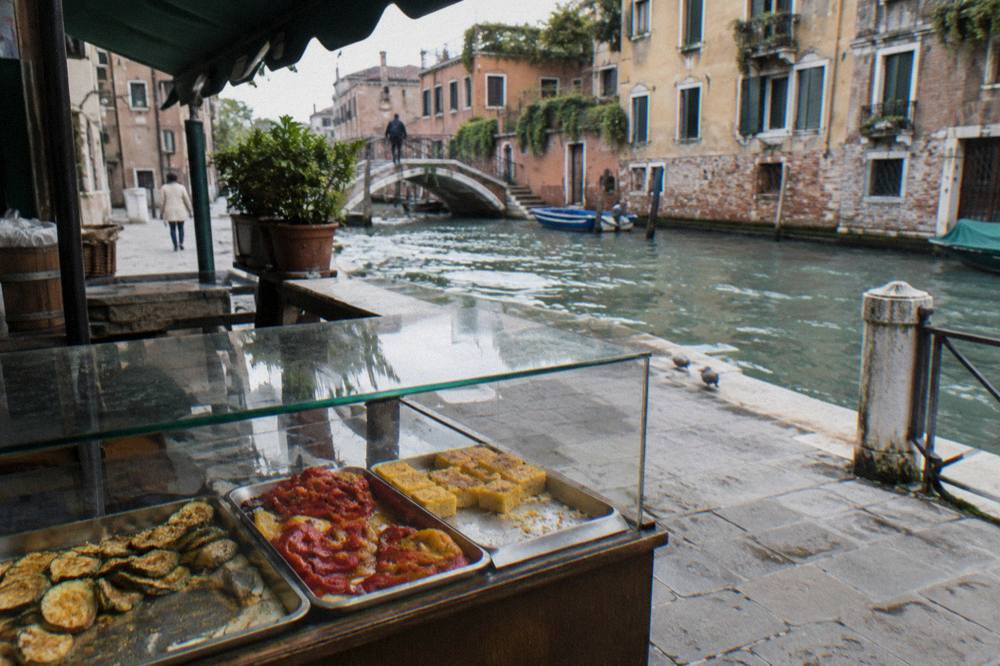
Vegans need sharper aim. Cheese appears everywhere, and the classic vegetarian hits, from montasio slabs to mozzarella in carozza, are off the table. But grilled and marinated vegetables, boiled potatoes with oil and herbs, and the humbler fried zucchini flowers (ask how they are filled) are all real counter items. The phrase that matters is "senza formaggio e senza carne di pesce", without cheese and without fish, said slowly and checked twice, because anchovy is so common in Venetian cooking that a server may not think of it as fish at all.
For gluten-free travelers the trap is different. Polenta is naturally gluten-free and everywhere, and so is risotto, but Venice fries heavily and most bacaro fryers share oil and crumbs across everything they cook. A dish can be made without gluten and still be unsafe for coeliac diners. The honest advice is to say "sono celiaco", I am coeliac, rather than "senza glutine" alone, because that word signals seriousness and often produces a different answer about the fryer.
What Plant-Based Dishes Are Genuinely Venetian?
The strongest vegetarian picks are the vegetable and legume cicchetti, creamy baccalà mantecato is off-limits for vegans since it is whipped salt cod but vegetarian-friendly fish-wise is not, so the true vegetarian anchors are polenta with mushrooms or cheese, fried zucchini flowers, sardele in saor's cousin onion-based marinated vegetables, radicchio dishes, and the sweet end of the counter, from fritole to bussolà. Typical counter prices run a reported €1.50 to €4 per piece.
Here is the practical truth about the fish question: baccalà mantecato, the whipped stockfish spread that defines the Venetian counter, is fish, and vegetarians who avoid fish skip it. Vegans do too, on the same grounds. That removes one icon, but the counter around it is still crowded. The table below lists the plant-based staples you can genuinely expect, with the caveat that any single bar's daily selection varies and nothing on a counter is guaranteed.
| Dish | What it is | Vegetarian | Vegan | Gluten-free notes |
|---|---|---|---|---|
| Polenta e funghi | Soft or grilled polenta with mushrooms | Yes | Usually yes | Polenta is gluten-free; check the mushroom sauce |
| Fiori di zucca fritti | Fried zucchini flowers | Yes, if cheese-filled | No if filled with cheese | Shared fryer risk is high |
| Cicchetti di verdure | Fried or grilled vegetable pieces on bread | Yes | Often | Bread base contains gluten |
| Melanzane in saor | Sweet-and-sour eggplant with onion | Yes | Usually yes | Often safe, ask about the frying |
| Radicchio trevisano | Grilled or stewed bitter red chicory | Yes | Yes | Naturally gluten-free |
| Bussolà di Burano | Butter-and-egg ring biscuits from Burano | Yes | No | Contains wheat and butter |
Two of those deserve a note on origin. The bussolà is a Burano specialty, a rich egg-yolk biscuit historically baked for fishermen and Easter, and it is the island's standard edible souvenir; it is firmly vegetarian and firmly not vegan or gluten-free. The in saor preparation, onion-and-vinegar marinade, is the same technique behind the famous sarde in saor, and cooks apply it to vegetables as readily as sardines, though any given bacaro may only make the fish version on a given day.
For the vegan traveler, the safest strategy is the produce market before the bacaro. The Rialto produce market runs Monday to Saturday from 7:00 to 20:00, per the official Venezia Unica listing, and seasonal vegetables, fruit and olives from the stalls cover lunches cheaply and without negotiation. Our Rialto market guide walks the whole area, including which parts a plant-based visitor should linger in.
Beyond the snack counter, sit-down cooking has vegetarian depth in risotto (specify vegetable stock; ask about the stock explicitly, because kitchen default may be meat or fish), bigoli with vegetable sauces where the pasta itself is egg-and-wheat, and grilled vegetables with polenta. The related warning also applies here: portions of cheese, salted fish and cured meat dominate antipasti boards, so a vegan ordering "antipasti" blindly will usually land on anchovies.
If you would rather have a guide steer you through this, the small-group format matters. The three-hour Eat Like a Local walk, this site's featured tasting experience, runs in small groups where a guide can swap a tasting at the counter far more easily than in a party of twenty, but that flexibility is a reasonable expectation, not a promise; confirm with the operator first through 3-Hour Small-Group Tasting and message them about your diet.
Gluten-Free Eating In Venice: What Works And What To Watch
Gluten-free travelers can eat well in Venice on polenta, risotto and grilled fish or vegetables, but the bacaro fryer is shared by default, so fried cicchetti are a cross-contact risk rather than a safe choice. Say "sono celiaco" to signal medical seriousness, expect plain cooking rather than substitutes, and treat any food walk as unconfirmed for gluten-free until the operator answers in writing.
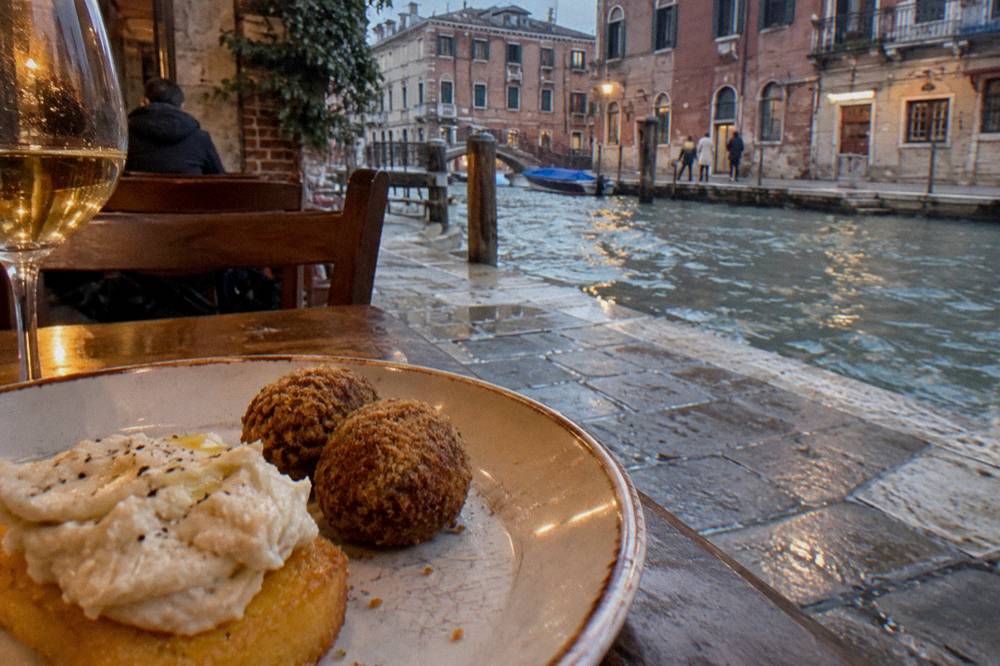
The city's carbohydrate backbone is bread and fried dough, from tramezzini sandwiches to fritole at Carnival, so gluten is ambient. Against that, the naturally gluten-free pillars are strong: polenta in every form, risotto (in restaurants, and again, ask about the stock), baccalà mantecato served on polenta rather than bread for fish-eaters, and whole grilled or roasted vegetables. Ice cream shops are widespread and usually flag which flavors contain gluten, though scoops and shared scoops are their own cross-contact question for the highly sensitive.
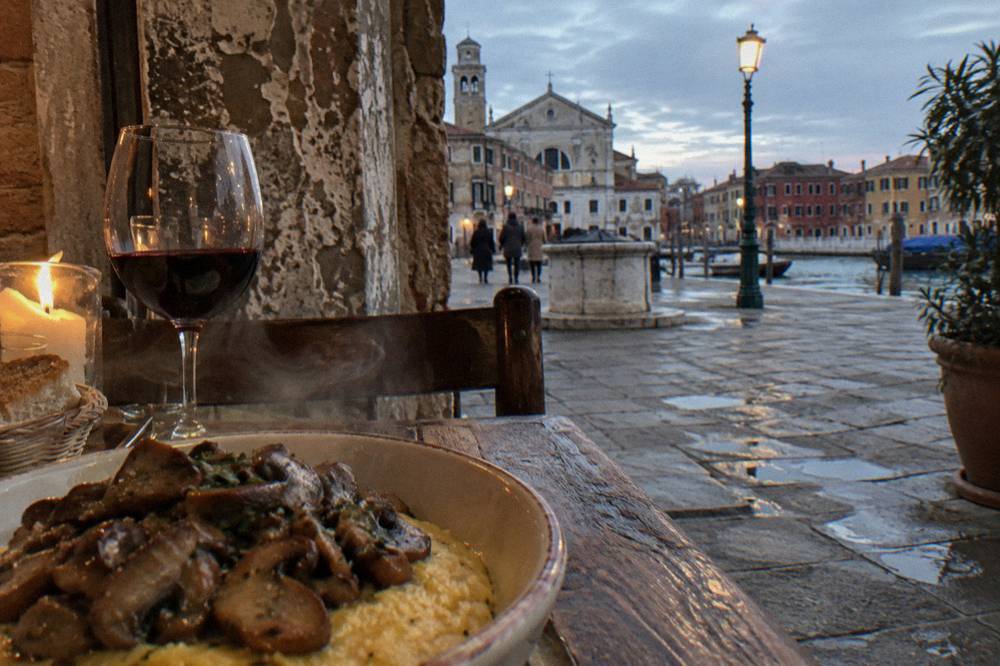
The one rule worth internalizing is the fryer rule. A bacaro that fries salt cod, cheese and vegetables in the same oil is normal, not careless; that is how the format works. So the gluten-free question in a bacaro is never "does this dish contain wheat" but "was this cooked in oil that also cooked breaded things", and the answer is usually yes. Plain grilled, boiled and marinated items avoid the problem entirely. For a fuller picture of what to skip, see our Venice street food guide, which flags the fried items separately.
| Situation | Usually safe | Approach with care |
|---|---|---|
| Bacaro counter | Marinated vegetables, grilled polenta, olives, cheese plates | Anything fried; anything on a bread base |
| Restaurant | Risotto with confirmed vegetable stock, grilled vegetables, polenta dishes | Pasta unless a GF option is stated; fried sides |
| Gelateria | Fruit sorbets (ask about scooping) | Cone anything; flavors with biscuit or cake pieces |
| Market | Whole fruit, vegetables, olives | Nothing; raw produce is the safest food in the city |
A practical point about the municipal rules that shape street eating: Venice prohibits consuming food and drinks in glass or ceramic containers outside permitted outdoor seating areas, and bans takeaway sales of drinks in glass bottles or glasses, as reported in the current municipal regulation, so plan to eat your market purchases standing near the stall or seated somewhere legal rather than walking with them, and check the current rules on the comune's site. The regulation is aimed at glass and public order, not at food types, but it shapes where a gluten-free traveler assembling a market lunch can actually sit down and eat it.
How To Check A Food Walk Can Accommodate Your Diet
Message the operator before booking, in writing, naming the restriction exactly, vegetarian, vegan, gluten-free or coeliac, and ask three things: can tastings be substituted, is the route built around counters you cannot eat at, and is there a price adjustment. No tasting walk compared on this site is described as vegetarian, vegan or gluten-free, so silence or a vague yes is not an answer.
This is the single most important section of the guide for dietary-restricted readers. Tour listings sell a fixed count of tastings, and a "10 tastings and 6 wines" headline assumes the standard menu. Whether a guide can swap three of those ten tastings for vegetable versions depends on the operator's relationships with the bars, the size of your group and the day, and none of that is visible on a booking page. Only the operator can tell you, and only if you ask specifically. Everything else covered here is indexed on Venice Food Tours.
| Question to ask | Why it matters | What a good answer sounds like |
|---|---|---|
| Can you substitute tastings for a vegetarian / vegan diet? | The listing's tasting count assumes the standard menu | A specific yes, naming what replaces what |
| I am coeliac, not just avoiding gluten: is that workable? | Coeliac signals medical cross-contact, not preference | An honest answer about fryers and shared surfaces |
| Will the group stop at counters I cannot eat at? | The route matters as much as the menu | A route description with alternatives |
| Is there a price change if I receive fewer tastings? | Some operators discount, some do not | Any figure in writing before you pay |
| Can you confirm this in a message rather than a call? | Written confirmation protects you | A reply you can screenshot |
Booking conditions work in your favor here. The listings compared on this site generally allow free cancellation up to 24 hours before departure, which means the safest sequence is: message, wait for the answer, then book, then re-confirm the diet note a day or two before the walk. An operator who answers the first message promptly is also, not coincidentally, the operator more likely to remember the note on the day.
The access fee question, which dietary travelers sometimes worry about alongside everything else, is currently simple: the 2026 day-visitor access-fee trial ended and from 27 July 2026 no fee applies, per the official access-fee page, which also lists proposed 2027 dates with amounts still to be announced. That page, at cda.veneziaunica.it, is the source to re-check after 31 December 2026 if your trip falls in 2027.
The 24-hour cancellation window on most of these listings is the safety net that makes the pre-booking message low-risk. Send the question, hold the date, and cancel without cost if the answer is no.
Which Tour Formats Suit Restricted Diets Best?
Small-group and short walks are the most adaptable formats, private walks the most certain, and fixed-count tasting marathons the least flexible. Durations across the walks compared here run from 2 to 4 hours, and a guide with eight guests can negotiate a counter substitution in a way a guide with twenty-five cannot; group sizes are capped citywide at 25 in the historic centre, a standing reported rule.
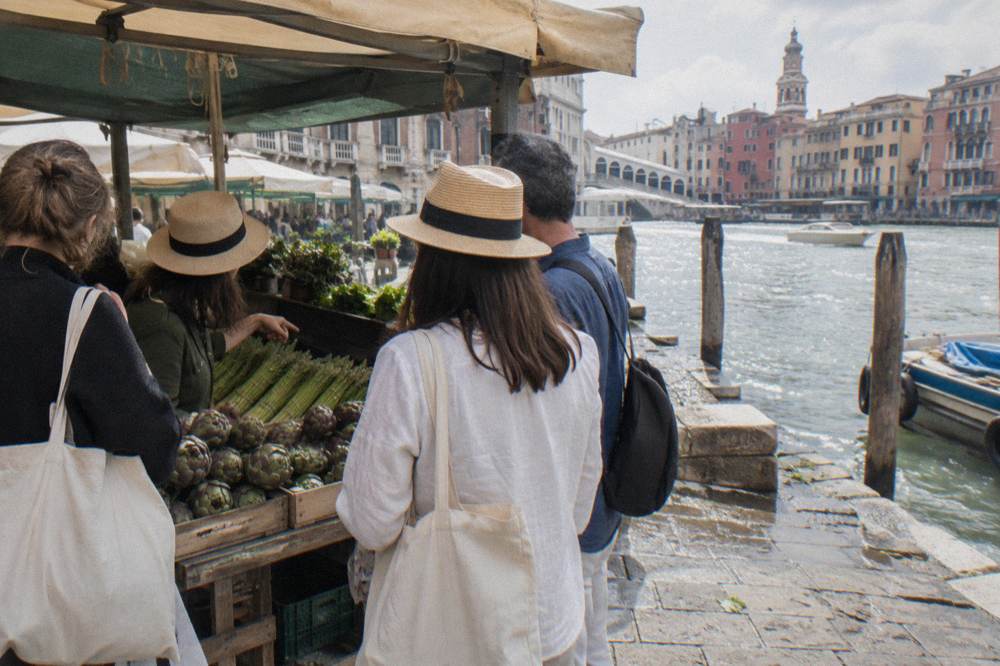
The arithmetic of adaptability is straightforward. The Eat Like a Local small-group format runs three hours, the street food walk with a local guide runs 2.5 hours, and the Jewish Ghetto and Cannaregio walk runs four hours with wine. Longer walks visit more stops, and policies vary by listing: the Jewish Ghetto and Cannaregio tour accommodates vegetarians only with advance notice, while some street food walks have limited dairy- and gluten-free options. If a tour's tastings cannot be adapted, a shorter walk wastes less of your day.
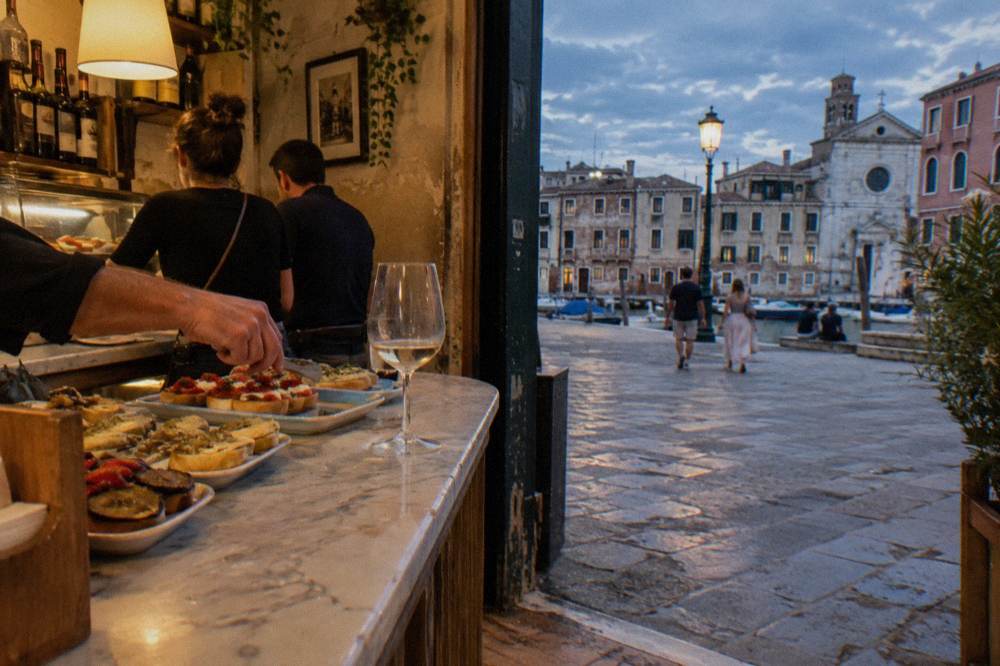
The street food walk is the natural fit for a curious vegetarian, because street formats lean on fried and standing foods where vegetable versions are common, and the two-hour length leaves room to retreat to a market if a stop does not work. It is also the walk where gluten-free travelers should be most explicit about cross-contact, for the fryer reasons above.
The Cannaregio walk makes a different case: the Jewish Ghetto quarter is one of the few parts of Venice with a distinct sit-down restaurant culture, and four hours with wine suggests seated stops rather than pure counter hopping, which tends to be easier for substitutions. Vegetarian travelers will still find the kosher question separate from their own, and our article on kosher food in Venice covers that distinction; a walk through the Ghetto does not make its food kosher.
For travelers who want certainty rather than probability, private formats remove the negotiation. A private walk costs more per person, and when it is worth paying for is covered in our private food walk guide; the short version is that a strict allergy or a coeliac requirement is exactly the scenario where the premium buys real value, because the operator builds the route around you from the start rather than bending a fixed one.
Reading A Bacaro Counter As A Vegetarian
Scan the counter before ordering, point at what you can eat rather than asking for menu translations, and remember that anchovy hides in Venetian cooking under names like "in saor" and "al latte". Vegetable cicchetti typically run a reported €1.50 to €4 a piece and an ombra of house wine €1 to €2.50 at the counter, prices confirmed on the official Visit Venice food pages.
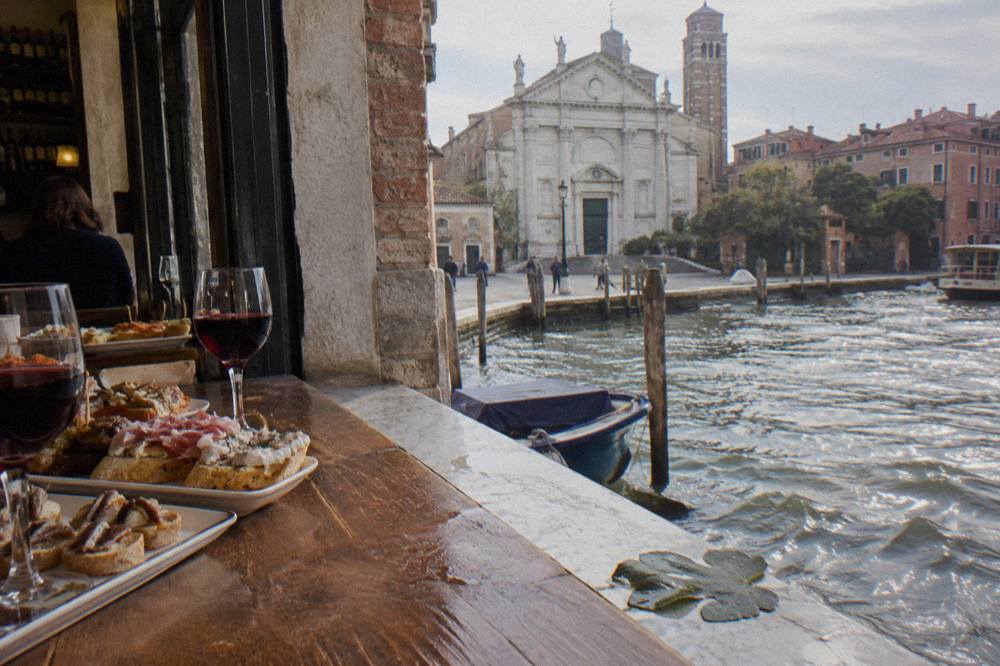
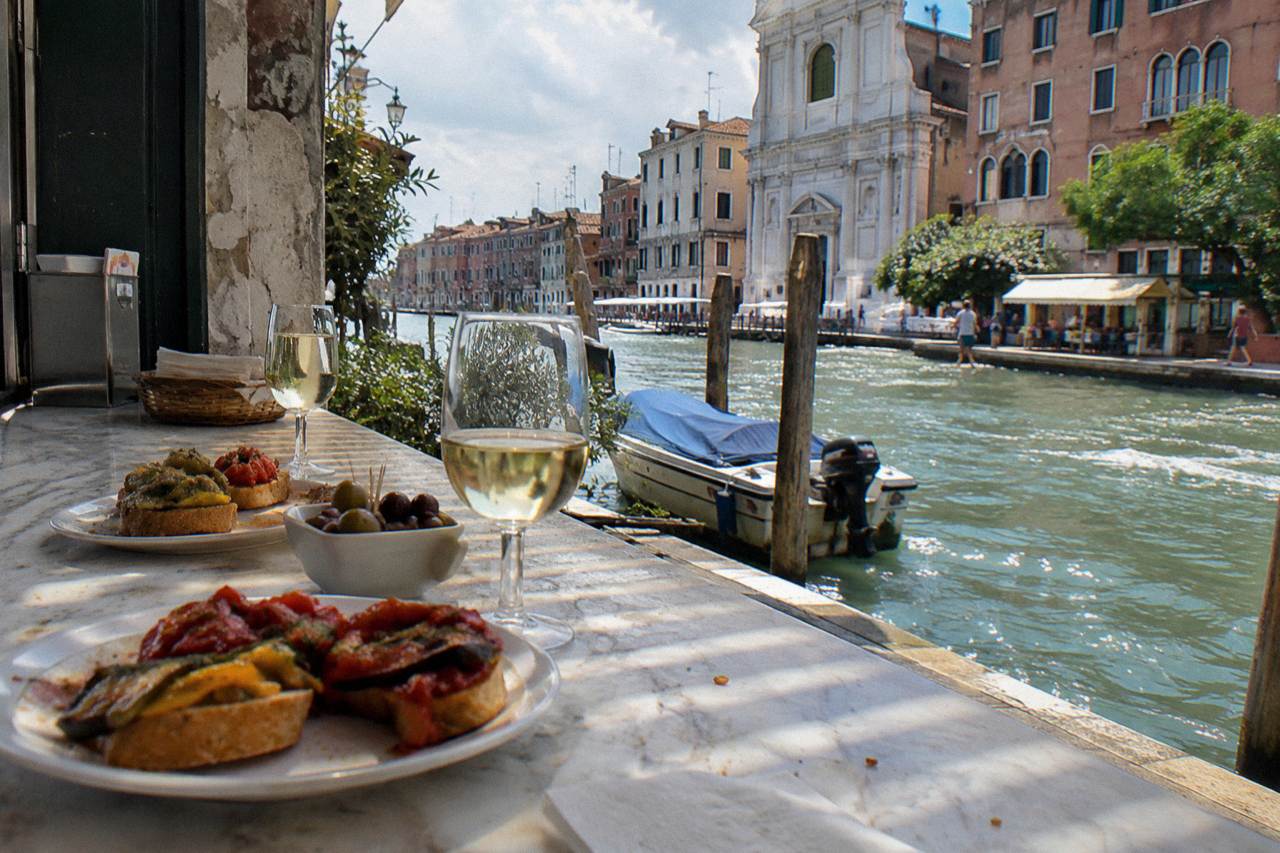
The counter is a visual menu. Everything on offer sits under glass or on trays, so a vegetarian can audit it in seconds: polenta squares, fried vegetables, cheese, marinated dishes, and the fish items to skip. Ordering is pointing plus a number. This is also the cheapest eating in Venice precisely because you stand; coperto, the seated cover charge of a reported €1 to €4 per person where applied, is generally avoided at the counter, and tipping is optional and rare in this setting.
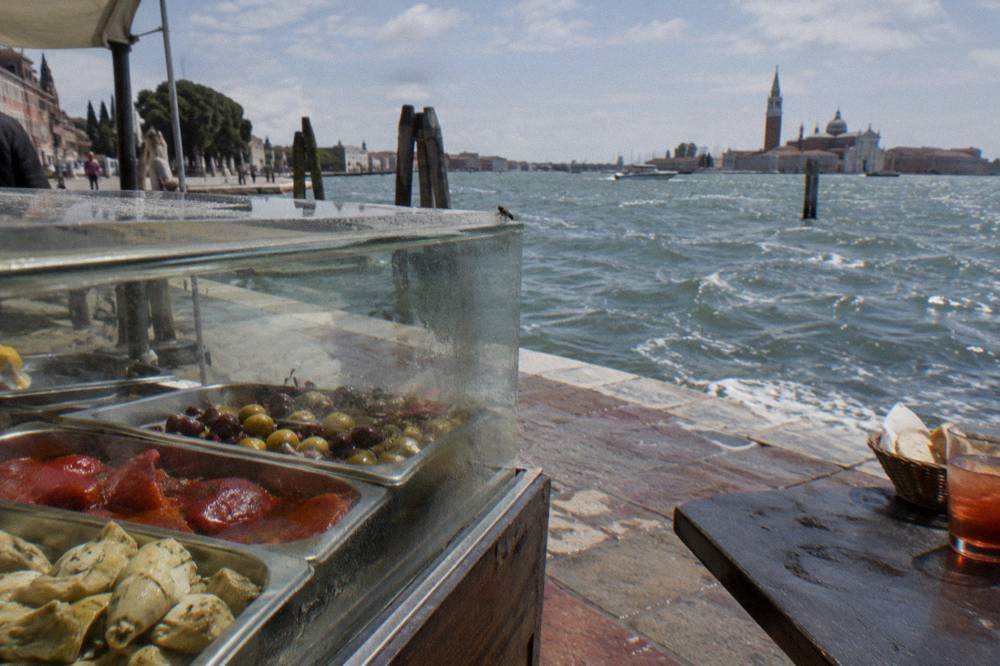
The hidden-fish list deserves memorizing. In saor means a sweet-and-sour onion marinade that is usually but not always applied to sardines; "moleche" are soft-shell crabs; anything described as "alla veneziana" with a dark sauce may be cuttlefish ink. If you are unsure, the phrase "c'è dentro del pesce?", is there fish in it, asked with a pointing finger, resolves it in one second. The wider ordering vocabulary is in our guide to cicchetti and how to order it.
For vegans the counter still works with three additions to the script: ask that cheese be left off polenta dishes, steer to the boiled and marinated vegetables rather than the fried tray, and treat the fryer question as irrelevant by avoiding fried items altogether. A vegan bacaro crawl in Venice is narrower than a vegetarian one, but it is a real meal, not a stint of olives.
Wine and spritz carry no dietary complications for vegetarians and vegans in practice, and they are half the culture of the bacaro; the local pours and their etiquette are covered in our guide to the ombra and Venetian wine rituals. An ombra, the small roughly 100 ml glass of house wine, is the standard companion to cicchetti at a reported €1 to €2.50 in local spots.
A Three-Day Plant-Based Eating Plan For Venice
Structure the stay as markets in the morning, bacari at midday and early evening, and one booked, diet-confirmed food experience on the middle day. Rialto's produce market runs Monday to Saturday 7:00 to 20:00 and its fish market Tuesday to Saturday 7:00 to 14:00, so plan the market morning on a weekday, and remember Sunday closes both, which pushes the day toward Cannaregio or Dorsoduro bacari.
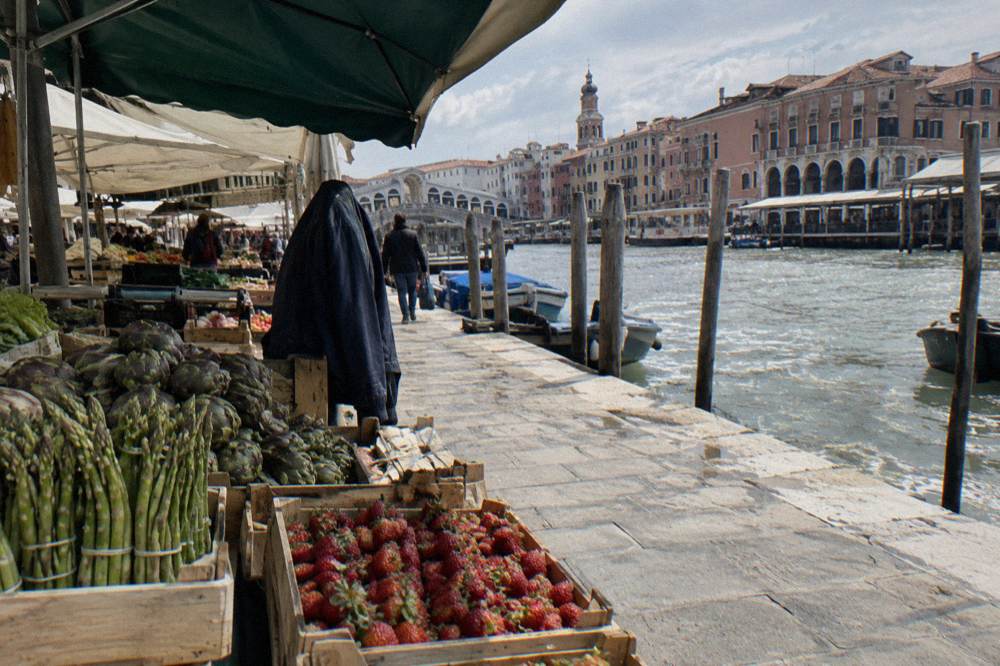
Day one belongs to Rialto. Arrive mid-morning after the wholesale trade has finished, buy fruit and vegetables at the Erbaria, then work the bacari of San Polo for lunch, pointing at vegetable cicchetti. The timing matters more than most visitors realize: the fish market closes at 14:00 and both markets close Sunday, facts confirmed on the official Venezia Unica market pages, so a Sunday arrival means the market half of the plan moves to Monday.
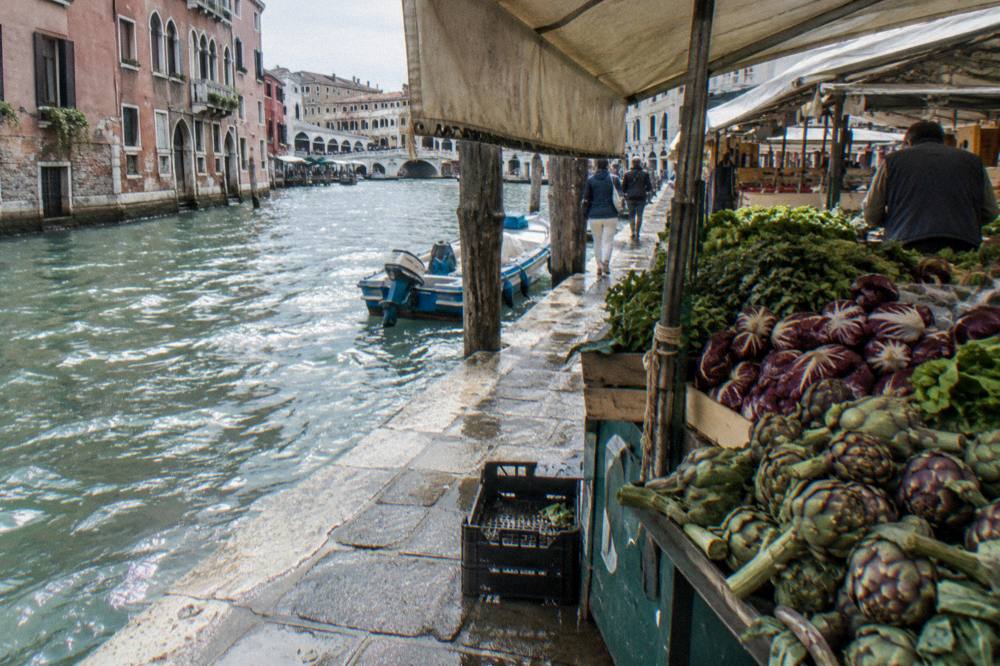
Day two is the booked experience, whatever the diet message has confirmed. This is the day to take the small-group walk in Cannaregio or the street food route, and it is the day your pre-booking message pays off. Evening is Venice's own hour: aperitivo time fills the bacari from early evening, and the standing, drinking, snacking rhythm of that window is explained in our evening food walk guide.
Day three, take the vaporetto. Line 12 runs from Fondamente Nove via Murano to Burano on a daytime interval of roughly 20 minutes at peak times, per the published network descriptions, and a single 75-minute ACTV ticket is a reported €9.50. Burano is a fish-and-biscuit island, so vegetarians go for the colors and the bussolà, vegans for the colors, and the lace island's vegetable-free reputation is exactly why the market breakfast beforehand matters. The fuller island itinerary, with its food stops, is in our Burano and Murano day trip guide.
| Day part | Vegetarian plan | Vegan adaptation | Gluten-free adaptation |
|---|---|---|---|
| Morning | Rialto produce market, fruit and coffee at a bar standing | Same, skip pastries | Same, skip pastries unless labeled |
| Midday | Bacaro counter, vegetable cicchetti and cheese | Marinated vegetables, grilled polenta, no cheese | Grilled polenta, no fried tray |
| Aperitivo hour | Ombra or spritz with cicchetti | Spritz with olives | Spritz, skip bread-based snacks |
| Evening | Sit-down risotto with confirmed vegetable stock | Grilled vegetables and polenta | Same, confirm stock and no fried garnish |
Seasonality rewards flexibility. The lagoon's own calendar brings castraùre, the small violet artichoke buds from Sant'Erasmo, for a brief spring window, and radicchio and pumpkin carry the winter counters. What is on the glass case in any given week depends on the market that morning, which is the honest reason no guide can promise a specific dish list, and the reason a flexible counter strategy beats a fixed restaurant reservation for restricted eaters.
One sweet footnote for vegetarians rather than vegans: the two-hour pastry, chocolate and gelato stroll is the format most naturally vegetarian in its subject matter, though gelato flavors vary and gluten-free guests still need to ask about cones and scooping. As with everything here, the operator's answer before booking is the only one that counts.
Common Questions About Vegetarian And Vegan Food In Venice
Is Venice Good For Vegetarians?
Yes, with aim. The bacaro counter carries vegetable cicchetti, polenta, cheese and marinated vegetables as everyday staples at a reported €1.50 to €4 a piece, and risotto with vegetable stock covers sit-down meals. Restaurant menus lean seafood, so vegetarians eat best at the counter and in kitchens that will confirm a vegetable stock.
Can Vegans Find Food In Venice?
Workably, yes, but narrowly. Vegans rely on grilled and marinated vegetables, plain polenta without cheese, market fruit and olives. Cheese and fish are pervasive, and anchovy appears in dishes a server may not think to flag, so the questions "senza formaggio" and "c'è dentro del pesce" are worth asking every time.
Is Venice Gluten-Free Friendly?
Partly. Polenta, risotto and grilled dishes are naturally gluten-free and everywhere, but bacaro fryers are shared, so fried cicchetti are a cross-contact risk for coeliac diners. Saying "sono celiaco" rather than just asking for gluten-free food gets a more careful answer about preparation.
Are Any Venice Food Tours Vegetarian Or Gluten-Free?
None of the walks compared on this site is described as vegetarian, vegan or gluten-free on its listing. That does not mean they cannot accommodate you; small-group walks in particular often substitute tastings. Message the operator before booking, name the restriction exactly, and get the answer in writing.
What Should I Ask A Tour Operator About My Diet?
Three things: whether tastings can be substituted for your restriction, whether the route includes stops you cannot eat at, and whether the price changes if you receive fewer tastings. Ask in writing before paying, and re-confirm a day or two before the walk.
What Can Vegetarians Eat At A Bacaro?
Typical vegetarian counter items include polenta with mushrooms or cheese, fried zucchini flowers, grilled or marinated vegetables, and cheese with bread. Selections change daily with the market, so treat the counter as a visual menu and point at what works rather than expecting a fixed vegetarian list.