Sarde In Saor: Venice's Sweet And Sour Sardines
Sarde in saor is Venice's oldest way of keeping fish edible at sea: sardines fried, then bathed in sweet and sour onions. Five centuries later it is the dish most likely to explain how the city eats.
Short answer
Sarde in saor is fried sardines marinated in vinegar, onions, raisins and pine nuts, a preserving method Venetian fishermen used long before refrigeration. You find it as a cicchetto at standing bacari and on antipasti plates, typically alongside baccalà mantecato. Guided tasting walks stop at bacari where it is commonly served; check each listing's inclusions before booking.
Fried sardines, sweet and sour onions, raisins, pine nuts, and time. That is sarde in saor in a single line, and behind it sits one of the oldest surviving preserving techniques in Italian cooking. The dish began as ship's provisions: vinegar and onion slowed the fish from spoiling on multi-day fishing trips in the lagoon, and the marinade happened to taste better on day two than on day one. Today it appears on counters across the city as a cicchetto, the small plate Venice eats standing up, and it is one of the clearest windows into how the city's food actually works.
What Is Sarde In Saor And Why Does Venice Eat It?
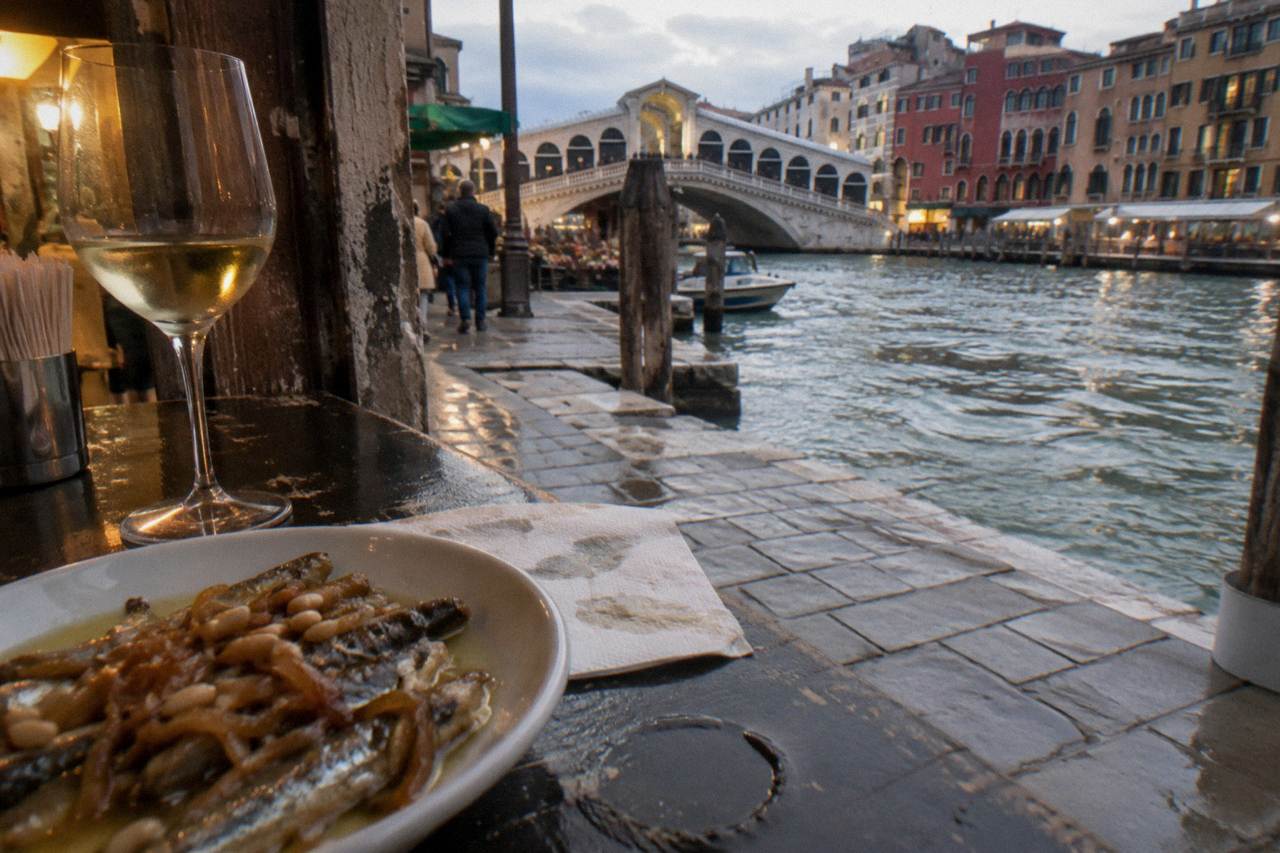
Sarde in saor is fried sardines layered with onions cooked slowly in vinegar, usually with raisins and pine nuts, then left to marinate for a day or more before serving. It is simultaneously a preserving method and a dish: the acid keeps the fish and softens the frying, so the finished plate is eaten at room temperature, never hot.
The word "saor" comes from the Venetian for flavor or sapor, and that is the honest description of what the marinade does. White onions are cooked down until they collapse into something sweet and glossy, vinegar sharpens them, and the mixture is poured over the fried sardines while still warm. Raisins and pine nuts are the classic additions, a sweet note that food historians link to Venice's eastern Mediterranean trade routes, the same routes that brought the city its taste for spices, dried fruit and bitter oranges.
What surprises most first-time visitors is the temperature and the texture. The sardines are not crisp; the marinade softens the fried surface until the whole thing eats more like a salad than a fried fish. It is served cold or at room temperature, which makes it a summer dish in spirit even though bacari keep it on the counter year round. If you come to it expecting hot fried sardines, the first bite can confuse. The second usually converts.
The dish also explains the structure of a bacaro counter better than almost anything else on it. Because saor keeps well, a bar can prepare a tray in the morning and serve honest food all day from it, which is exactly how cicchetti service works. Venice adopted the technique because lagoon fishermen needed food that survived days at sea without refrigeration, and the city never stopped making it after refrigeration arrived. For the full mechanics of that counter culture, read how a bacaro crawl works, which walks through the ombra-and-cicchetto rhythm this dish lives inside.
Where Did The Dish Come From?
Sarde in saor traces to the medieval and Renaissance era, when Venetian fishermen, especially those from Chioggia at the lagoon's southern end, fried their sardine catches and preserved them in vinegar and onion for the voyage home. Its survival on modern bacaro counters is a direct line from working food to beloved dish, one of the few cases where the preserving method became the point.
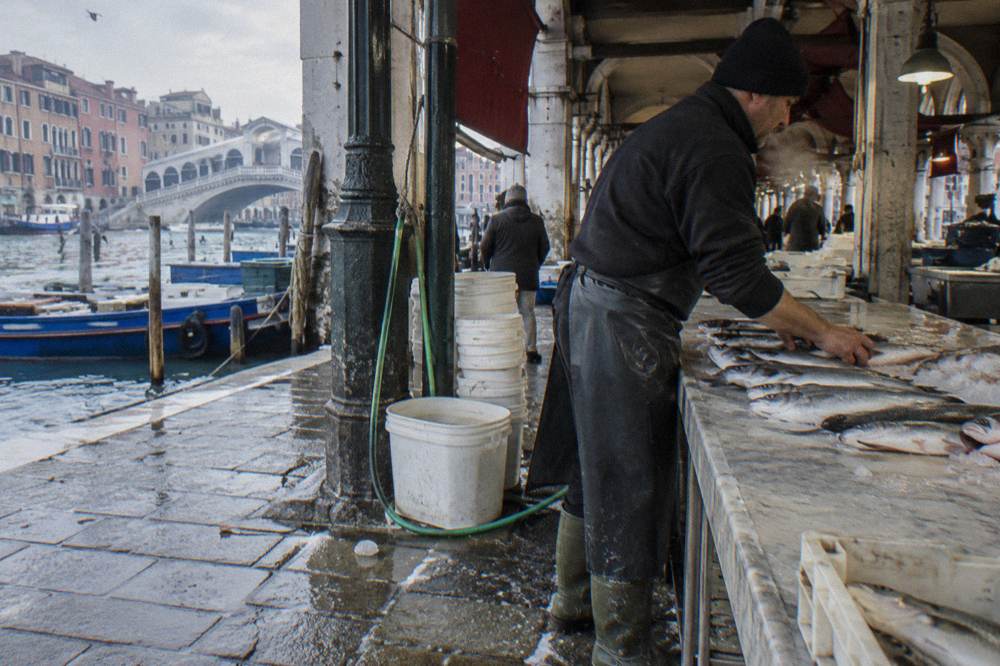
Chioggia, Venice's smaller fishing sister city, still claims the dish, and the sardine boats that supply the Rialto fish market are part of the same story. The logic was practical: a catch of small oily fish spoils fast, frying extends that by a day, and a vinegar bath extends it further. The onions were cheap, local and abundant, and the sugar in them balances the vinegar's edge as the marinade sits. Somewhere along the way cooks noticed the fish tasted better after a night in the saor, and the waiting became the recipe rather than a compromise.
“Fantastic night at Rosa’s home! This was an incredible way to spend a delicious evening with family or friends. Rosa was warm, funny, and friendly and knows her cooking! I was with my family who are between the ages of 14-72 and all had a great time. Will come visit again the next time we are in Venice!”
The sweet and sour character itself is older than the fish dish. Venice's spice trade with the Levant and the eastern Mediterranean filled its kitchens with raisins, pine nuts and dried fruit, and medieval Venetian cooking leaned sweet and sour in a way northern Italian cooking mostly did not. Sarde in saor, with its raisins and sometimes a pinch of cinnamon in home versions, carries that medieval palate straight onto a modern bar counter.
The official Venice tourism site documents cicchetti culture, the standing-counter tradition this dish belongs to, alongside the typical price ranges for a piece and a small glass of house wine. Reported ranges put cicchetti at around €1.50 to €4 a piece and an ombra, the roughly 100 ml glass of house wine, at around €1 to €2.50 in local spots, figures confirmed on the official site; posted lists at each bar apply, so check the board.
If the history of the dish interests you, a guided walk puts it in context faster than independent reading, because a guide can point at the counter and explain what each tray is while you eat. These three walks are the ones that fit the dish best:
What Goes Into A Traditional Saor?
A traditional saor is four ingredients plus patience: fresh sardines, white onions, white wine vinegar, and olive oil for frying, with raisins and pine nuts added in the classic version. The onions cook slowly until sweet, the sardines are floured and fried, and the layers rest together for at least a day before serving.
The sardines matter most. Small, fresh, oily fish, cleaned and beheaded, are floured lightly and fried until just golden; overcooking dries them out and the marinade cannot rescue that. The onions are sliced thin and cooked in olive oil over low heat for a long time, until they go from sharp to jammy. Vinegar goes in toward the end and reduces, sometimes with a little sugar to soften the blow. Then the assembly: a layer of onions, a layer of fish, more onions, and the dish rests.
The raisins and pine nuts are more than garnish. Softened raisins carry sweetness into the acidic marinade, and pine nuts add the fat and crunch the softened fish has lost. Some home cooks add a scrap of lemon zest or a pinch of cinnamon, both echoes of the spice-trade era, and a few bars near the Rialto make a version with a slight bitter-orange note. None of these variations changes the fundamental identity of the dish.
Recipes vary in the ratio of sugar to vinegar and in whether the raisins are soaked first, but the structure barely changes from home kitchen to bacaro. Two practical notes for anyone cooking it themselves. First, the resting period is not optional; made and eaten the same day it tastes mostly of vinegar, and the traditional window is one to three days in the cool. Second, the dish is naturally suited to standing service because it is meant to be held and served at room temperature, which is exactly what a bacaro counter does with it all day.
| Element | Role In The Dish | Notes |
|---|---|---|
| Sardines | The protein, fried before marinating | Small fresh oily fish, floured and fried briefly |
| White onions | The bulk of the saor, sweetened by slow cooking | Sliced thin, cooked until fully soft |
| White wine vinegar | The preserving acid | Reduced into the onions, balanced with a little sugar |
| Raisins | Sweetness inside the marinade | Often soaked in warm water or wine first |
| Pine nuts | Fat and texture | Toasted lightly, added between layers |
| Olive oil | Frying and cooking medium | Also helps the marinade coat the fish |
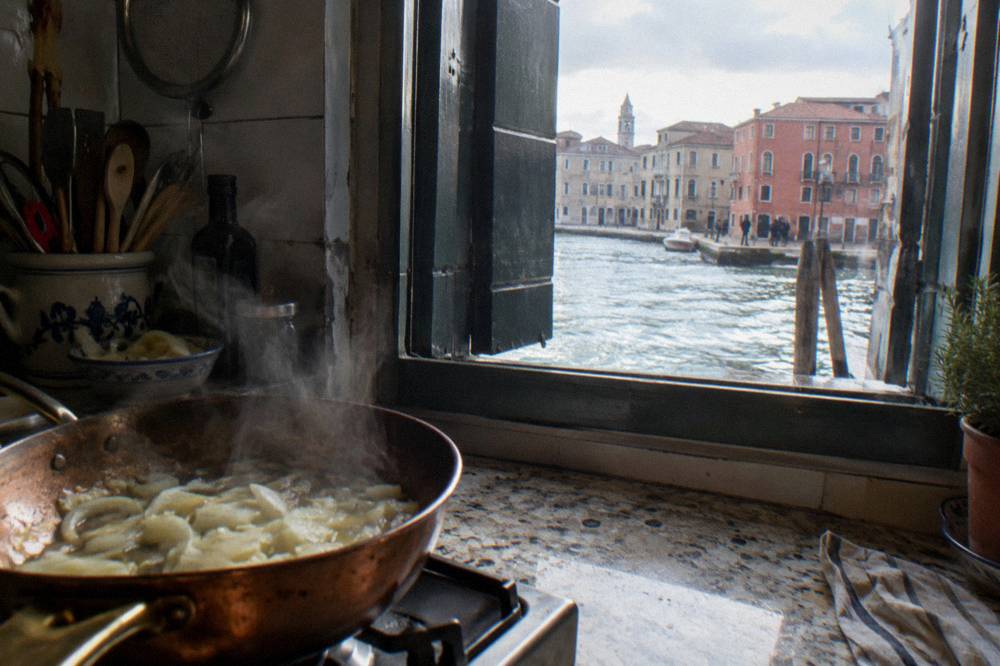
Where Do You Find Sarde In Saor In Venice?
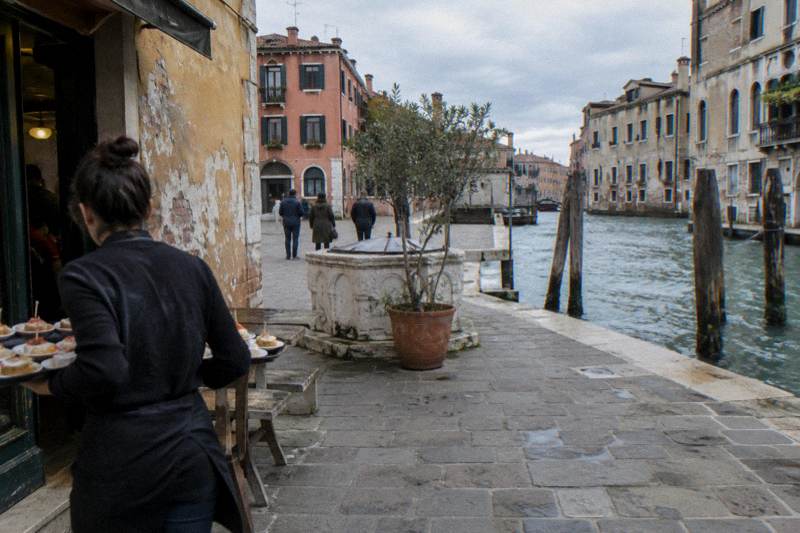
You find sarde in saor in three places: on bacaro counters as a cicchetto, on restaurant antipasti plates, and at the Rialto market area's eating spots, since the fish market and the bacari grew up together. It is most common as a standing plate, one or two marinated sardines on bread, ordered alongside an ombra.
The bacaro is the dish's natural home. A tray of saor sits well on a marble counter, needs no reheating, and portions cleanly with a fork, so most traditional bars keep it in rotation. Around the Rialto, the connection is literal: the Pescheria supplies the sardines and the surrounding bars cook them, a relationship that goes back as long as the market has existed. The Rialto market's official hours list the fish market as Tuesday to Saturday, 7:00 to 14:00, closed Sunday and Monday, and the produce market Monday to Saturday, 7:00 to 20:00, so a morning visit lines up with both the fish and the bars serving the dish.
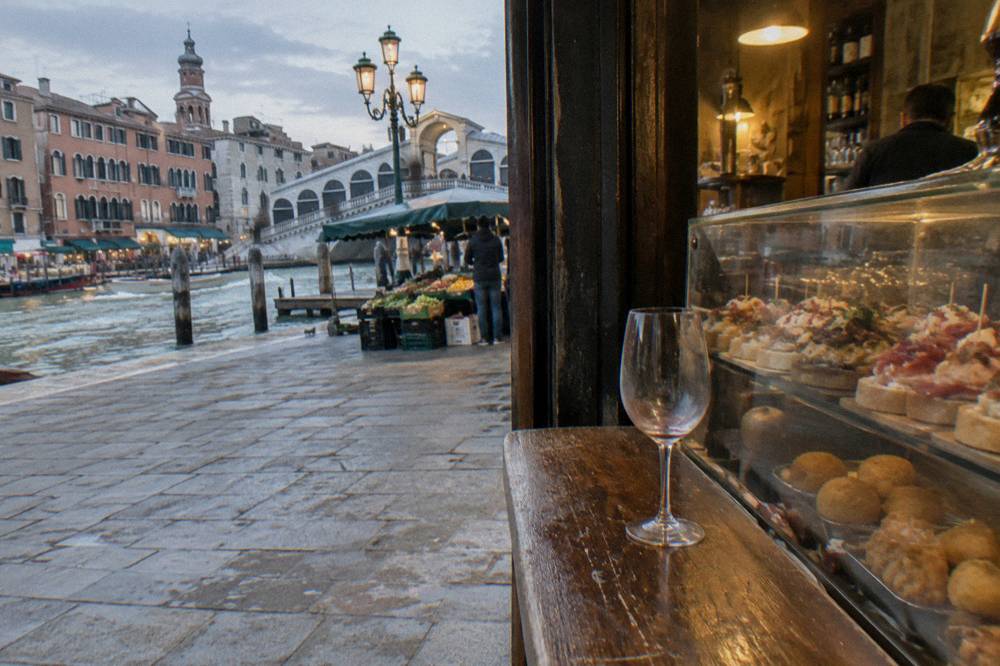
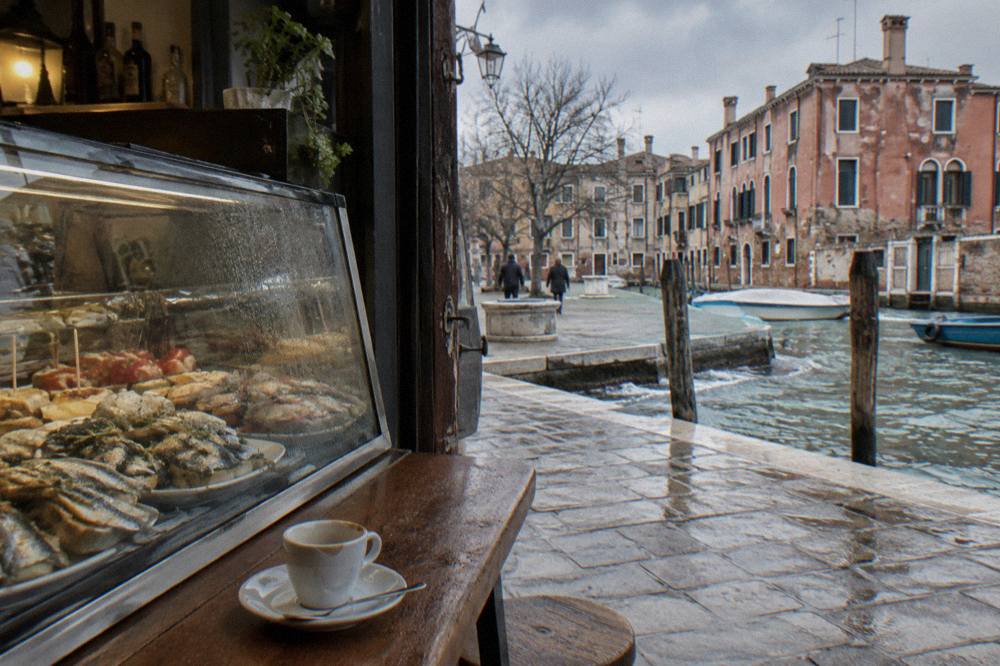
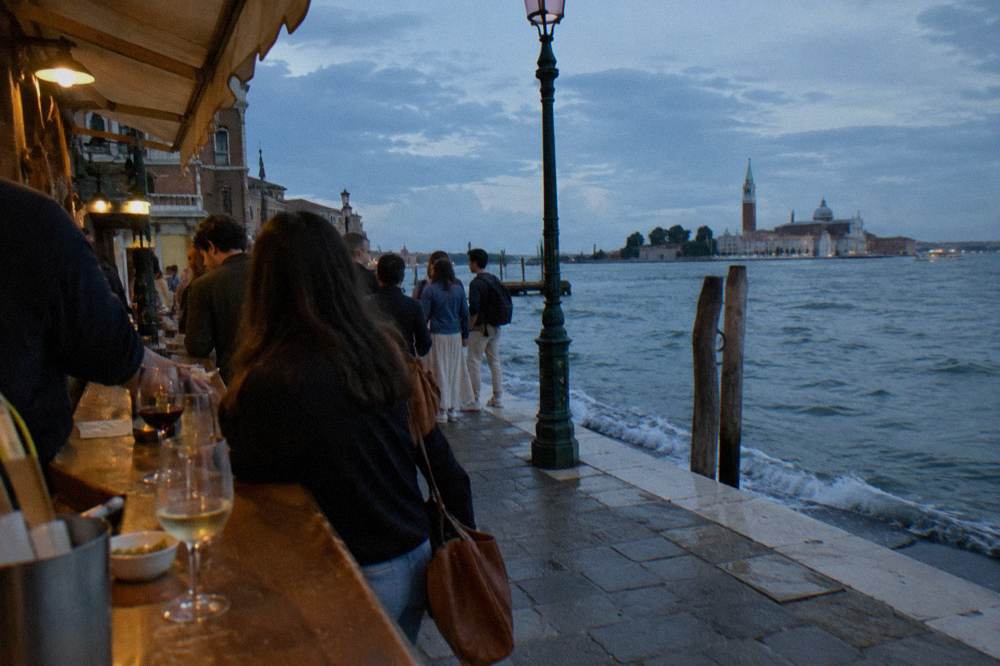
Neighborhood-wise, the classic ground is San Polo around Rialto, Cannaregio's Strada Nova side streets, and Dorsoduro near the Zattere, but the honest answer is that any bacaro with a serious cicchetti counter is a candidate, and the way to know is to look at the tray rather than the sign. A glossy, onion-heavy saor under glass is a good sign; a dried-out one under heat lamps is not, and no visitor should feel obliged to order from it. Restaurant versions, where you do sit down, tend to be larger, plated, and served as a starter, sometimes with creamed baccalà alongside for contrast.
For a broader map of where to stand and eat, the guide to the best cicchetti bars covers the counter landscape, and eating by neighborhood breaks down which sestiere suits which kind of crawl. If you would rather have a guide walk you into the right bars on the first evening, the small-group Eat Like a Local tasting walk runs three hours through exactly this kind of territory; the listing's inclusions page states what is tasted and poured.
How Does Sarde In Saor Appear On Food Tours?
On guided food walks, sarde in saor appears as one cicchetto among several: a stop at a bacaro, a plate of the marinated sardines with bread, and the guide's explanation of the preserving history. The featured tasting walks run 2.5 to 3.5 hours with a series of stops, tastings and drinks; whether a specific dish is served on a given departure depends on the bars visited that day.
This is the honest framing for any dish-focused booking. Tours move through working bars, counters change daily, and the guide adapts. What a good tasting walk reliably delivers is the context: you stand at the marble, the guide names what is on the tray, and you learn to read a bacaro counter yourself, which outlasts any single plate. Several of the walks compared here stop at traditional bacari where saor is a staple of the counter, and their listings describe the tasting counts and what each includes. Only a listing's stated inclusions count as promises. The wider set of guides lives on Venice Food Tours.
The three walks in the band above cover three formats, and the differences matter more than the prices:
| Walk | Length | Format | Best For |
|---|---|---|---|
| Eat Like a Local small-group tasting tour | 3 hours | Small-group tasting walk | A first evening, learning to read counters |
| Venice Street Food Tour with a Local Guide | 2.5 hours | Street food plus sightseeing | One-visit travelers who want food and sights |
| Venice Bacaro Food Tour: Eat and Drink like a Venetian | 3 hours 30 minutes | Bacaro crawl, eating and drinking | Making the walk the evening's meal |
Which one fits depends on your pace. A shorter walk suits a first evening; the 3.5-hour option doubles as dinner. Pricing and current availability sit on each operator's live listing, since per-person from-prices shift with date and group size.
Between those two poles, the street food format deserves a note. It pairs counter classics like saor with sightseeing, which suits travelers who want the food and the city explained in one move.
And if your interest in the fish runs deeper, a market-anchored walk connects the Pescheria stalls to the plate, though note the fish market's Tuesday to Saturday schedule from the section above.
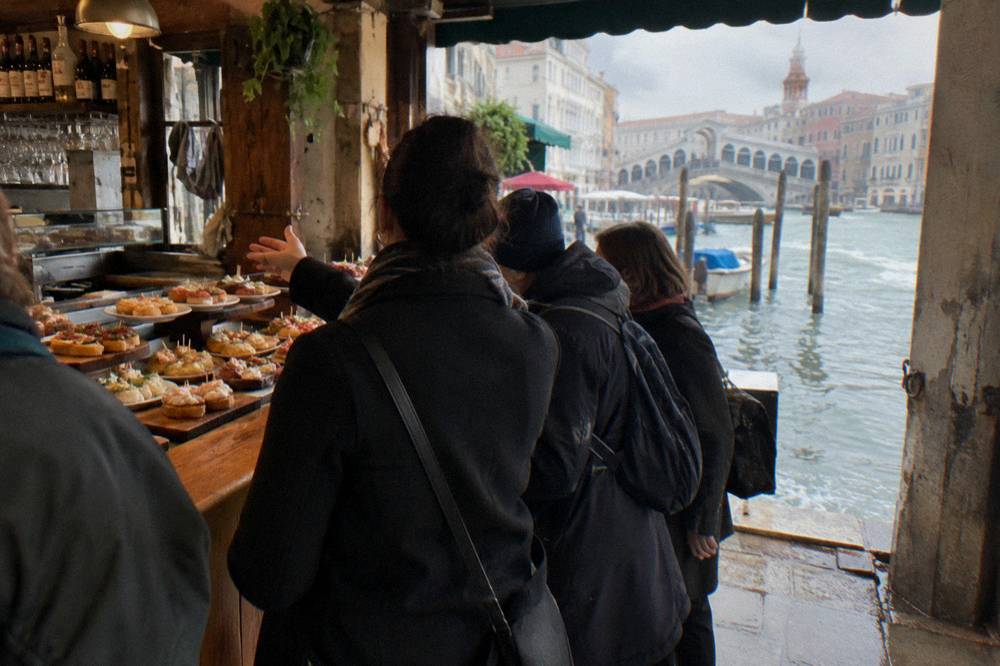
How Does It Compare With Other Venetian Dishes?
Sarde in saor is the sweet and sour anchor of the Venetian counter, and its closest companion is baccalà mantecato, whipped salt cod on polenta, which is rich where saor is sharp. Both are preserved-fish dishes born from the same practical world, and bacari usually serve them side by side on the same tray line.
Beyond that pair, the counter's staples, bigoli in salsa, fegato alla veneziana, risi e bisi and spaghetti al nero di seppia, each carry their own season and story, and knowing which is which turns a confusing glass case into a readable menu. The comparison worth making is not a ranking but a lineage. Baccalà began as salted stockfish from the north, saor as fresh sardines preserved in acid; both solved the same problem of distance and time. Bigoli in salsa, whole-wheat pasta with onion and salted anchovy sauce, repeats the onion-and-cured-fish logic in pasta form. Fegato alla veneziana, calf's liver with onions, borrows the slow onion base without the fish. The city's cooking is a small set of techniques applied with discipline, and saor is the clearest single expression of them.
| Dish | Base Ingredients | Where It Sits | Character |
|---|---|---|---|
| Sarde in saor | Fried sardines, vinegar onions, raisins, pine nuts | Cicchetto, antipasto | Sweet, sharp, room temperature |
| Baccalà mantecato | Salt cod, olive oil, milk or water, polenta | Cicchetto, antipasto | Rich, whipped, mild |
| Bigoli in salsa | Whole-wheat bigoli, onions, salted anchovies | Pasta course | Savory, umami-heavy |
| Fegato alla veneziana | Calf's liver, white onions | Secondo | Sweet onions, iron-rich meat |
| Risi e bisi | Rice, peas, pancetta | Spring primo | Soupy, green, seasonal |
| Spaghetti al nero di seppia | Pasta, cuttlefish ink | Secondo | Briny, black, lagoon-driven |
Two of these deserve their own reading. The baccalà and polenta guide covers saor's counter-twin in depth, and what to eat in Venice maps the full dish list for a first visit. For the sweet ending after a saor-heavy crawl, the Venetian sweets guide picks up where the fish leaves off.
What Does A Saor Stop Cost, And How Do You Order It?
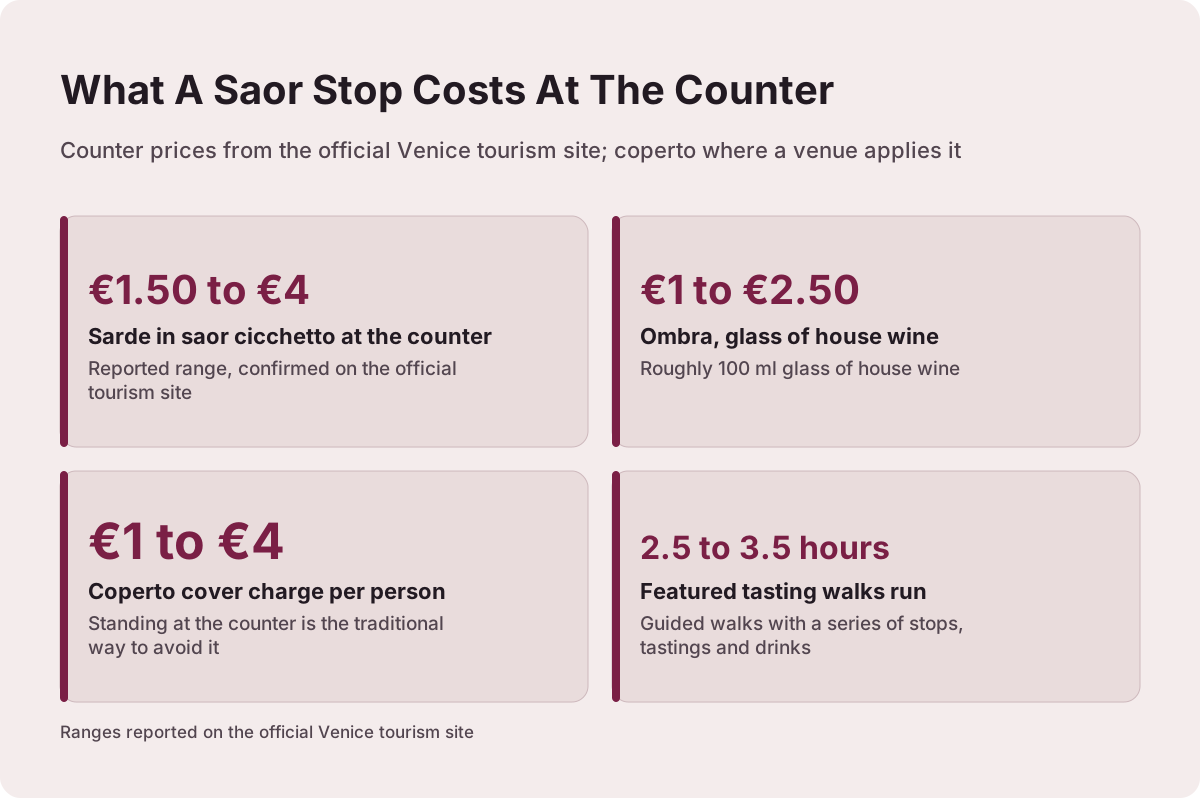
Standalone, a cicchetto with sarde in saor typically runs around €1.50 to €4 at the counter, reported figures confirmed on the official Venice tourism site, with an ombra of house wine at around €1 to €2.50. On a guided walk the cost is bundled into the tour price, shown per person on the operator's live listing. Ordering takes two words: point at the tray and ask for an ombra.
The economics are part of the dish's appeal. A saor cicchetto and an ombra together cost less than a coffee in most of northern Europe, which is why the bacaro crawl exists as an institution rather than an occasion. A coperto, the bread and cover charge, typically runs €1 to €4 per person where a venue applies it, and standing at the counter is the traditional way to avoid it; tipping is optional and rarely expected when standing, though rounding up is appreciated.
Ordering needs two words at most: "sarde" and "ombra", or point at the glass case and hold up fingers. Bars in the tourist core post prices and most counter staff handle pointing gracefully at any hour. The ritual matters more than the vocabulary: you take your plate and glass, stand at the counter or a wall shelf, eat, and move on. A slow crawl of three or four bars is normal and lets you compare saor against saor, which is the fastest education in Venetian cooking available.
When Is The Best Time To Eat It?
Sarde in saor is a year-round dish on bacaro counters, with no closed season to plan around and no month when it disappears. It sits most logically in spring, when the lagoon's sardine supply is strong and a room-temperature plate suits warm weather, and in autumn, when cooler evenings favor the same. The honest answer is to eat it whenever you are standing at a counter that makes it well.
The preserving origin means seasonality applies less to the finished dish than to its ingredients, and modern supply has flattened even that. What does shift is the rest of the counter around it: spring brings artichokes from Sant'Erasmo and the first peas that go into risi e bisi, autumn brings the seafood the lagoon is famous for. If you are planning the whole trip around food, the season-by-season guide and the best time to visit for food and crowds cover the calendar in detail.
One planning note that affects any Venice visit: the 2026 day-visitor access fee trial ended and, per the official access fee page, no fee applies from 27 July 2026 and no payment or exemption is needed to visit. The fee returns in 2027 on listed dates between late March and mid-August, with amounts not yet published as of the official page's latest update, so check that page if your trip falls in 2027.
Practical timing for a saor-focused crawl: bacari open from late morning and the counter is fullest from early evening, when Venetians take their ombra after work. The Rialto bars are liveliest mid-morning on market days, using the section's Tuesday to Saturday fish market hours. Either window works; mid-afternoon is the quietest and the least atmospheric.
Which Food Walk Pairs Best With The Dish?
Readers curious about sarde in saor fit a tasting walk best: the featured small-group walk runs three hours with a series of tastings and drinks through bacaro territory, the street food walk adds sightseeing, and the longer Venetian-style experience doubles as an evening out. Deciding factors are pace and appetite: the short walk for a first evening, the street food walk for an overview, the long bacaro experience when the walk is dinner.
Whatever you book, the dish itself is best treated as a gateway rather than a goal. Sarde in saor opens a door into the preserving logic that shapes half the Venetian counter, from baccalà to bigoli in salsa, and a guided evening moves you through that logic faster than a week of solo guessing. Stand, taste, ask what the onions are doing, and order the second ombra. All three walks are described on their operator listings with current prices and inclusions.
Common Questions About Sarde In Saor
What Is Sarde In Saor?
Fried sardines marinated in sweet and sour onions with vinegar, raisins and pine nuts, served cold or at room temperature. It began as a preserving method for Venetian fishermen and is now a standard cicchetto on bacaro counters.
What Does Sarde In Saor Taste Like?
Sweet, sharply acidic and soft: the onions turn jammy, the vinegar softens the fried fish, and the raisins carry sweetness through each bite. It is not a hot or crispy dish, and the texture is closer to a marinated salad than fried fish.
Is Sarde In Saor Served On Food Tours In Venice?
It commonly appears on tasting walks that stop at traditional bacari, but whether it is served on any given departure depends on the bars visited that day. Check a tour's stated inclusions on the operator's listing before booking if a specific dish matters to you.
How Much Does Sarde In Saor Cost In Venice?
Reported figures put a piece of cicchetti, including marinated sardines, at around €1.50 to €4 at the counter, with an ombra of house wine at around €1 to €2.50, per official Venice tourism sources. Posted prices at each bar apply, so check the board.
Can Vegetarians Eat Sarde In Saor?
No, it is a fish dish. Vegetarians can usually find cheese, vegetable or polenta-based cicchetti on the same counters; the vegetarian and vegan guide on this site covers what to look for and what to ask.
When Was Sarde In Saor Invented?
It traces to the medieval and Renaissance period, when lagoon fishermen, especially from Chioggia, fried sardines and preserved them in vinegar and onion for voyages. The exact origin date is not documented, but the technique predates refrigeration by centuries.