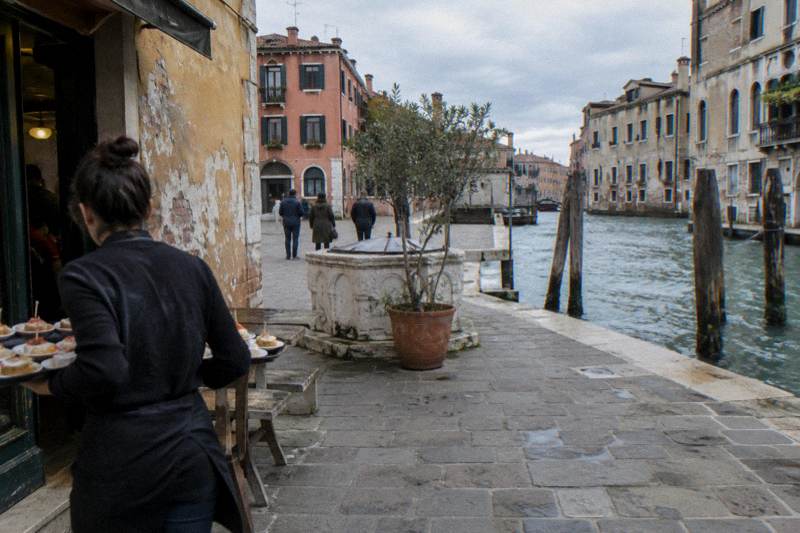
Cicchetti Tour In Venice: How A Bacaro Crawl Works
A cicchetti tour is a guided walk between Venice's standing wine bars, tasting small snacks and an ombra of wine at each stop. Here is how the crawl actually works, stop by stop, and what a guide changes.
Short answer
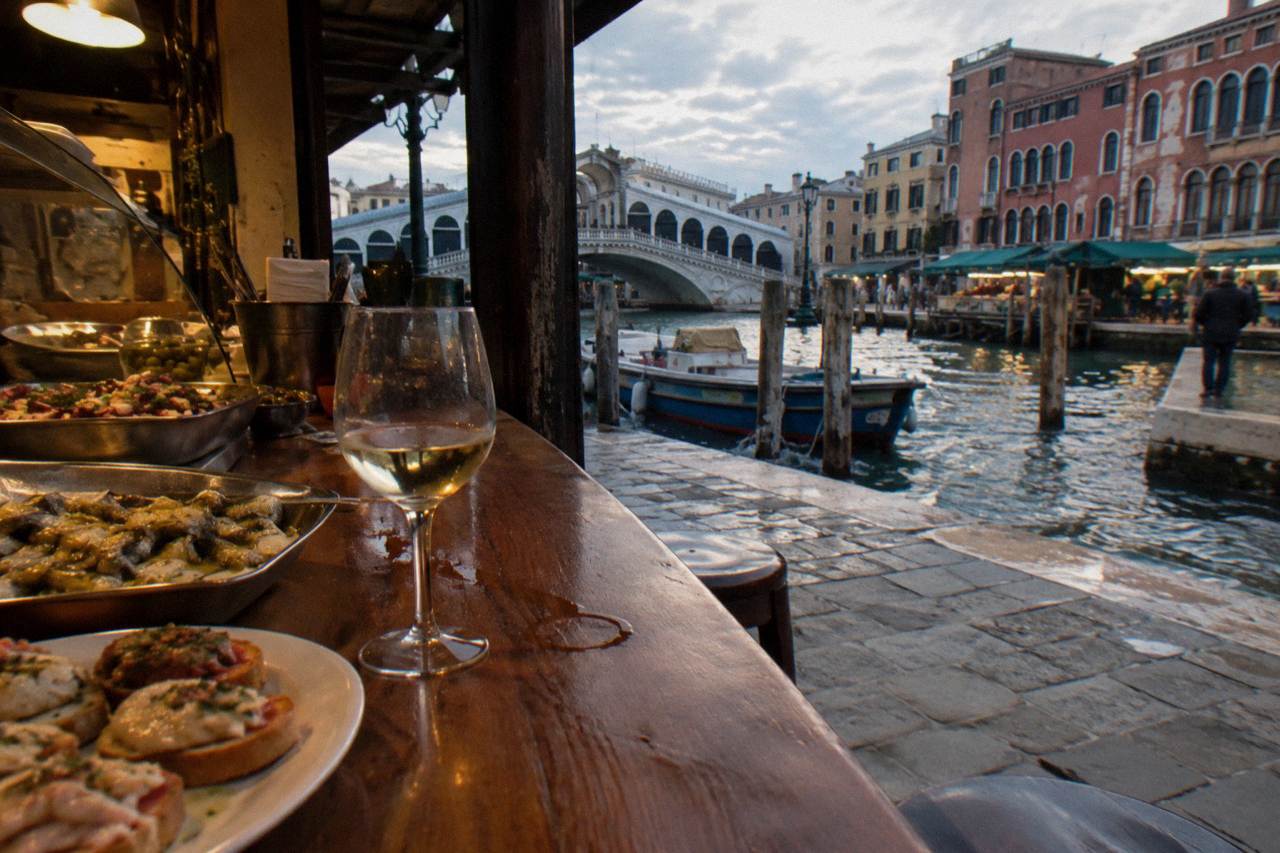
A cicchetti tour in Venice is a guided walk between two and four bacari, the small standing wine bars where Venetians eat cicchetti, snack-sized bites costing about EUR 1.50 to 4 each at the counter, with a small glass of house wine, an ombra, at about EUR 1 to 2.50. Guided versions run 2 to 4 hours and build the tastings into the price.
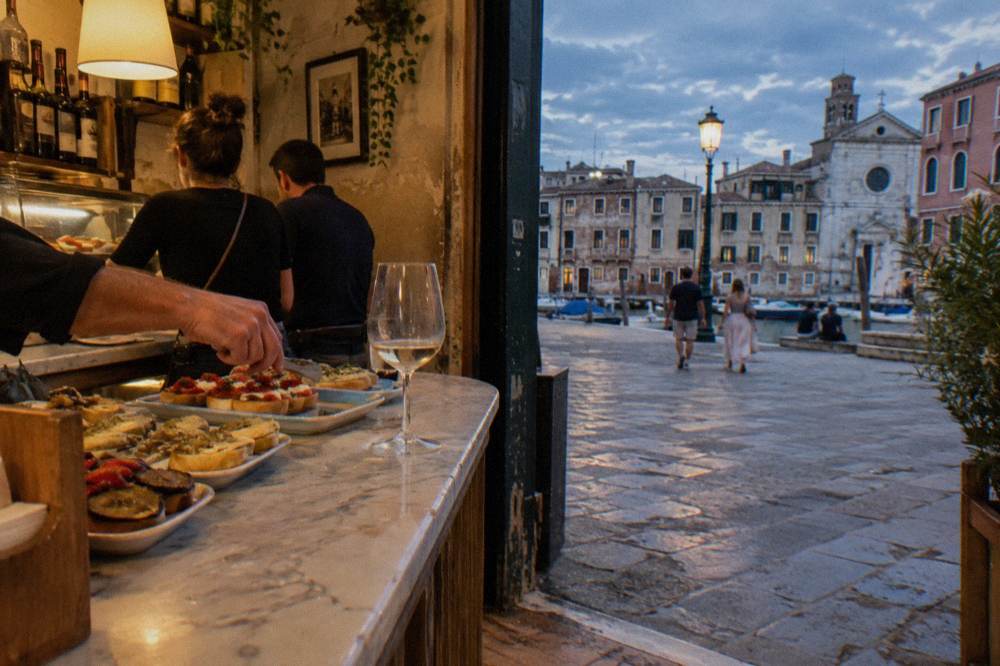
Venice eats standing up. The proof is the bacaro, a small bare-wood wine bar where locals shoulder up to the counter mid-afternoon or early evening, point at cicchetti, the bite-sized snacks laid out on trays, and wash them down with an ombra, a small glass of house wine that costs about EUR 1 to 2.50 at the counter as reported by the official Venice tourism site. A cicchetti tour takes that daily habit and turns it into a guided route: a local guide leads a small group from bar to bar, orders for the table, explains what each dish is, and keeps the pace moving through a couple of neighborhoods.
This guide explains the mechanics. How many bars a crawl actually visits, what happens at each stop, how fast the group moves, what the drinks and snacks cost if you did it alone, and where a guided walk genuinely earns its price versus simply wandering the bacari by yourself. Where a detail depends on the specific tour, the operator's booking page is the source: tasting counts, exact routes and inclusions vary by listing.
What Is A Cicchetti Tour In Venice?
A cicchetti tour is a guided tasting walk through two to four Venice bacari, in which a guide leads a small group from bar to bar, orders a set of snack-sized cicchetti and small wines at each counter, and explains the dishes, the wine and the neighborhoods along the way. Guided versions on this site run from 2 hours to 4 hours, and most tastings and drinks are built into the ticket price.
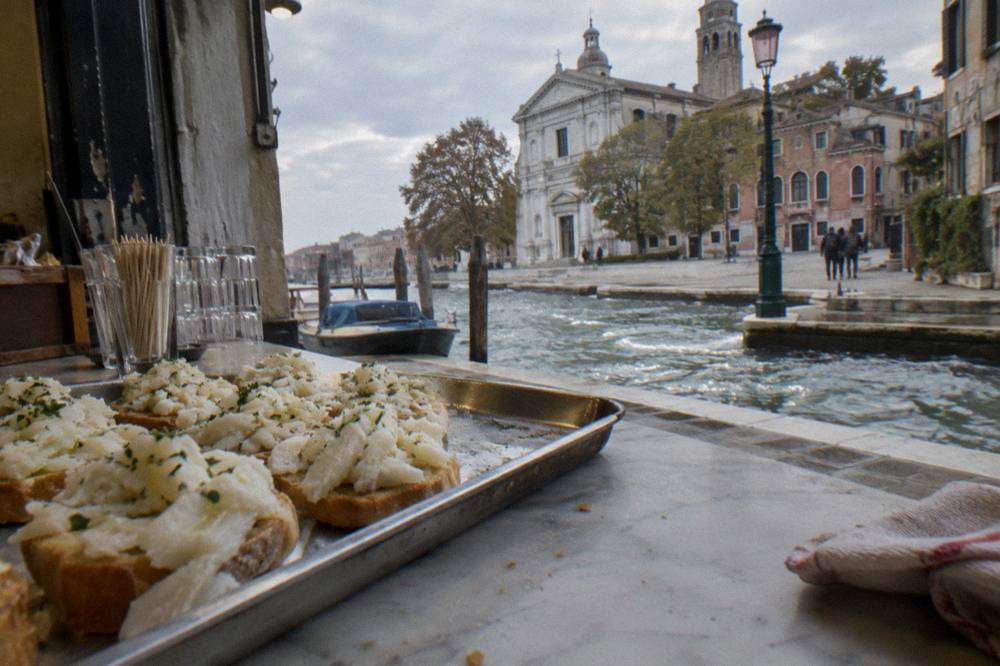
The word cicchetti (singular: cicchetto) covers the whole family of small bites: sarde in saor, sweet-and-sour sardines with onion and pine nuts; baccalà mantecato, whipped salt cod on polenta or bread; polpette, fried meatballs; and crostini, topped toasts. None of it is restaurant food. It is counter food, designed to be eaten in two or three bites while standing, and it is how Venice has snacked for centuries.
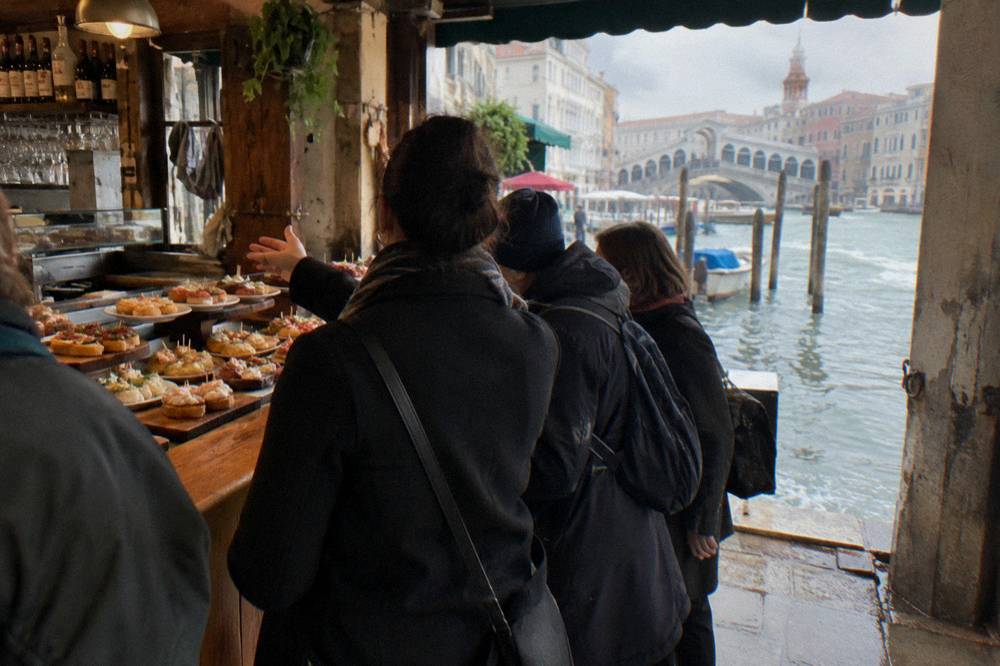
The tour format follows that habit rather than fighting it. A group meets a guide at a set point, walks to a first bacaro, eats and drinks standing or perched on stools, then moves on. The stops are usually close together, strung along a route through one or two sestieri, so the walking between bars is minutes, not half-hours. Because Venice caps guided groups at 25 people in the historic centre and bans loudspeakers, as reported, guides keep groups small and talk face to face or use headsets.
Not every crawl is identical. Some listings build in a sit-down course or a spritz stop; some stay inside one neighborhood; a few add a gondola leg or a market visit. The tasting counts are the clearest differentiator: listings on this site describe anywhere from a handful of tastings up to 10 cicchetti with 6 wines on the longest version. Check the booking page for the exact count, because the count is what you are largely paying for.
How A Bacaro Crawl Works, Stop By Stop
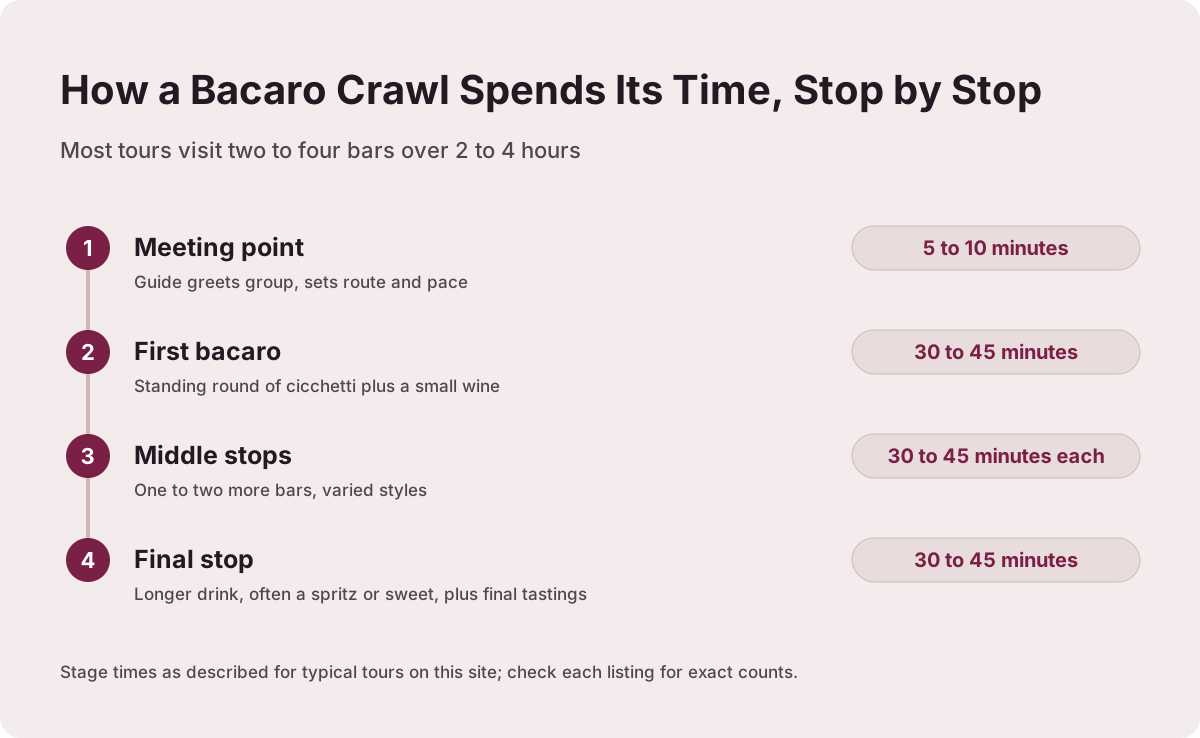
A crawl runs on a simple loop: meet the guide, walk to the first bacaro, eat a round of cicchetti with a small drink standing at the counter, hear what the dishes are, then repeat at the next bar. Most tours visit two to four bars over 2 to 4 hours, with 10 to 20 minutes of easy walking between stops and a drink at each counter included in the ticket.
The first stop sets the pattern. The guide orders for the group, which matters more than it sounds: at a busy counter, a non-Italian speaker pointing at trays slows everything down, while a known local gets the fresher tray from behind the bar. The round lands, the guide names each bite, and the group eats. There is rarely a table. Standing is the tradition, and it is also practical, since a group of standing eaters turns over far faster than a seated one.
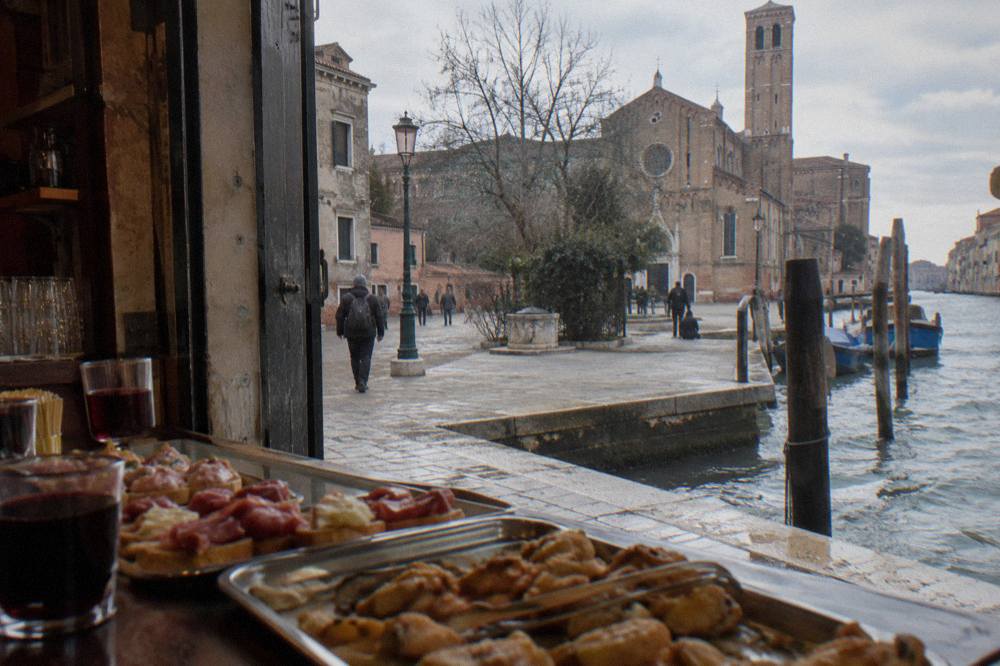
The middle stops vary the theme. One bar may be an old-school all-ombra spot with barrels and no seats; the next a younger cicchetteria with a wider by-the-glass list. Guides usually weave the neighborhood into the walk: the route through Cannaregio passes different calli than one anchored near the Rialto market, and the market-anchored walks lean on whatever the Pescheria landed that morning. The fish market at Rialto runs Tuesday to Saturday, 7:00 to 14:00, closed Sunday and Monday, per the official Venezia Unica listing, so a market-plus-cicchetti combo depends heavily on the day of the week.
The final stop is often the longest and the most sit-down of the lot. Many listings end with a proper drink, a spritz or a glass of Veneto wine, sometimes with a sweet, giving the group a chance to settle and ask questions before the guide points everyone toward dinner or the vaporetto. The listing for each walk states exactly what the finale includes.
| Crawl stage | What happens | Typical time | What is included |
|---|---|---|---|
| Meeting point | Guide greets group, sets route and pace | 5 to 10 minutes | Guide only |
| First bacaro | Standing round of cicchetti plus a small wine | 30 to 45 minutes | Tastings and a drink, per listing |
| Middle stops | One to two more bars, varied styles | 30 to 45 minutes each | Tastings and drinks, per listing |
| Final stop | Longer drink, often a spritz or sweet | 30 to 45 minutes | Drink and final tastings, per listing |
If that structure appeals but you would rather not build it yourself, these three walks cover the format well: a small-group 3-hour standard, a longer Venetian-style crawl, and a high-count tasting version.
The small-group Eat Like a Local walk runs 3 hours and suits a first-timer who wants the format explained. Eat Drink Repeat packs 10 tastings and 6 wines into 2.5 to 3 hours, the highest count on this site, for visitors who want a full progressive meal. The Venice Bacaro Food Tour stretches to 3 hours 30 minutes, the more leisurely pace of the three. Prices are on each listing and vary by date.
What A Guide Adds Over Wandering Alone
A guide adds three things a solo crawl cannot easily replicate: ordering power at busy counters where English is thin, a curated route of bars chosen for the kitchen rather than the foot traffic, and context on every dish and glass. The trade-off is cost, since the same food eaten independently runs about EUR 1.50 to 4 per cicchetto and EUR 1 to 2.50 per ombra at the counter, versus one ticket price for the guided version.
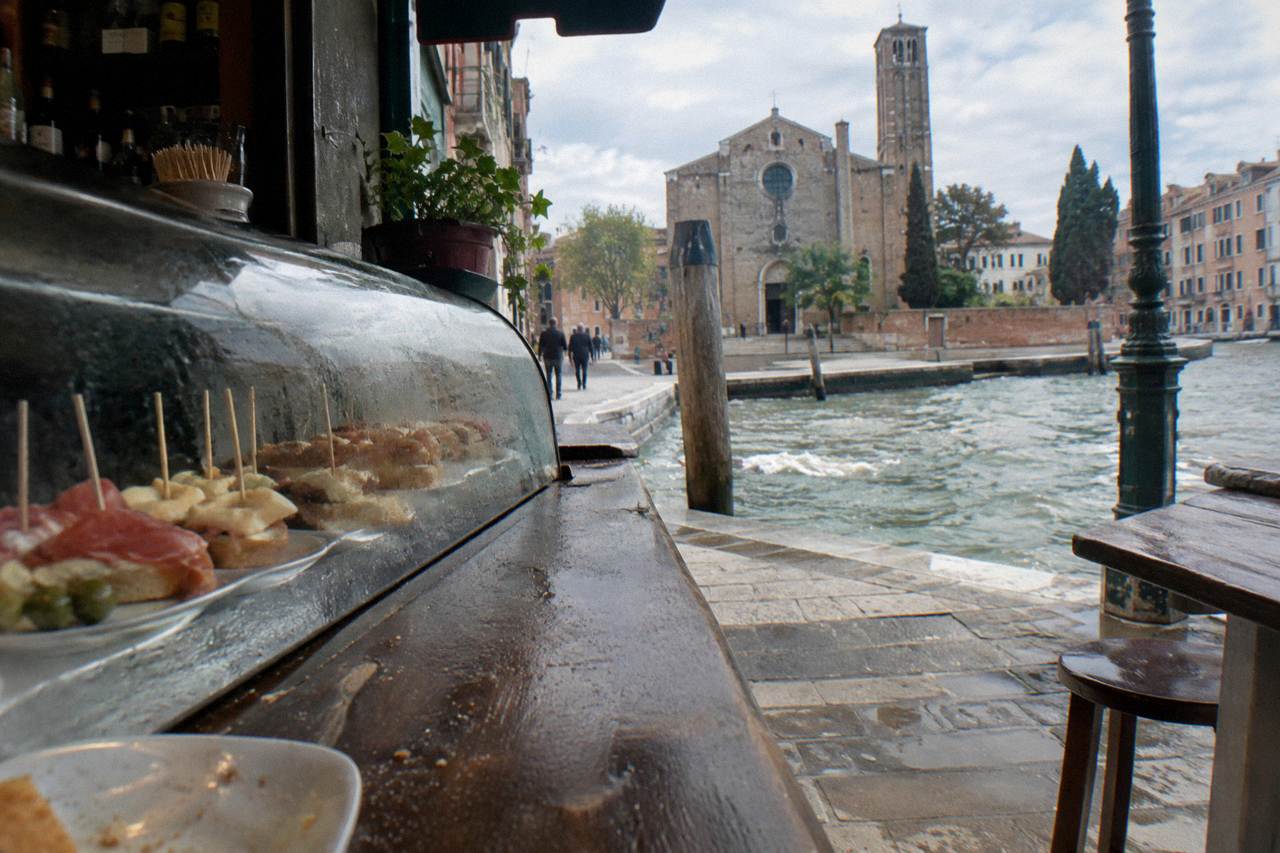
The ordering point is underrated. Bacari are working bars with small staffs, and the counter is a fast, transactional space. A guide who is known to the bar changes the experience: the round arrives quickly, the trays are the fresh ones, and unusual dishes appear that a stranger would never be offered. A review on the featured walk's live listing calls the guide's local knowledge the difference between eating snacks and understanding them, and that is the honest summary of the value.
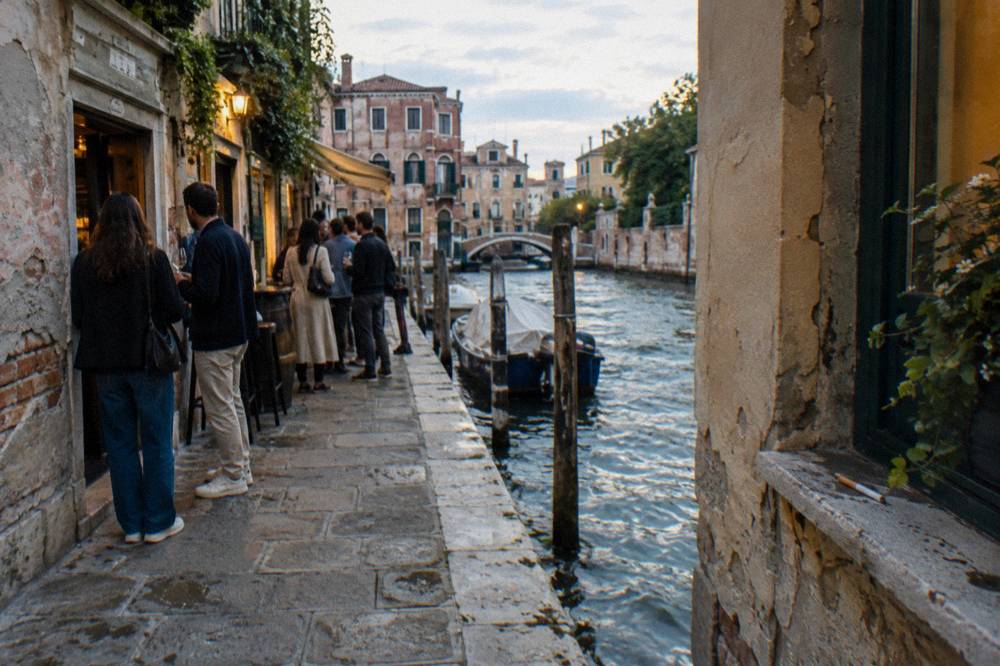
The curation point matters in a city where the worst food sits nearest the biggest sights. Deciding which bacaro near a major campo is real and which is a tourist trap is genuinely hard without local knowledge, and a wrong pick costs both money and an evening. A guided route removes that risk entirely. The independent counter-argument is real too: a confident traveler with a shortlist of bars, a little Italian and small denominations of cash can build a fine crawl alone, and the standing tradition makes solo eating completely normal.
Where the guided version wins decisively is depth. A guide explains why baccalà mantecato takes a wooden paddle and patience, why the ombra is named for the shadow of the old Rialto wine sellers, and how the spritz fits the aperitivo hour. For background on the dishes themselves, the site's guide to what to eat in Venice covers the classics in detail, and how to order cicchetti explains the counter ritual if you do go alone.
Want The Crawl Planned For You?
A guided cicchetti walk picks the bars, counts the tastings and orders the wine for you. The featured small-group walk runs about 3 hours, and its listing shows the current price with free-cancellation terms.
The featured walk itself, Eat Like a Local: Venice 3-Hour Small-Group Food Tasting Tour, is the natural first pick in this family: the small-group cap keeps the counters manageable, and the 3-hour length leaves the evening free. It is one of the options compared in the site's broader rundown of which Venice food walk to book.
For a contrasting format, the sunset version below runs the same crawl logic but times it into the aperitivo hour, when the bacari are at their liveliest.
How Many Bars, How Long, And At What Pace?
Most cicchetti crawls visit two to four bars over 2 to 4 hours, which works out to roughly 45 minutes per stop including the walk between. The pace is gentle: Venice distances are short, the walking is flat, and the longest gap between bars on a typical route is 10 to 15 minutes. Duration, not distance, is the real variable, since longer tours add stops rather than kilometers.
The shortest format on this site is the 2-hour pure crawl, which fits a tight schedule or a first evening. The standard is 2.5 to 3.5 hours, long enough for three stops and a proper final drink. The market-combined versions reach 4 hours because they add a Rialto walking leg before the bacari. Within a family, more hours almost always means more stops or a longer finale, not a faster march: these are eating walks, not covering-the-city walks.
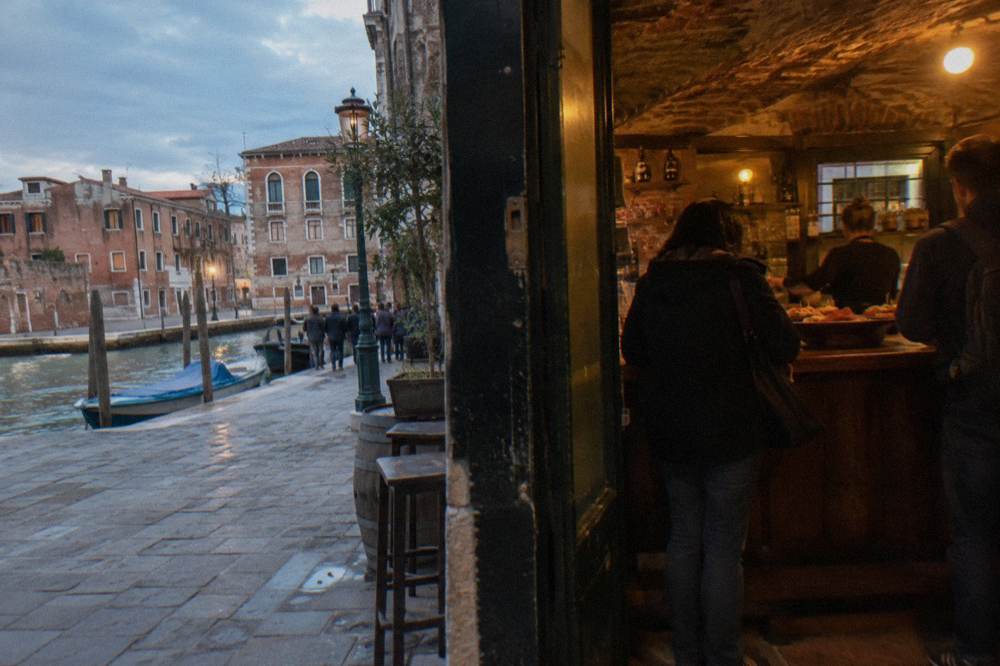
Pace also depends on group size. City rules cap guided groups at 25 in the historic centre, as reported, and the cicchetti walks here run well under that, but a fuller group moves slower through narrow calli and takes longer to serve at each counter. If pace matters, the listings that describe themselves as small-group or semi-private are the ones to filter for. The exact maximum for any given walk is on its booking page.
| Tour format | Duration | Typical stop count | Best fit |
|---|---|---|---|
| Express crawl | 2 hours | 2 to 3 bars | Tight schedule, first evening |
| Standard small-group walk | 3 hours | 3 to 4 bars | First-time visitors |
| Extended Venetian crawl | 3 hours 30 minutes | 4 or more bars | Slow eaters, long evening |
| Market plus crawl | 4 hours | Market plus bars | Food-first travelers |
The tasting math follows from the stop count. A 10-tasting walk spread over three bars is roughly three bites and two drinks per stop, a light progressive dinner. A 6-tasting walk is a substantial snack, not a meal. Planning around appetite honestly is the single best way to avoid disappointment, and the site's breakdown of what a Venice food walk costs and includes does that arithmetic tour by tour.
For a compact alternative in the same family, the unblended 2-hour crawl below keeps the format tight for a short visit.
What Cicchetti And Ombra Cost On Your Own
On your own, cicchetti cost roughly EUR 1.50 to 4 per piece and an ombra of house wine about EUR 1 to 2.50, according to the official Venice tourism site, meaning a solo crawl of three bites and two wines per bar across three bars lands in the low tens of euros before any coperto. A guided tour instead charges one ticket price, which the listing states up front.
The counter prices deserve their own explanation, because they are the baseline every guided price is measured against. There is no fixed city tariff; each bar posts its own list, and the pieces range from simple crostini at the low end to elaborate fried or fish-topped bites at the high end. Standing at the counter also tends to avoid the coperto, the cover charge of about EUR 1 to 4 per person where applied, which seated service in the same bars may add. Check the posted list at each bar.
Tipping follows the standing tradition: it is optional and not expected when eating cicchetti at the counter, with rounding up or a small extra reserved for exceptional service, as reported. The site's fuller treatment of tipping, coperto and restaurant etiquette covers the seated-restaurant side, which behaves differently.
| Item at the counter | Reported price | Notes |
|---|---|---|
| Cicchetto, simple | EUR 1.50 to 2.50 | Crostini, polpette, basic bites |
| Cicchetto, elaborate | EUR 3 to 4 | Fish-topped, fried, larger pieces |
| Ombra (small house wine) | EUR 1 to 2.50 | About 100 ml, often EUR 1.50 to 2 in local spots |
| Coperto | EUR 1 to 4 where applied | Disclosed on menus; often avoided standing |
One rule to know before any crawl, guided or not: Venice prohibits drinking from glass containers outside permitted outdoor seating areas and bans takeaway alcohol sales in glass, as reported from the municipal regulation. Drink your ombra at the counter, where it belongs. The regulation is on the Comune di Venezia site; check current rules before you travel.
Meeting Points, Dietary Needs, And Group Rules
Cicchetti tours meet at a fixed central point stated on each booking page, usually a campo or landmark near the first bar, and run in groups capped by city rules at 25 in the historic centre, with most food walks deliberately smaller. Dietary accommodations are not guaranteed by any listing unless it says so: vegetarian, vegan and gluten-free needs should be messaged to the operator before booking, since classic cicchetti lean heavily on bread, fried items and fish.
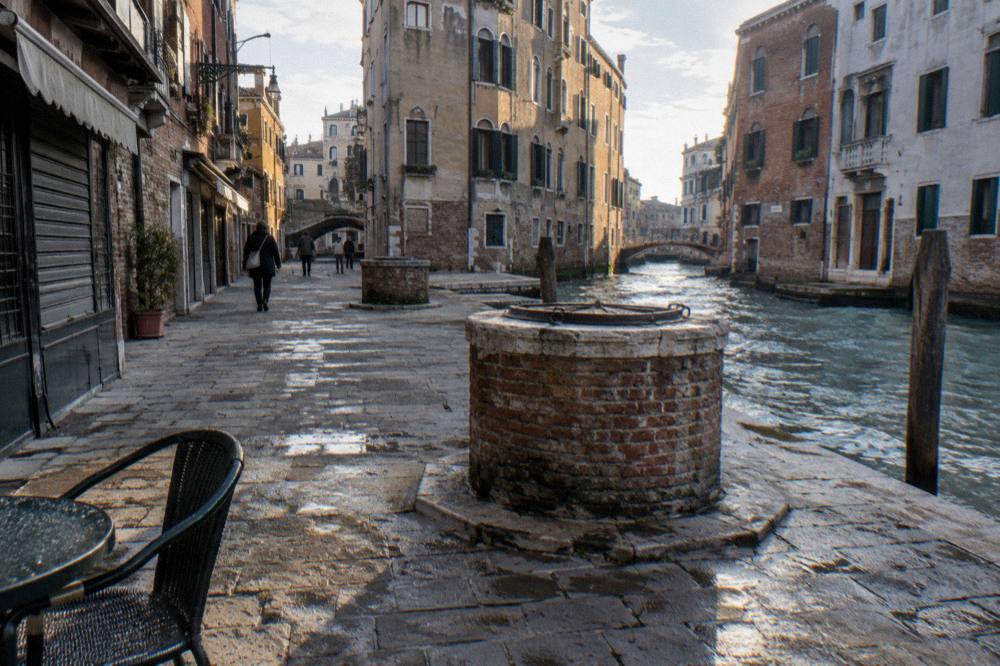
The meeting-point detail is worth checking at booking time rather than on the day. Venice addresses are idiosyncratic, and listings typically name a campo, a bridge or a well-head rather than a street number. Arrive ten minutes early: these walks start on time because the first counter round is often pre-ordered. The site's guide to meeting points and what to bring covers the practicalities, including comfortable shoes and why a small bag beats a backpack in a crowded bacaro.
Dietary needs are the honest weak point of the format. Cicchetti as a category is bread-heavy, and the classic pantheon, sarde in saor, baccalà mantecato, polpette, presumes fish and meat. Some operators adapt on request, but no listing here is described as vegetarian, vegan or gluten-free unless it says so explicitly. The message-before-booking rule is not a formality: a kitchen can often prepare alternatives only if it knows ahead. For a fuller picture, see vegetarian, vegan and gluten-free food in Venice.
Group rules are set by the city, not the operator. Guided groups in the historic centre and the lagoon islands are capped at 25 people and loudspeakers are banned, as reported, so guides speak to their group directly or use headsets. What any specific walk's own maximum is, beyond that city cap, appears on its booking page. Cancellation terms also vary by listing; the featured walks here offer free cancellation, which is worth confirming on the operator's page before you commit.
Getting to the meeting point is usually simple: a single ACTV vaporetto ticket costs EUR 9.50 for 75 minutes as reported on the official operator page, and a 24-hour pass EUR 25, so a crawl plus a morning of riding fits comfortably inside a day pass. Check the ACTV official fare page for current prices. And since the question comes up in every planning thread: the day-visitor access fee does not apply as of 27 July 2026, per the official access-fee page, though it returns in 2027 with arrangements to be announced.
For evening planners, the sit-down version below pairs the crawl format with a proper dinner course at the end.
Whether guided or independent, the crawl rewards the same instinct: eat where the trays turn over fast, drink the house wine, and give the counter your full attention for an hour or two. That is the whole ritual, and it is the reason Venice Food Tours exists as a site. If you are weighing the crawl against a cooking class instead, the comparison in food walk or cooking class settles the usual questions.
Common Questions About Cicchetti Tours In Venice
How Many Bars Does A Cicchetti Tour Visit?
Most guided crawls visit two to four bacari over 2 to 4 hours. Longer tours add stops rather than distance; the exact count for any walk is stated on its booking page.
How Much Do Cicchetti Cost If I Do It Myself?
At the counter, cicchetti run about EUR 1.50 to 4 per piece and an ombra of house wine about EUR 1 to 2.50, as reported by the official Venice tourism site. Each bar posts its own list; there is no fixed city tariff.
Is A Cicchetti Tour Enough Food For Dinner?
It depends on the tasting count. A 10-tasting walk spread over three bars works as a light progressive dinner; a 6-tasting walk is a substantial snack. Check the listing's count before booking around a meal.
Do I Need To Tip On A Cicchetti Tour?
Tipping is optional. At standing bacari counters it is largely unexpected, with rounding up the local gesture for good service; guided tour gratuity follows the same optional logic.
Can Vegetarians Or Gluten-Free Travelers Join A Cicchetti Crawl?
Only if the operator can adapt. Classic cicchetti lean on bread, fried items and fish, and no listing is described as vegetarian, vegan or gluten-free unless it says so. Message the operator before booking.
How Long Is A Typical Cicchetti Tour In Venice?
The format on this site runs from 2 hours for an express crawl to 4 hours for a market-combined version, with 3 hours the standard. The pace is gentle, with short flat walks between bars.