Baccalà Mantecato And Polenta: Venetian Staples
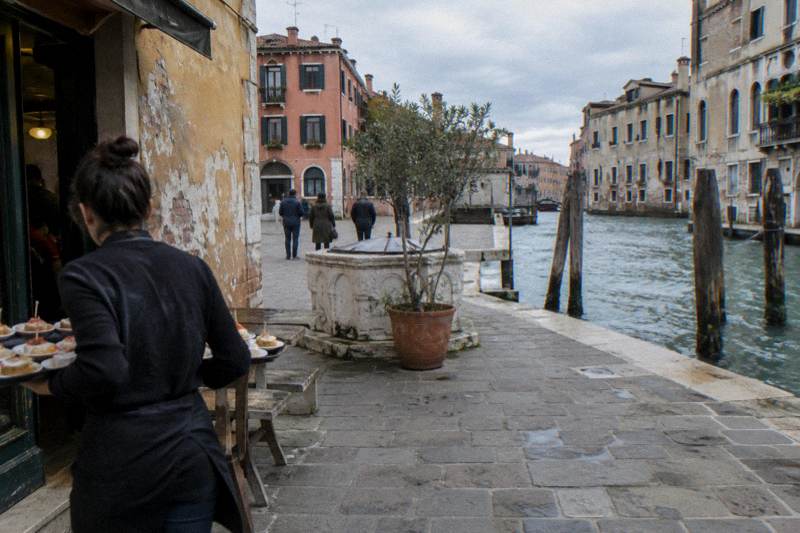
Baccalà mantecato, airily whipped salt cod piled on grilled or fried polenta, is the one dish that follows you through every bacaro in Venice. Here is what it is, where the habit came from, and how to eat it standing at the counter.
Short answer
Baccalà mantecato is whipped salt cod with olive oil, served on polenta or bread, and it anchors the cicchetti counter of nearly every bacaro in Venice. A piece typically runs EUR 1.50 to 4 reported, with a small ombra of wine around EUR 1 to 2.50. A guided tasting walk is the easiest way to taste it across several bars.
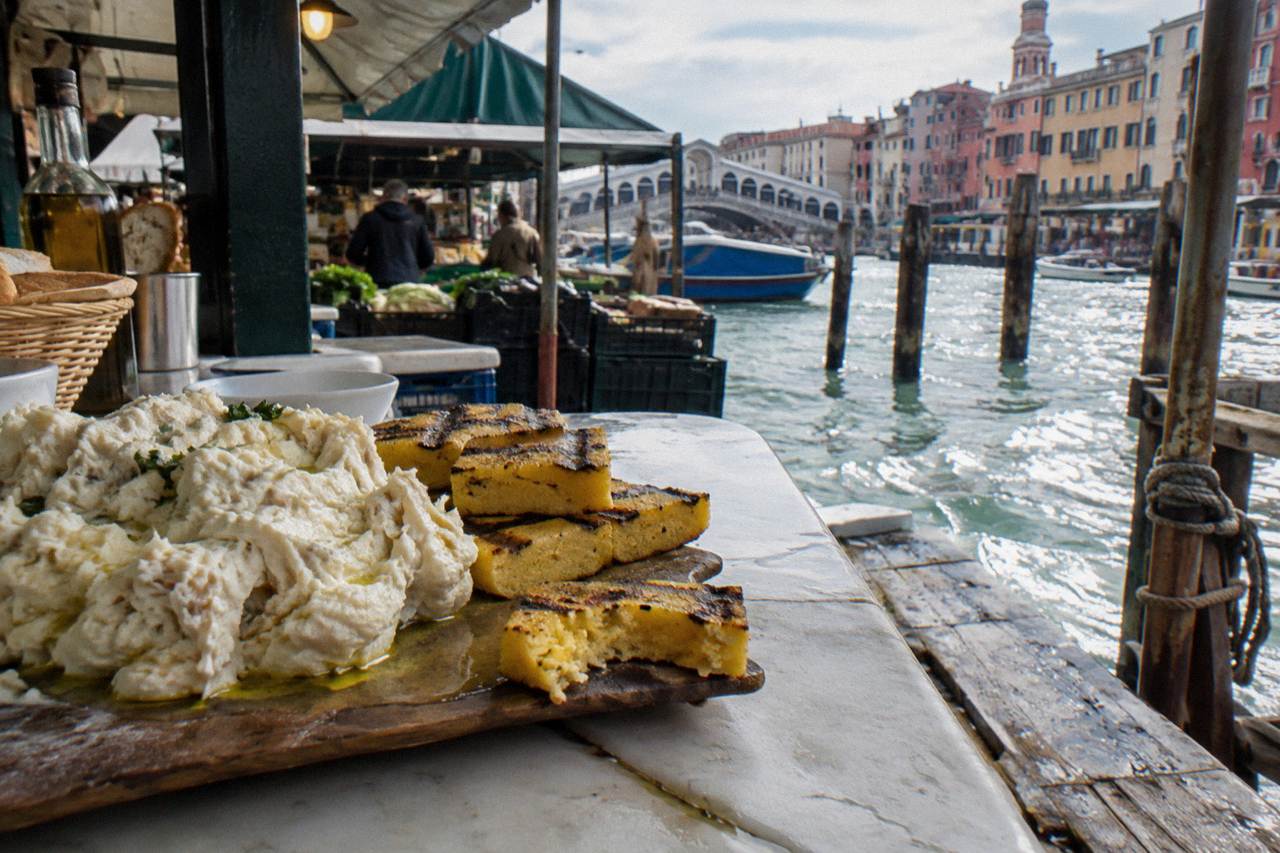
Baccalà mantecato is less a recipe than a habit. Take dried salt cod, soak it for days, poach it, then whip it with olive oil until it turns pale and light as a cloud, and you have the spread that sits in a ceramic bowl on the counters of bacari from Cannaregio to Castello. Underneath it, almost always, comes polenta: firm, cut into squares or ovals, grilled or fried until the edges catch. Together they are the single most reliable thing you can order in Venice, and the dish most likely to appear on a cicchetti crawl more than once in an evening.
This guide explains what baccalà mantecato actually is, why Venice built its snack culture around stockfish and cornmeal, how to order it without hesitation, and how it fits into a food walk. For the broader mechanics of a crawl, the companion piece on how a bacaro crawl works covers pacing, standing etiquette and drink pairings in detail.
What Is Baccalà Mantecato?
Baccalà mantecato is salt cod, rehydrated over one to three days and poached gently, then whipped with olive oil and a little of its cooking liquid until it becomes a smooth, pale cream, served cold or at room temperature on polenta, bread or a bread roll. Despite the name, in Venice "baccalà" usually means stockfish, air-dried cod, rather than salt-packed cod, a confusion centuries old.
The Venetian name is a historical accident. The story told on both sides of the trade credits a shipwrecked Venetian merchant, Pietro Querini, who was rescued in the Lofoten islands of Norway, where he saw cod air-dried on wooden racks in the Arctic wind, and brought the idea and the dried fish back to Venice. Norway still tells the story from its side, and Italy still imports the bulk of its stockfish from those same islands. The fish that arrives is hard as a plank and keeps for months, which is exactly why a trading city built on long sea voyages adopted it.
The transformation is the whole point. Soaking restores the flesh; slow poaching keeps it moist; then the mantecatura, the whipping, is where the name comes from. The word shares a root with the technique used for risotto: you work oil into the fish steadily, the same way butter is worked into rice, until the mixture emulsifies and triples in volume. Done well, the result tastes of the sea and the oil at once, rich but not heavy, with nothing fibrous left.
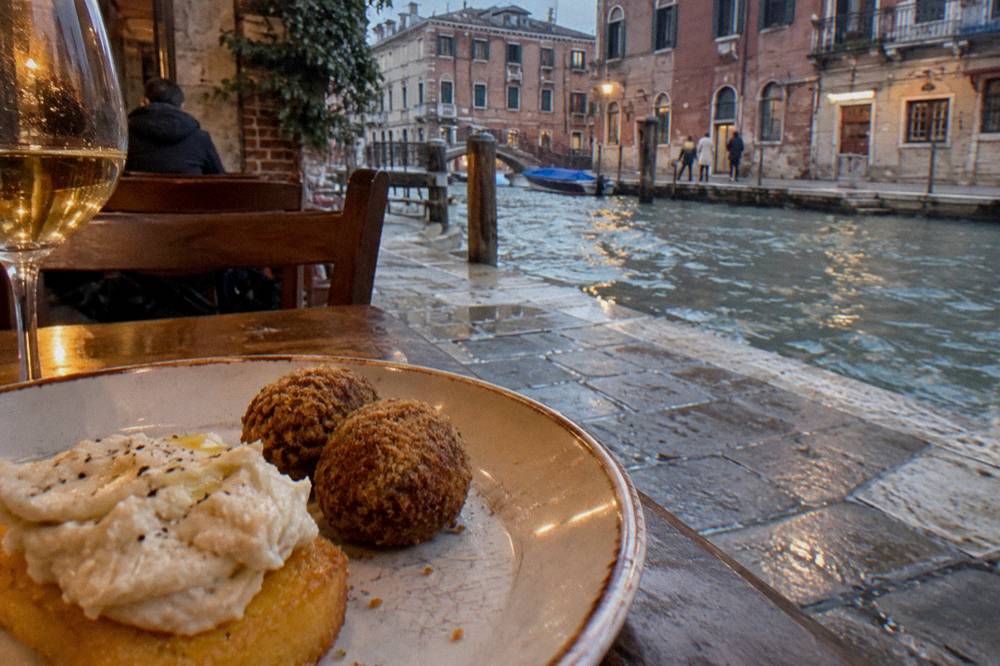
What lands on the counter is usually one of three things: a spoonful on a small rectangle of grilled or fried polenta, a smear on a soft white roll, or a bowl with bread alongside for self-service. In a city where cicchetti run around EUR 1.50 to 4 a piece at the counter, as reported on the official Visit Venice food pages, it is often among the cheaper and more filling options on display.
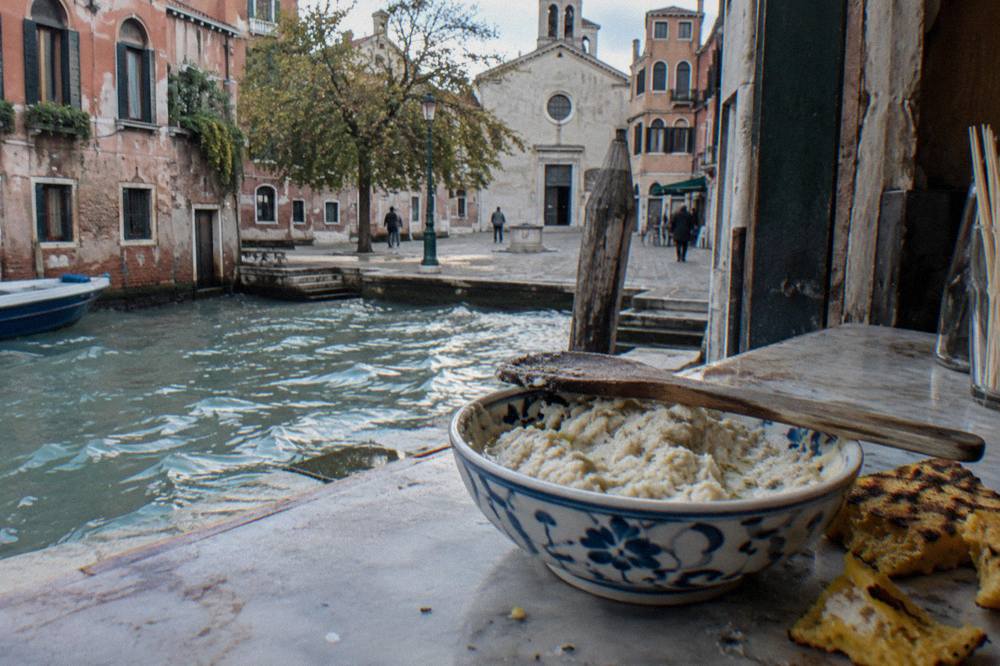
A note on the two fish. Strictly, baccalà is salt-cured cod and stoccafisso is air-dried stockfish, but in Venetian dialect baccalà refers to the dried stockfish preparation, and menus across the city use the word for the whipped dish regardless. Ask for "baccalà mantecato" anywhere and you will get whipped cod; the distinction matters mainly when shopping for the raw fish.
Why Polenta Became The Base?
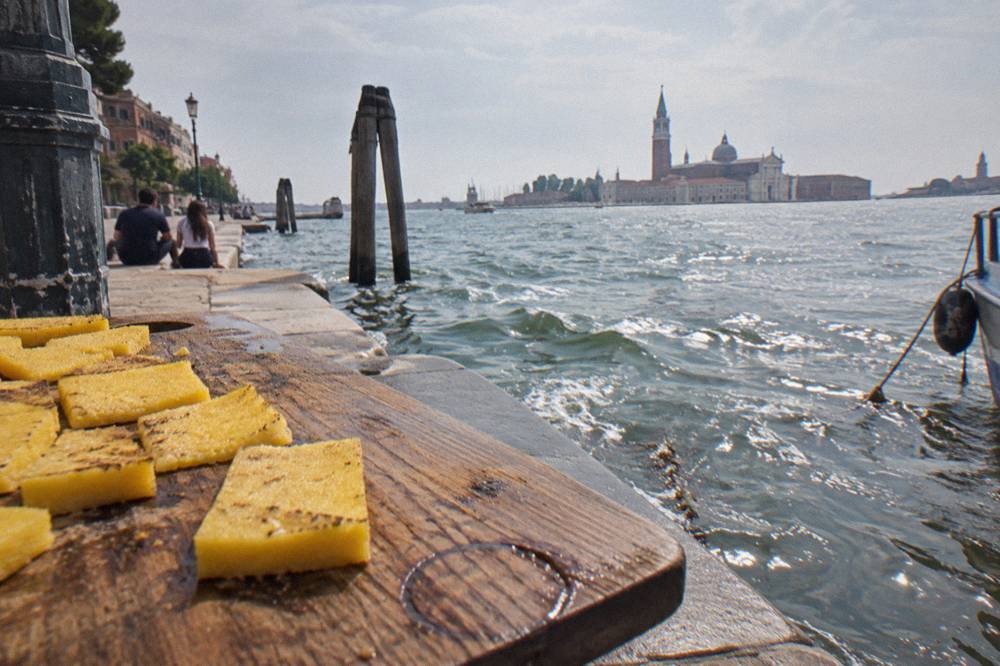
Polenta arrived in Venice after maize came from the Americas, and it stuck because cornmeal was cheap, filling and shelf-stable in a humid lagoon city of sailors and port workers. Cut cold polenta into squares and grilled or fried, it became the sturdy, hand-held platform that cicchetti culture is built on, holding whipped cod, baccalà in saor or anything else without falling apart.
Before corn, the poor of the Veneto ate millet, buckwheat, chestnut flour and whatever grain reached the trading port. Maize yielded more per field and stored well, and in time it became the default carbohydrate of the lagoon's working class. The historical cost was pellagra, the niacin-deficiency disease that spread through corn-dependent northern Italy in the centuries after maize took hold, a reminder that this was poverty food long before it was picturesque food.
The practical logic survives at the counter. Polenta sets firm, cuts cleanly, and takes a second turn on the griddle or in the fryer, which gives it a crisp skin and a soft middle. That texture contrast, crisp base and airy whipped topping, is why the pairing became standard rather than accidental. White bread does the job too, and many bars offer both, but polenta keeps its structure under a wet topping in a way sliced bread cannot.
Venetian polenta also runs yellower and coarser than the fine-ground versions common elsewhere in the north. Traditional recipes cook it for 40 minutes to an hour with constant stirring, then pour it onto a wooden board to set. Bars that fry it to order get a better result than ones holding it under a heat lamp, which is one reason the same dish can taste different two doors apart.
The pairing of fish and grain is older than either ingredient's current form. Risi e bisi, the spring rice-and-pea dish historically tied to the Doge's table, and the baccalà itself both follow the same lagoon logic: stretch expensive protein with cheap starch. Polenta simply did it standing up, at a counter, in two bites.
A tasting walk is the most efficient way to compare versions of this dish side by side, since each bar whips its own and the differences are real. The small-group Eat Like a Local three-hour tasting walk moves through several stops with a guide who knows which counters turn over fastest, and there are other formats worth weighing.
How Do You Order Baccalà Mantecato At The Counter?
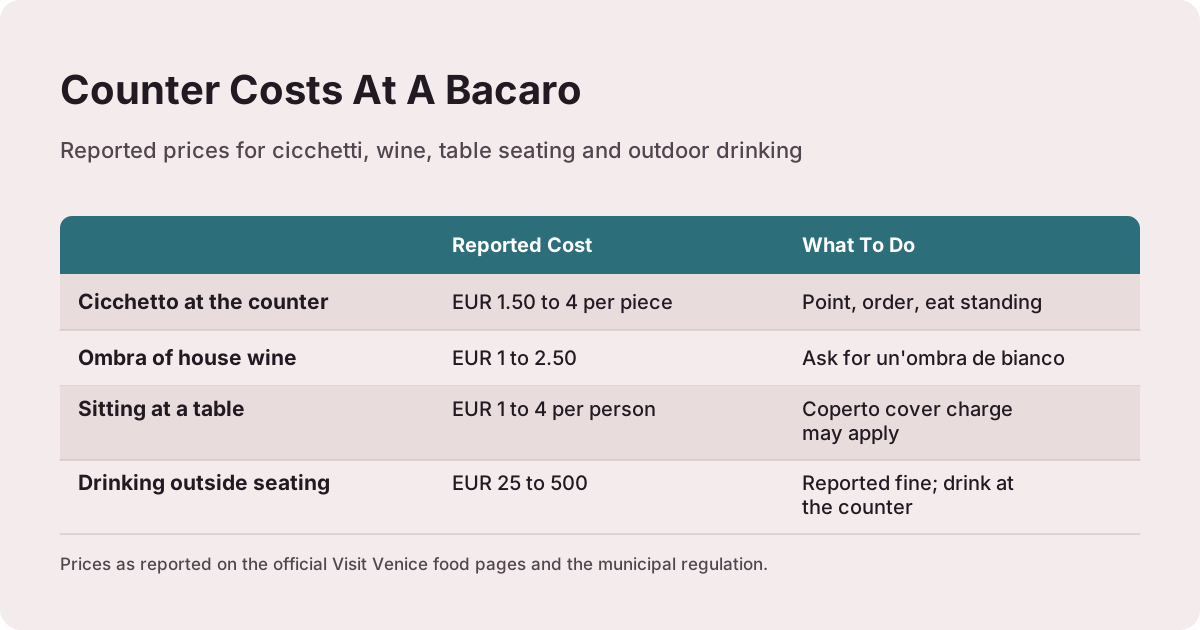
Point and ask for "un baccalà mantecato", pronounced bak-ka-LA man-te-KA-to, and pay per piece at the counter, usually EUR 1.50 to 4 reported at standing bacari. In most places you order and drink at the bar; sitting at a table triggers table service and often a coperto cover charge of around EUR 1 to 4 per person. An ombra, a small glass of house wine, runs around EUR 1 to 2.50.
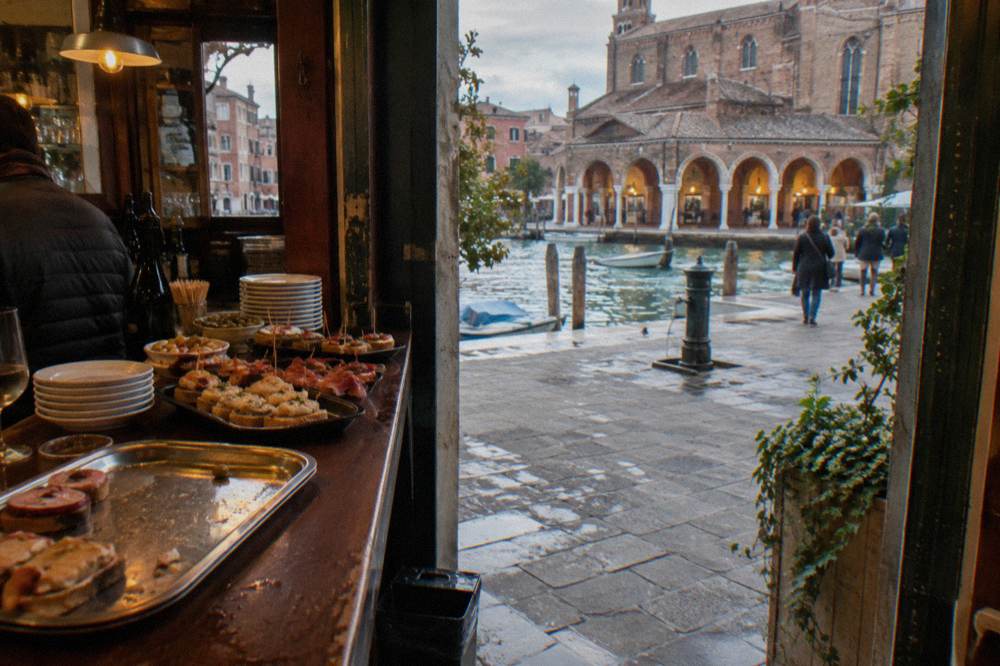
The mechanics are simple once you have seen them once. In a traditional bacaro there is no queue system: you work your way to the counter, greet the staff with a buongiorno or buonasera, and say what you want. Cicchetti are counted and tallied; at the end you settle the bill, either immediately or, in very local places, when you leave. During aperitivo hour the counters crowd, and the locals outside with a glass in hand are the model to copy.
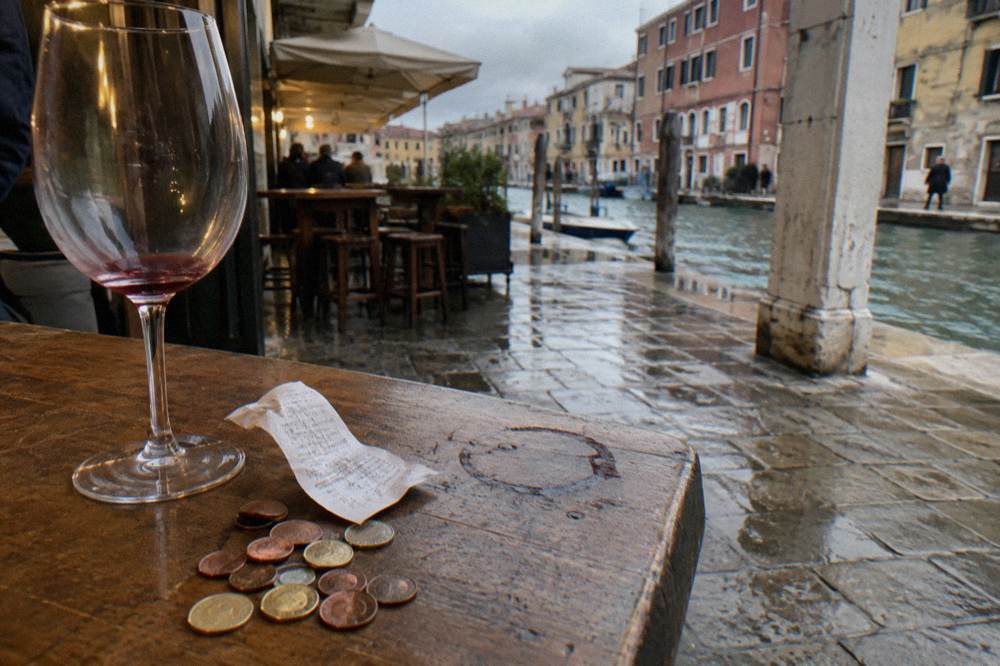
The drink matters as much as the food. The classic pairing is an ombra of white wine, unfiltered and still, poured short; the name comes from the old habit of shadow, ombra, following the wine sellers who moved with the shade in Saint Mark's Square. A spritz works too, and the guide to spritz, Aperol, Select and the local way explains the ordering conventions. For the deeper background on wine service and rituals, see bacari etiquette, ombra and the Venetian wine ritual.
One rule worth knowing before you drink outside: Venice bans drinking from glass, ceramic or similar containers outside permitted seating areas, and bans takeaway sales of alcohol in untapped glass bottles or glass glasses for public consumption, with reported fines of EUR 25 to 500 under the municipal regulation. Drink at the counter, or ask for plastic where allowed, and check current rules before you travel.
| Situation | What To Do | Typical Cost, Reported |
|---|---|---|
| Cicchetto at the counter | Point, order, eat standing | EUR 1.50 to 4 per piece |
| Ombra of house wine | Order "un'ombra de bianco" | EUR 1 to 2.50 |
| Sitting at a table | Service comes to you; coperto may apply | EUR 1 to 4 per person |
| Standing during aperitivo hour | Expect crowds from around 6 pm | Same counter prices |
Dietary questions deserve a direct word: baccalà mantecato contains fish and usually olive oil, sometimes milk, and the polenta base is corn, but nothing about any bar's preparation can be assumed gluten-free or dairy-free. Where a tasting tour is involved, message the operator before booking about dietary needs, since listing pages do not always state accommodations.
Where Does Baccalà Mantecato Sit Among Venice's Other Staples?
Baccalà mantecato is the anchor, but the same counters carry a repeating cast: sarde in saor, sweet-and-sour sardines with onion and raisins; polenta with squid in its black ink; bigoli in salsa, thick whole-wheat pasta with onion and anchovy; and fried moeche, soft-shell crabs, in season. Each follows the same lagoon logic of preserved fish and cheap grain, and a crawl that samples several tells the city's food history in five bites.
Sarde in saor is the other great preserved-fish cicchetto, and in a sense the two dishes are siblings: saor, the sweet-and-sour onion marinade, was a preservation method for fishermen at sea, while stockfish was preservation by drying. The dedicated piece on sarde in saor, Venice's sweet-and-sour sardines covers its history and season. Both dishes sit on the same polenta or bread bases, and both improve after a day or two of rest.
The wider canon appears mostly at meals rather than at the counter. Fegato alla veneziana, calf's liver with softened onions, and risi e bisi are restaurant dishes; spaghetti al nero di seppia, cuttlefish-ink pasta, straddles both worlds. For a full run-down of what to eat across the city, the guide to traditional Venetian dishes goes dish by dish, and the piece on street food, what to try and what to skip covers what to order and what to pass over at a street-food counter.
| Dish | What It Is | Where You Usually Meet It |
|---|---|---|
| Baccalà mantecato | Whipped stockfish with olive oil | Cicchetti counter, on polenta or bread |
| Sarde in saor | Sardines in sweet-and-sour onion | Cicchetti counter |
| Polenta e seppie nere | Polenta with cuttlefish in ink | Counter and trattorie |
| Bigoli in salsa | Thick pasta, onion and anchovy sauce | Restaurant, sometimes as a counter plate |
| Risi e bisi | Rice and peas, spring dish | Restaurant |
| Fegato alla veneziana | Liver and onions | Restaurant |
Season changes the picture more in Venice than in most cities. Moleche, soft-shell crabs, appear briefly in spring and autumn; white asparagus and castraùre, the first violet artichoke buds from Sant'Erasmo, mark late spring; fritole, the fried sweet dough of Carnival, take over bakery windows in winter. The calendar piece on Venice food by season maps the year, and it is worth knowing that baccalà mantecato is the one staple that barely moves: dried stockfish keeps, so the dish appears in every month.
Can You Taste Baccalà Mantecato On A Guided Walk?
Yes, and a tasting walk is often the fastest way to do it, because whipped cod is a standard cicchetti item and guided crawls move through several bacari in one evening. What any specific tour tastes is set by its own listing: only the listed stops and inclusions count, so check the booking page for the current stop list. The three-hour small-group format is the most common, and 2.5 to 4 hour walks dominate the category.
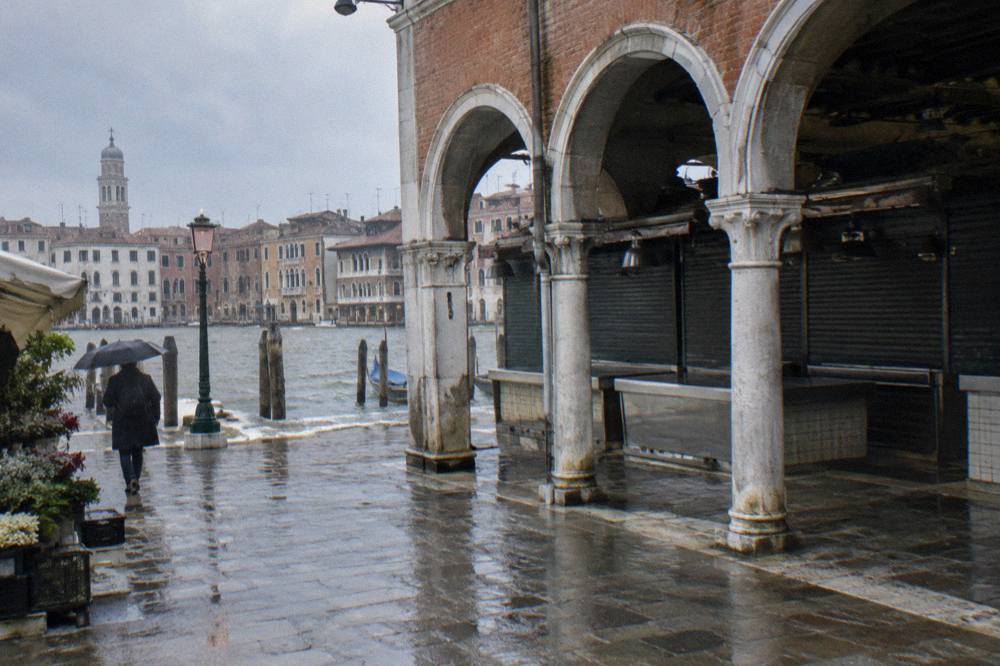
Three formats fit this dish naturally. The classic cicchetti crawl visits a string of bacari, and whipped cod appears wherever the counters are traditional. A market-and-street-food walk adds the Rialto context, where the fish market runs Tuesday to Saturday, 7:00 to 14:00, and is closed Sunday and Monday; listings themselves warn that the fish market is closed on those days and Italian holidays. An evening walk times the crawl to aperitivo hour, when the counters are fullest.
| Format | Typical Length | What It Adds Over Going Alone |
|---|---|---|
| Cicchetti and bacaro crawl | 2 to 3.5 hours | Several bars, counted tastings, pacing handled |
| Market and street-food walk | 2.5 to 4 hours | Rialto context plus tastings |
| Evening walk with dinner | 2.5 to 3.5 hours | Aperitivo hour timing, a sit-down finish |
Two rules of Venetian group touring apply to any walk you book. Guided groups in the historic centre and the lagoon islands are capped at 25 people, a standing rule reported as ongoing since 2024, and loudspeakers are banned, which is why guides use headsets. A listing's own group-size figure is the one that counts; do not assume small-group means small until the booking page says the number.
For choosing among the walks themselves, the comparison piece on which Venice food walk to book breaks the decision down by budget and format, and the cost breakdown at what a Venice food walk costs explains what the price of a walk typically covers. Prices for the individual walks compared here sit on their own live listings, and deals on the booking pages can shift the figure week to week.
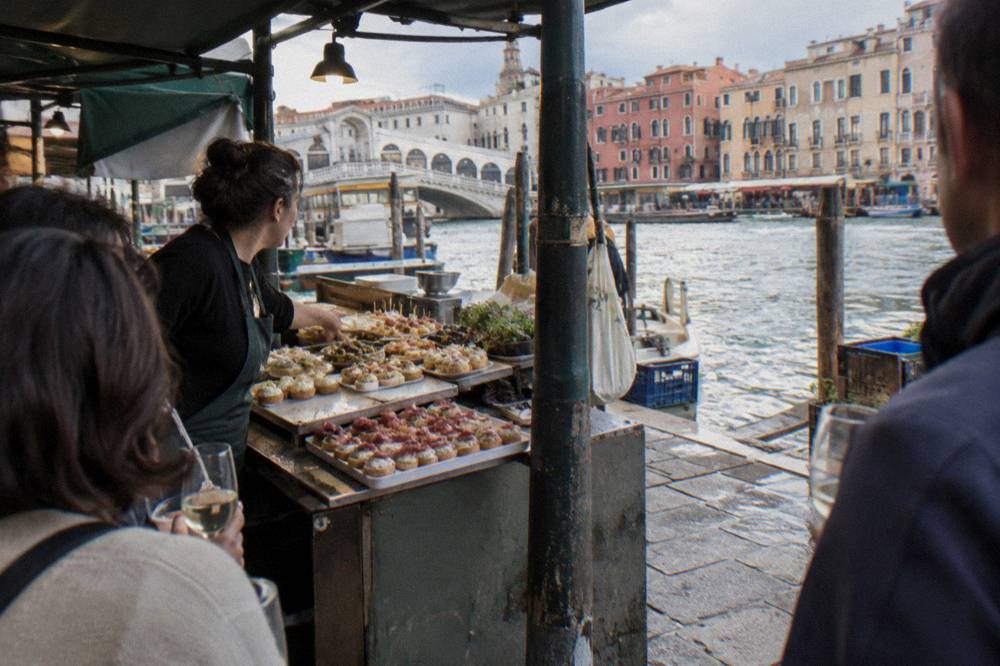
The street-food option is worth a look if the market angle appeals: the Venice street-food tour with a local guide moves through the market quarter, and the listing describes its tastings in detail.
How Venice's Fish Market Connects To The Dish?
The Pescheria at Rialto still sells lagoon and Adriatic fish Tuesday to Saturday, 7:00 to 14:00, closed Sunday and Monday, and while stockfish itself is imported dried, the market is where Venice's fish-eating culture stays visible. The produce market alongside runs Monday to Saturday, 7:00 to 20:00. Both are free to walk through, and a morning visit pairs naturally with a lunchtime market tour.
There is a small irony at the heart of the dish: the cod never swims in the lagoon. It is Norwegian, dried in the Arctic air, and imported, one of the longest-running food trade relationships in Europe. What the Rialto market shows instead is the rest of the picture: go (goby) from the lagoon for Burano's risotto, moeche in their seasons, sardines by the crate, and the auction rhythm that has run on that spot for centuries. The dedicated pages on the Rialto market guide and the fish market itself cover what to look at stall by stall.
“Our market tour and cooking class with Lorenzo was a lovely experience. He is an engaging teacher, friendly and fun, and his kitchen provided a comfortable learning environment (and he played great music on the stereo, too). It was delightful to share the lunch we all cooked together: delicious ravioli, sea bass and tiramisu. A definite highlight of our trip to Venice!”
The timing rule matters for planners. Arrive on a Monday and the Pescheria is shut; arrive after 14:00 on any day and the stalls are winding down. The piece on Rialto market hours and the best time to go gives the full breakdown, and the official Comune di Venezia page on the city's markets lists both Rialto markets as daily markets of the historic centre. A market walk in the morning plus a bacaro crawl in the evening is the classic food-first day, and the itinerary piece on how many days to spend in Venice builds exactly that sequence.
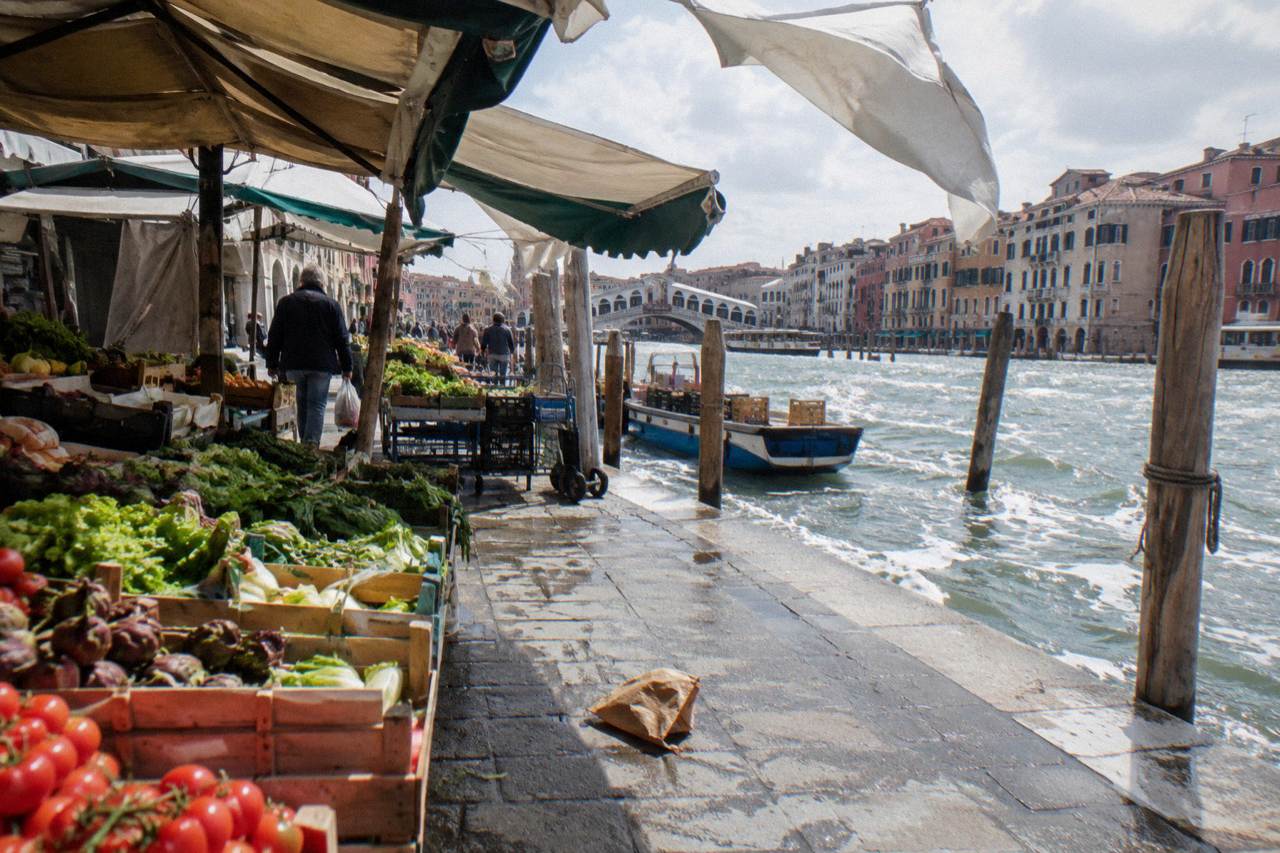
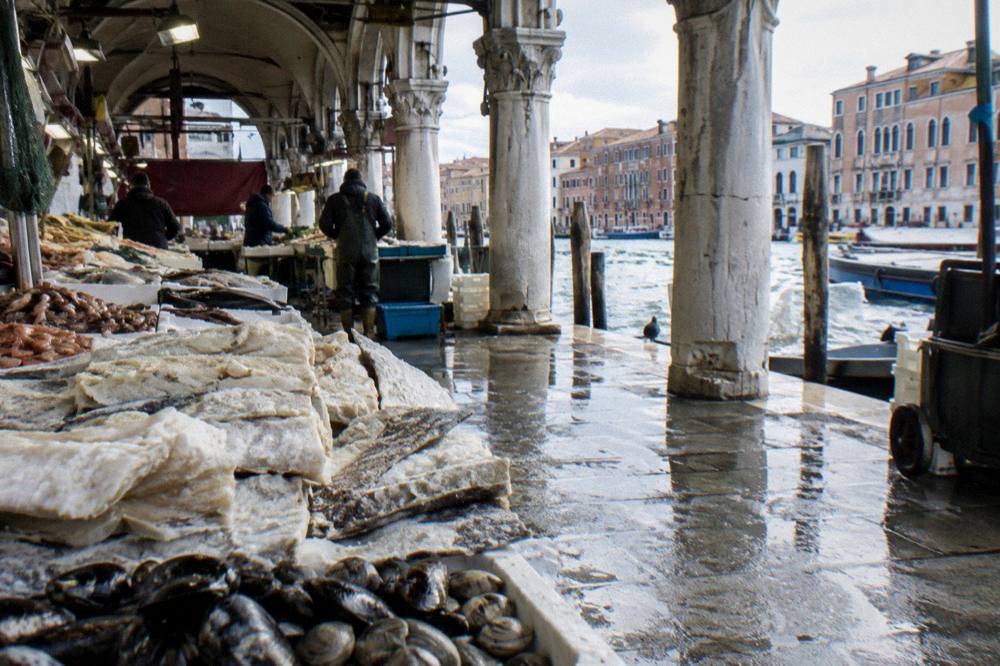
For travelers building the whole day around food, the choice between walking and cooking is a real one, and the comparison at food walk or cooking class, which to book sets out the trade-offs. The classic Venetian bacaro food tour that frames the crawl as eating and drinking like a Venetian is another strong format for this dish, with the stop list on its own listing.
Can You Make It At Home, Or Learn It In A Class?
You can do either. Home versions need a two-to-three day soak for the dried fish before poaching and whipping, so the dish rewards planning rather than skill. In Venice, cooking classes that include market shopping and a full meal walk you through the technique in three to four hours; the class listings each state what dishes they cover, so match the listing to the dish you want before booking.
“Our host and culinary chef Carolyn was absolutely wonderful. We were welcomed into her beautiful family home - learning the history and skill of Italian cooking. Highly recommend Carolyn's class to anyone interested in taking your cooking skills to a higher level.”
The home route is forgiving. After the soak, the fish poaches in barely simmering water for 20 minutes or so, then drains, skins and whips, first roughly, then with oil added in a thin stream until the colour pales and the texture lightens. The classic base wants a day of setting before it grills well. It keeps two or three days refrigerated, which is why bacari can hold a bowl of it through service. The failures are all mechanical: over-boiling that breaks the flesh, oil added too fast so the emulsion splits, and under-soaking that leaves it salty and tough.
A class compresses the learning. Several Venice classes pair a Rialto market visit with pasta-making and a meal, and the formats are compared in the Venice cooking class guide and the pasta and tiramisu class rundown. Typical shared classes run about three hours with maximum group sizes reported around 12, though every operator differs, so the listing's own numbers govern. Whether any given class covers baccalà mantecato specifically depends on its menu: check the booking page before assuming, since not every Venetian class includes fish work.
| Route | Time Involved | What You Get |
|---|---|---|
| Make it at home | 3 days soak, 1 hour cooking | The technique, at your own pace |
| Shared cooking class | About 3 hours, reported | Market context plus a meal, guided |
| Market tour plus class | 4 hours | Shopping and cooking in one sequence |
| Guided tasting walk | 2 to 3.5 hours | The dish at several bars, no cooking |
The choice usually comes down to the trip's shape. A short first visit rewards the crawl, where the dish arrives in its native setting with the ombra beside it; a longer stay or a return trip is when the class route starts to pay off. Whichever way you lean, Venice Food Tours exists to help you eat the city well, from market mornings to the last bacaro of the evening.
Common Questions About Baccalà Mantecato
What Is Baccalà Mantecato Made Of?
Dried stockfish, rehydrated over one to three days, poached gently, then whipped with olive oil and a little cooking liquid until pale and light. It is served on grilled or fried polenta, or on bread. In Venetian usage the name baccalà refers to air-dried stockfish rather than salt-cured cod.
Is Baccalà Mantecato The Same As Salt Cod Brandade?
They are close cousins. Both whip reconstituted cod with oil into a light cream. The Venetian version uses stockfish and olive oil, served cold on polenta, while the French brandade of Provence often uses salt cod and sometimes milk or cream, and is served warm with potato or bread.
How Much Does A Piece Of Baccalà Mantecato Cost In Venice?
At standing bacari, cicchetti run around EUR 1.50 to 4 a piece as reported on the official Visit Venice food pages, and whipped cod is usually among the mid-range items. Prices are posted at each counter, and eating standing avoids the coperto charge that seated service can add.
What Do You Drink With Baccalà Mantecato?
The traditional pour is an ombra, a small glass of unfiltered white house wine, reported at around EUR 1 to 2.50 at local counters. A spritz also works. Outside aperitivo hour, still water or a light Veneto white does the job.
When Did Venice Start Eating Stockfish?
The trade is credited to the shipwrecked Venetian merchant Pietro Querini, who encountered air-dried cod in Norway's Lofoten islands and brought it back to Venice. The trade he helped open continues: most Italian stockfish still comes from the same Norwegian islands.
Can I Taste Baccalà Mantecato On A Food Tour In Venice?
Whipped cod is a standard cicchetti item, so bacaro crawls and street-food walks commonly pass counters that serve it. What any specific tour tastes is set by its own listing's stops and inclusions, so check the booking page for the current stop list before relying on any one dish.