Where Did Stanley Tucci Eat In Venice?
An honest answer to where Stanley Tucci ate in Venice, why the accounts conflict, and how to build the same kind of eating day yourself with bacari, cicchetti and a guided tasting walk.
Stanley Tucci has probably done more for the public image of Italian eating in Venice than any living broadcaster. His series and books champion a simple idea: sit down, order what the locals order, take it slowly. So it is no surprise that one of the most searched food questions about the city is also one of the hardest to answer honestly. This page does answer it, just not with a neat list of restaurant names, because no such list survives fact-checking.
No verified source names the specific restaurants and bars Stanley Tucci ate at in Venice, and the popular accounts that circulate online conflict with each other. What the coverage consistently gestures toward is a style rather than an address list: standing bacaro counters, small plates of cicchetti, a glass of local wine, and unfussy neighbourhood trattorie. That style is fully reproducible, and this page shows how.
The honest starting point is this: if you have seen a listicle titled with this exact question, it was almost certainly assembled from general knowledge of famous Venetian venues, not from reporting on where a specific television episode filmed or where a specific chapter of a book was eaten. Venice has perhaps internationally famous bacari like All'Arco and Do Mori, and it is easy to bolt a celebrity name onto them and publish. None of those lists is corroborated by a primary source we could verify, and several contradict each other outright.
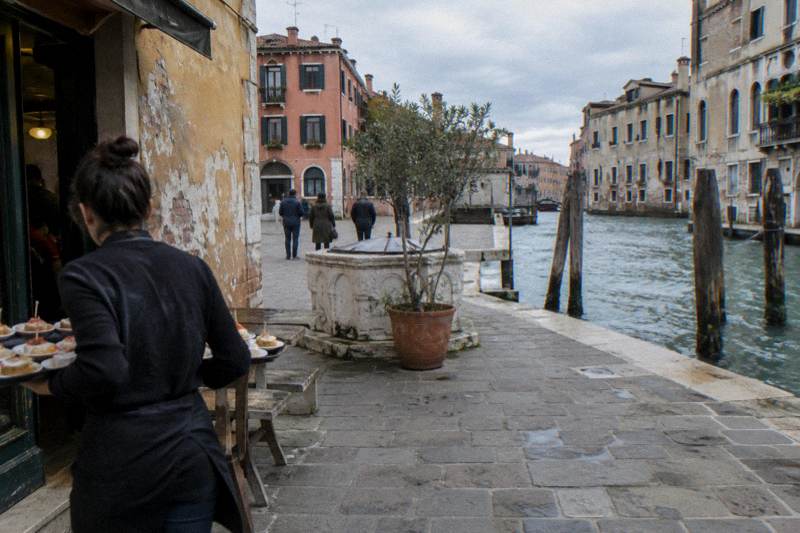
What is safe to say is broader. Tucci's public work on Italian food, across both the television series and the memoir-style writing, consistently gravitates toward the everyday rather than the ceremonial: market shopping, simple pasta, small producer wines, standing at a counter rather than being seated and served. In Venice that maps almost perfectly onto the bacaro tradition, the standing wine bar where Venetians have eaten small plates and drunk a small glass of house wine, an ombra, for centuries.
That gap between a famous name and a verifiable address is not a dead end for a traveller. It is actually a useful redirect. Chasing the exact table someone famous sat at, in a city where menus and ownership change constantly, tends to produce disappointment. Eating the way that person demonstrably enjoys eating, slowly, locally, at the counter, produces a good day in Venice almost regardless of which door you walk through.
Why There Is No Verified Tucci Restaurant List
Every circulating answer to this question fails the same basic test: it cannot point to a primary source, an episode credit, an interview or a book passage that names the venue. Restaurants named in one list are absent from the next, and some lists quietly recycle venues that are simply famous in Venice, with no connection to Tucci at all. Treat them as general restaurant suggestions wearing a celebrity headline.
This matters because Venice is unusually prone to the celebrity-attribution habit. The city is small, its famous eating addresses are heavily written about, and search demand for names like Tucci, or Bourdain, or celebrity visits generally, is high enough that content gets published to meet the search rather than the fact. For a genuinely documented celebrity eating trail through Venice no sourced trail is offered here, and the honest answer for each of them still comes with caveats. For Tucci specifically, no source we could confirm lists the show's Venice venuesues is effectively empty.
“My husband and I had so much fun with this experience! We had a great group of fellow Americans and Chef Filippo took great care of us. He is so knowledgeable, with lots of good local tips, and he made us laugh as well! We learned so much about Venice and cooking - truly a memorable time - and we had a delicious meal to enjoy when we were finished. I highly recommend this tour to anyone visiting Venice! Grazie!”
There is a second, subtler problem. Even where a programme films in a real venue, filming and eating are different events. A crew may shoot a market scene at dawn and a dinner scene in a restaurant that closed to the public that night. A cookbook recipe attributed to a region may never have been cooked in the city at all. Building an itinerary from a scene you remember is therefore fragile even in principle, and doubly so when nobody can confirm the scene.
So what should a fan of the Tucci approach actually do? Replace the unanswerable question, where exactly, with the answerable one: what does this style of eating look like in Venice, hour by hour, and how do I do it well? The rest of this page is that answer, built from verifiable facts: official market hours, reported counter prices, municipal rules and the specific tasting walks that structure the same experience.
The featured walk on this site, the Eat Like a Local small-group tasting tour, is built on exactly the premise the question implies. It runs three hours with a local guide leading a small group through a sequence of tasting stops; the current price and full inclusion list are on the operator's booking page. You can also read more about it in the site's guide to which Venice food walk to book before committing.
The Eating Style Tucci Celebrates, Translated To Venice
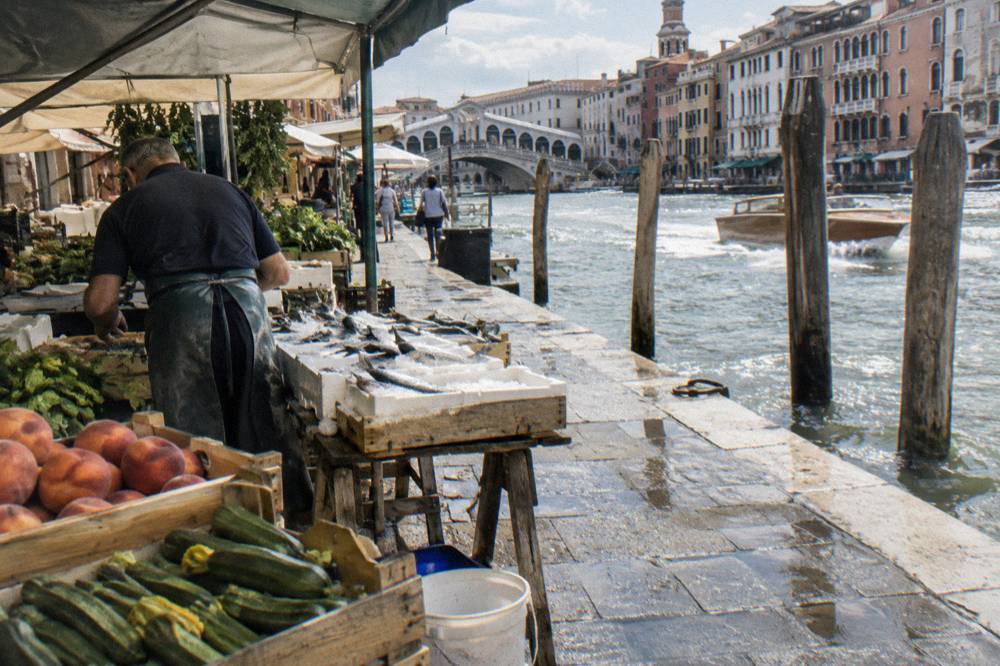
Across his series and writing, the approach is consistent: buy at the market, eat what the region actually produces, prefer the modest venue doing one thing well over the ambitious one doing many things adequately, and drink the local wine. In Venice that translates to the Rialto market in the morning, cicchetti and an ombra at a standing bacaro, and simple lagoon cooking at a neighbourhood trattoria, with Prosecco and Soave rather than famous reds.
None of this is performance for the camera. It is ordinary Venetian practice, which is precisely why it is so easy to copy. The produce market at Rialto runs Monday to Saturday from 7:00 to 20:00, closed Sunday; the fish market, the Pescheria, runs Tuesday to Saturday from 7:00 to 14:00, closed Sunday and Monday, per the official Venezia Unica listing. A morning market visit followed by a lunchtime crawl is the most Venetian eating day that exists, no celebrity required.
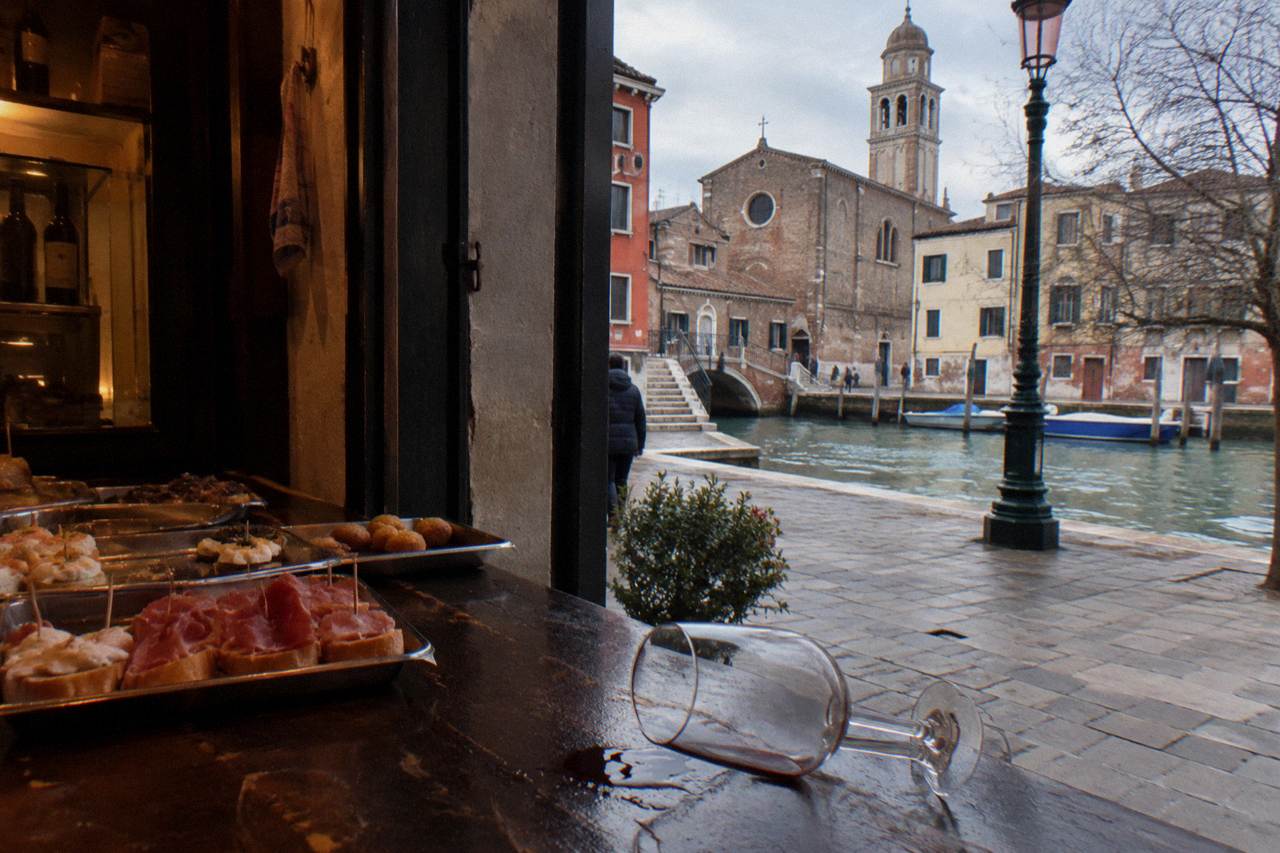
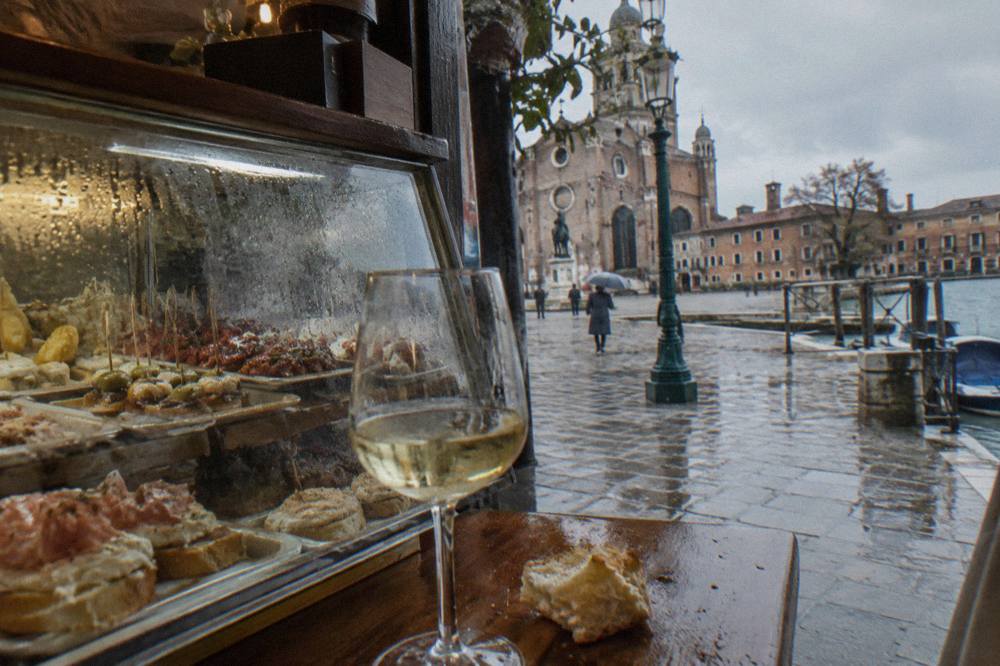
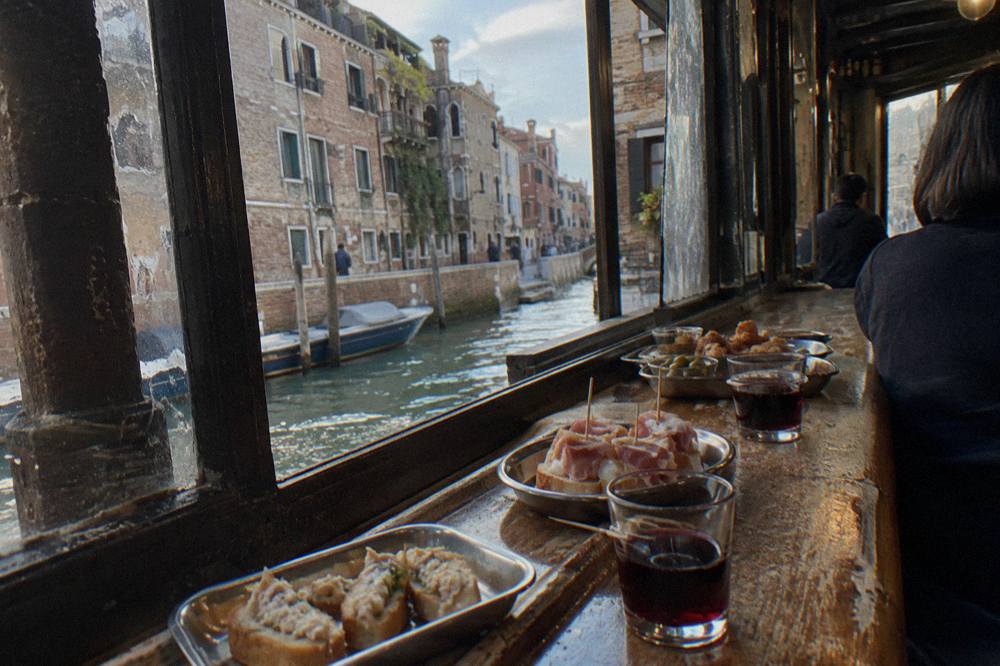
The counter culture is the heart of it. In a bacaro you stand, you point, you eat small pieces, and you drink small glasses. Reported prices for this are refreshingly stable: cicchetti typically run around EUR 1.50 to 4 a piece depending on how elaborate they are, and an ombra, the roughly 100 ml pour of house wine, around EUR 1 to 2.50 at local counters, with tourist-oriented bars charging more. These are reported ranges from the official Venice visitor site, and posted lists at each counter apply; the advice is always to glance at the board before ordering rather than after.
Wine in this context is not the centrepiece, it is the companion. The Veneto pours you will actually meet at a bacaro counter are Prosecco, the local sparkling wine, and still whites such as Soave, occasionally the local Raboso red. The site's wider primer on Veneto wines, Prosecco, Soave and Amarone covers how they differ, and the guide to bacari etiquette, ombra and the Venetian wine ritual covers the small customs, standing, ordering, paying, that make a counter feel welcoming rather than intimidating.
| Element of the day | Venetian version | What to know |
|---|---|---|
| Morning | Rialto produce market | Monday to Saturday 7:00 to 20:00, closed Sunday |
| Morning, fish | Pescheria fish market | Tuesday to Saturday 7:00 to 14:00, closed Sunday and Monday |
| Lunch or aperitivo | Cicchetti at a bacaro counter | Reported around EUR 1.50 to 4 per piece, posted lists apply |
| The drink | Ombra, small house wine | Reported around EUR 1 to 2.50 at local counters |
| Evening | Neighbourhood trattoria | Coperto, a cover charge, commonly EUR 1 to 5 where applied, is disclosed on menus |
One practical note belongs here because it shapes every evening plan: Venetians eat late by northern European standards, and restaurants reflect that. The site's post on what time people typically eat dinner in Venice covers the rhythm, but the short version is that an early table is a tourist table.
How To Build The Same Day Yourself
A faithful version of the style costs very little to assemble: a morning at Rialto, a midday crawl of three or four bacari between San Polo and Cannaregio, a pastry stop, and a simple dinner booked for after 20:00. Count on reported counter prices of a few euros per piece and per glass; a single vaporetto ticket is reported at EUR 9.50 for 75 minutes if you route through distant sestieri, though the whole crawl is walkable.
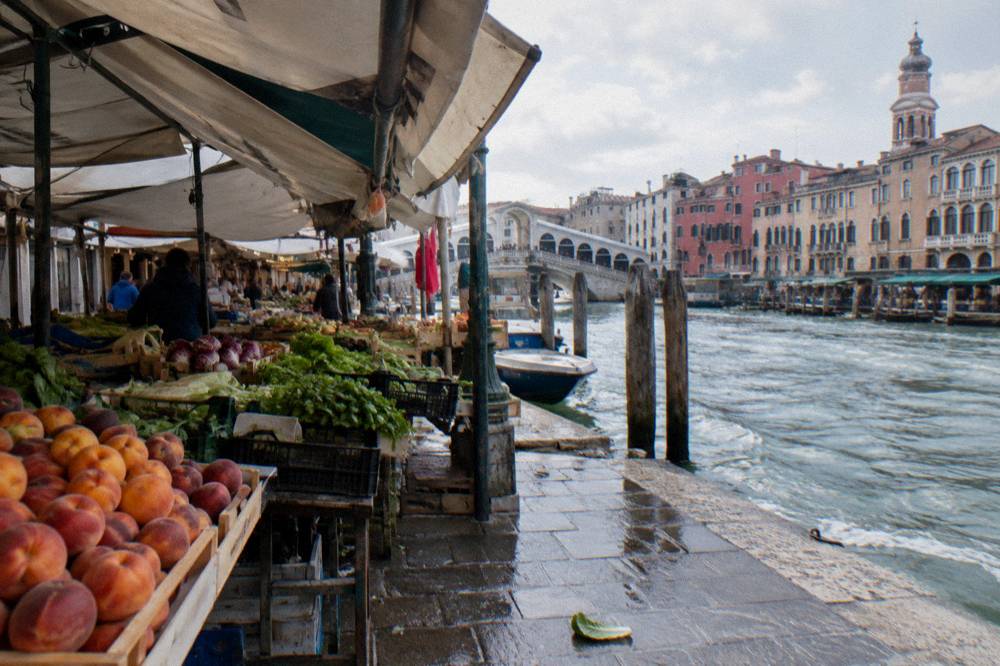
The build-it-yourself version rewards a little planning. Start at Rialto early enough to see the fish market before the 14:00 close, and go on a weekday if you can, since the Pescheria is dark Sunday and Monday and tour listings themselves warn about Italian holidays. Walk the produce stalls on the San Polo side, then loop toward a first bacaro before the lunch crush. Three or four counters is a full meal; six is a marathon. Pace the ombre accordingly. More of these guides are collected on Venice Food Tours.
Money behaviour at the counter is simple. You pay per piece, per glass, usually at the till or to the counter hand, and standing at the counter is also how you most often avoid a coperto, the per-person cover charge that sit-down venues commonly apply at around EUR 1 to 5 and must show on the menu. Tipping at a standing bacaro is genuinely optional; rounding up is appreciated, expected nowhere. There is a fuller treatment of this in the guide to tipping, coperto and restaurant etiquette in Venice.
Two municipal rules are worth knowing before you wander with a glass. Venice prohibits drinking from glass containers outside permitted seating areas, and bans takeaway sales of alcohol in untapped glass bottles or glass glasses for public consumption, with fines reported from EUR 25 to 500 under the municipal regulation. The practical translation: finish your ombra at the counter, not in the calle. And note that no day-visitor access fee applies as of 27 July 2026, per the official access-fee page, so a food-focused day trip needs no pre-registered payment; the fee is set to return in 2027 with arrangements announced by 31 December 2026.
What A Guided Tasting Walk Adds Over Going Alone
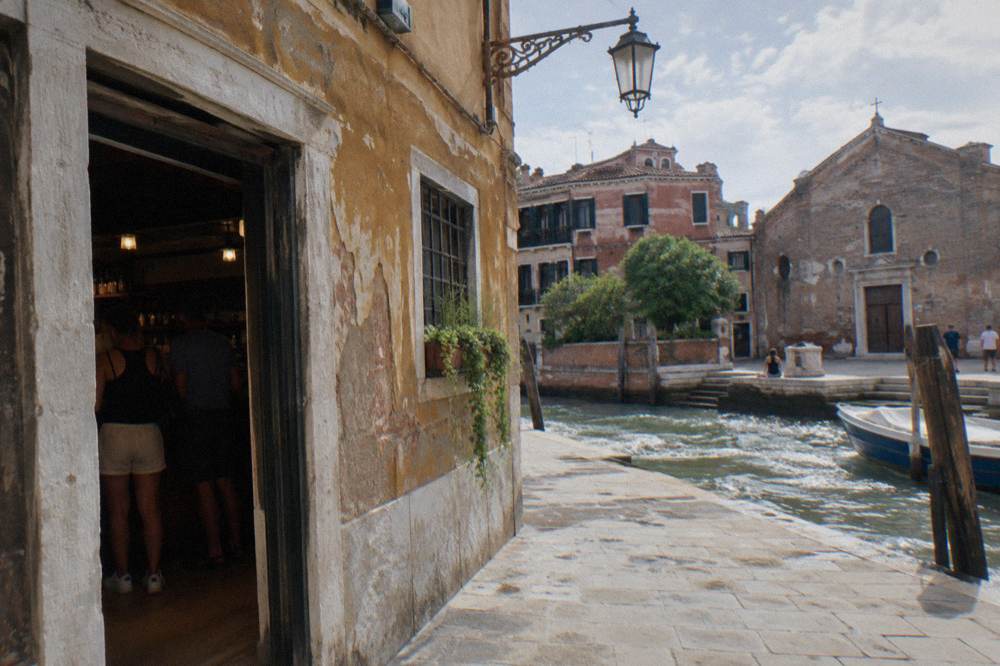
A guided tasting walk adds three things a solo crawl cannot: a route through bacari you would not find on your own, counters where a guide's presence unlocks family recipes, and counted, listed tastings that fix the budget up front. You trade flexibility for those gains, accepting a fixed start time, a group pace, and a higher per-person price, so the guided version usually wins on a first visit or any stay under two days.
The counter argument for going alone deserves a fair hearing. If you have three days, a sense of adventure and no dietary constraints, wandering Cannaregio or Dorsoduro and ducking into whichever bacaro has locals at the bar is a genuinely good plan, and the site's neighbourhood guide to Venice food by neighbourhood, Cannaregio, Dorsoduro and San Polo gives you the map for it. The reported price ceiling for a self-built crawl is low, a dozen cicchetti and six ombre across an afternoon would still cost less than most guided walks, at the reported counter rates.
But the guided walk solves real problems. The best bacari are small, unwelcoming to a hesitant outsider at peak hour, and invisible from the main drags between Rialto and St Mark's. A guide who walks in with a regular's greeting changes what comes out of the kitchen. The listings for the walks described here spell out exactly what is included, the number of tastings, the drinks, the stops, and what is on the booking page is what you get; where a detail like a specific dietary accommodation is not stated, message the operator before booking rather than assuming.
Among the three walks featured on this page, the Venice Bacaro Food Tour is the purest expression of the counter style, three and a half hours built around eating and drinking the way a Venetian does. It sits mid-length in the range of options here and pairs naturally with the question behind this article, since the bacaro crawl is the format the Tucci style points to most directly.
The longer alternative spends four hours in Cannaregio and the former Jewish Ghetto with wine included, and it is the choice if you want the neighbourhood depth, history included, rather than a pure crawl. Cannaregio is also where much of the city's everyday eating actually happens, which makes it the most honest place to test whether the famous style lives up to its billing. Prices for both walks, and the exact inclusion lists, are on each operator's booking page.
Does The Famous Name Change Where You Should Eat?
In practice, no. The venues a celebrity-linked listicle names are overwhelmingly the same famous addresses every guide already lists, so following the celebrity adds nothing except the risk of booking on a headline rather than on what you want to eat. Choose by format, neighbourhood and budget instead: a bacaro crawl for the counter culture, a market walk for the morning ritual, a cooking class if you want to make the food, not just eat it.
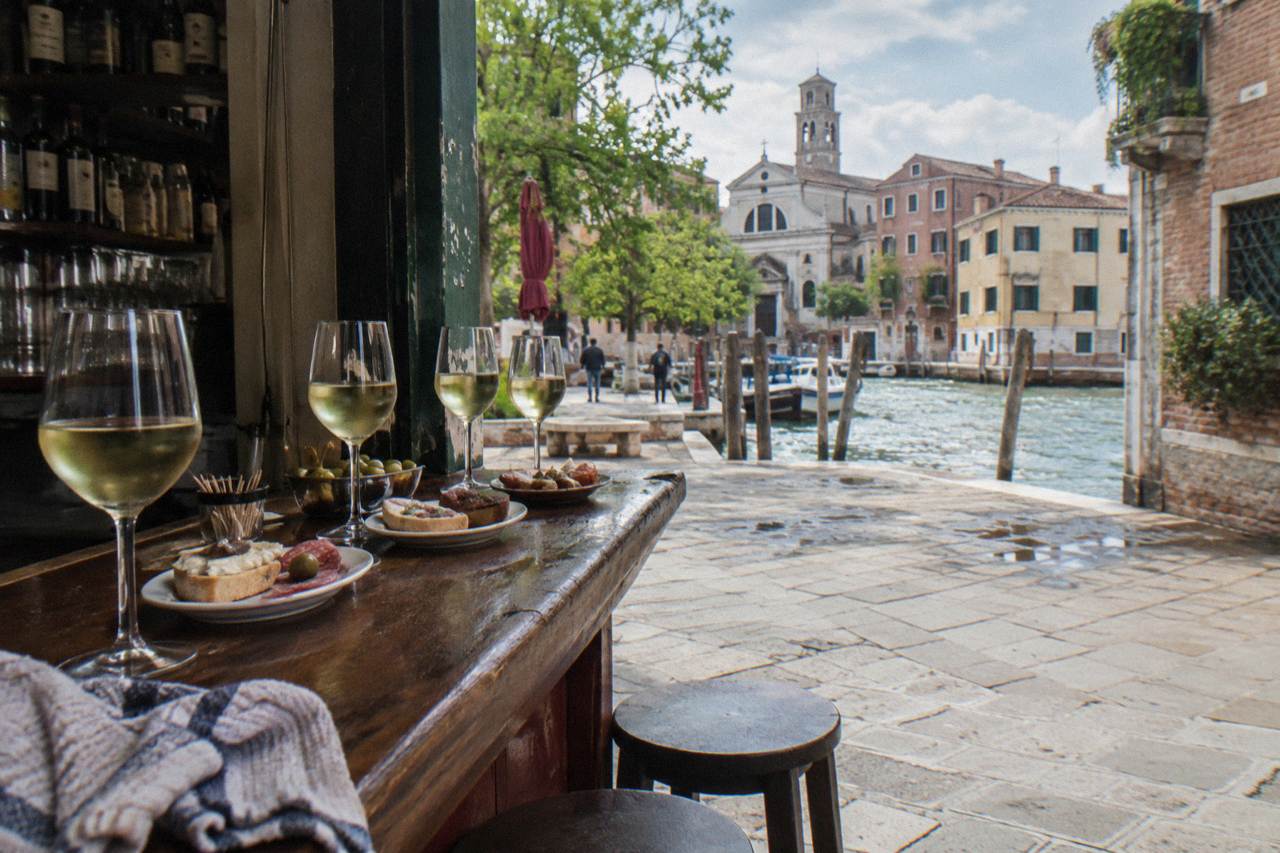
The celebrity framing does have one legitimate use. It sets an expectation of quality and simplicity that is worth holding onto as a filter. A place with a printed multilingual menu the length of a novel, photographs of dishes, and a host soliciting passers-by in three languages fails the filter regardless of who may once have filmed nearby. A counter with a handwritten board, one person frying baccalà and a line of locals standing with small glasses passes it automatically. If you want the shorthand, the site's primer on what is cicchetti and how to order it covers the ordering mechanics in five minutes of reading.
It is also worth saying plainly: disappointment in Venice food is usually a planning failure, not a city failure. Eating badly in Venice is easy if you stay on the main corridors and eat at 18:00; the post on why the food in Venice gets called bad dissects exactly how that happens. The Tucci approach, market in the morning, counter at midday, late simple dinner in a residential sestiere, is functionally an antidote to every one of those failure modes.
For readers who want the structure of a guided day in the neighbourhoods where everyday Venice eats, the Jewish Ghetto and Cannaregio walk below is the strongest single booking: four hours, wine included, and a part of the city most first-time visitors never reach.
Common Questions About Stanley Tucci And Venice
Where Did Stanley Tucci Eat In Venice?
No verified primary source names the restaurants and bars Stanley Tucci ate at in Venice, and the lists circulating online contradict each other and recycle generally famous venues. What the coverage points to is a style, standing bacaro counters, cicchetti, local wine and neighbourhood trattorie, and that style can be reproduced exactly without any celebrity address list.
Is There Any Official List Of Celebrity Restaurant Visits In Venice?
No. Venice has no official register of where public figures ate, and filming locations are not publicly documented venue by venue. Any list you find is compiled by the writer, not verified by the city or the broadcaster, and several such lists conflict with one another.
What Should I Eat In Venice If I Like The Slow, Local Approach To Italian Food?
Follow the ordinary Venetian day: the Rialto produce market Monday to Saturday or the fish market Tuesday to Saturday in the morning, cicchetti at a standing bacaro at midday, reported at around EUR 1.50 to 4 a piece with an ombra of house wine around EUR 1 to 2.50, and a simple late dinner in a residential neighbourhood.
Do I Need To Book A Food Walk To Eat Well In Venice?
No, but a walk helps on a short visit. A guided tasting walk gives you a route through bacari you would not find alone and counted, listed tastings at a known price, while going alone is cheaper and freer if you have time to wander. Cannaregio and Dorsoduro reward independent crawling; a first-time visitor with one or two days often gets more from the guided version.
What Is An Ombra And How Much Does It Cost?
An ombra is the traditional small pour of house wine, around 100 ml, drunk standing at a bacaro counter. At local counters it is reported at around EUR 1 to 2.50 a glass, with tourist-oriented bars charging more. Posted price lists at each counter apply, so check the board before ordering.
Do I Have To Pay The Venice Access Fee For A Food-Focused Day Trip?
No. The 2026 access-fee trial ended and, per the official page, from 27 July 2026 no fee applies and no payment or exemption is needed to visit. The fee is set to return in 2027, with arrangements due to be announced by 31 December 2026, so check the official access-fee page before a spring 2027 trip.
The question in the title will keep being searched, and the honest answer will stay the same: nobody can name those tables with a source. The good news is that the eating behind the question, the slow, local, counter-based version of Venice, is not hidden at all. It is standing in plain sight at every bacaro in the city, priced in small euros, and waiting at whatever counter you happen to lean on next.