Rialto Fish Market (Pescheria): What You See And Eat Nearby
The Pescheria at Rialto has been Venice's fish market for centuries, and it still runs on a strict Tuesday-to-Saturday rhythm. Here is what the stalls actually show, what the names mean, and what to eat within a few minutes' walk.
Short answer
The Rialto fish market (Pescheria) opens Tuesday to Saturday from 7:00 to 14:00, and it is closed Sunday, Monday and Italian holidays. Go before 10:00 for the busiest trading. The produce market next door runs Monday to Saturday, 7:00 to 20:00. A guided market tasting walk adds species names, context and nearby bites.
The Pescheria, Venice's historic fish market, sits a few minutes' walk west of the Rialto bridge, under the arcaded loggias at Campo de le Becarie. Fish has been traded on this spot in some form since the medieval period, and the market still supplies the city's restaurants and households with lagoon and Adriatic catch. For a visitor, it is one of the few working commercial scenes left in the historic centre, and it is free to walk through. This guide covers the official opening hours, what the stalls actually display, the Venetian names worth recognising, and where to eat once the appetite builds.
The market is also the anchor of a whole food neighbourhood. The produce stalls of the Erbaria line the surrounding streets, bacari and cicchetti bars fill the alleys within two hundred metres, and several guided tasting walks start here. If the plan is a food-first day in the San Polo district, the pairing of market browsing and a nearby tasting walk covers both sightseeing and lunch. For a broader map of the district, start with the companion Rialto market guide for fish, produce and tastings.
Where Is The Rialto Fish Market And Why It Matters
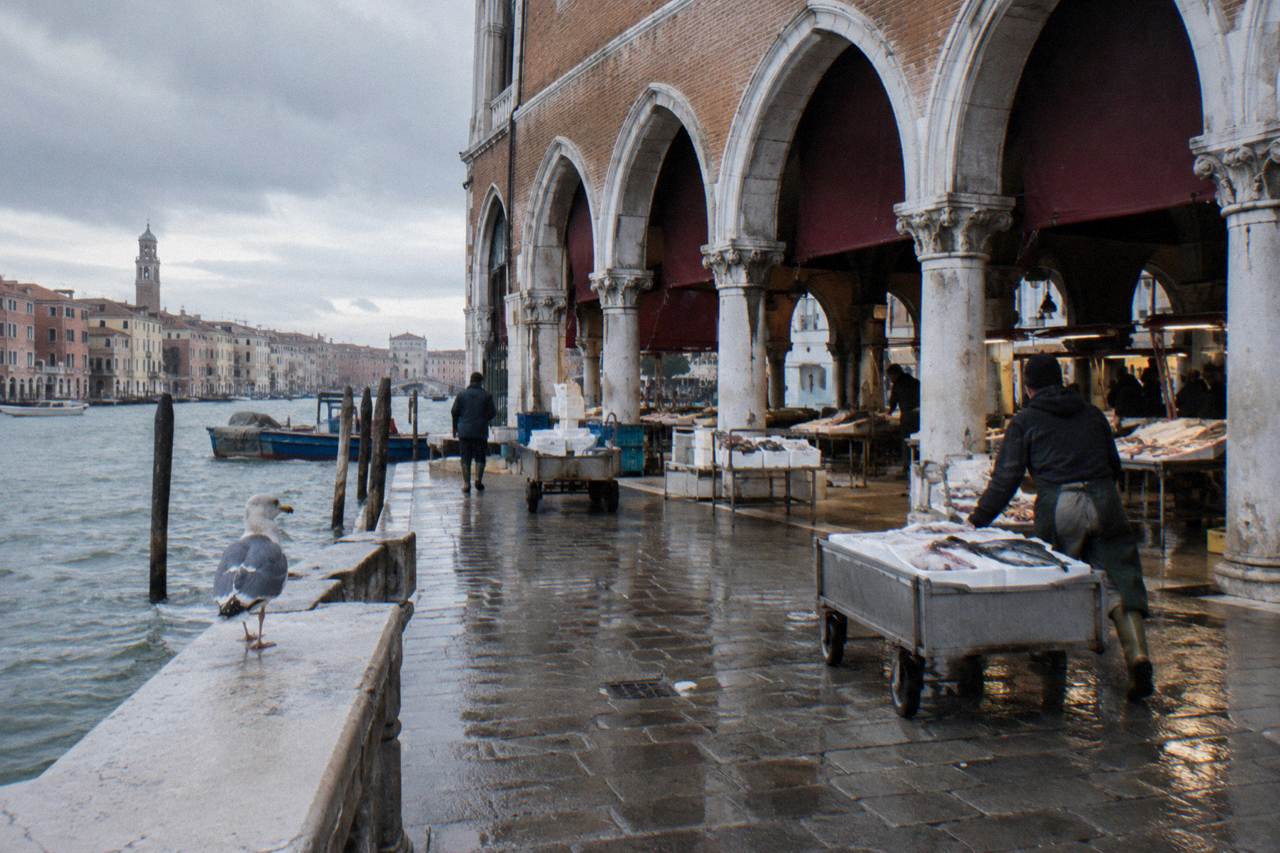
The Pescheria occupies a purpose-built brick building at Campo de le Becarie in San Polo, a short walk from the Rialto bridge, where wholesalers and restaurant buyers still trade lagoon and Adriatic fish in public view, which makes it one of the few working markets in the historic centre a visitor can freely watch. The structure wraps the stalls in arcades that keep the catch shaded. Trading happens in the open, with buyers and licensed intermediaries moving between stalls in the morning. Nothing about the visit is staged: at 8:00 the market belongs to the people who work it, and tourists are guests passing through. That is exactly the appeal. Few cities let a casual visitor stand a metre from the supply chain that feeds their dinner that evening, and Venice has kept that possibility alive in the middle of its most touristed district.
The market's location explains its food neighbourhood too. Because restaurant buyers have shopped here for generations, the bacari and trattorie around Rialto historically cooked what the market supplied, and the snack culture of cicchetti grew up around the same trade. The sausage, baccalà and fried fish on nearby counters belong to the same ecosystem. For a fuller picture of how the two markets split their roles, the Rialto market hours and best time to go guide lays out the weekly rhythm in detail, and this page sticks to the fish side.
Rialto Fish Market Hours: The Tuesday To Saturday Rhythm
The fish market opens Tuesday to Saturday, 7:00 to 14:00, and it is closed on Sundays, Mondays and Italian holidays; the produce market next door runs longer, Monday to Saturday, 7:00 to 20:00, also closed Sunday. These hours are as reported by the official Venice tourism site, and tour listings themselves warn that the fish market is closed Sundays, Mondays and Italian holidays, and that in the afternoon the fish market is done. The consequence for planning is simple: the mornings of Tuesday to Saturday are the only window, and the earlier half of that window is livelier, because trade winds down well before the 14:00 close. A first-time visitor who arrives at 13:00 on a Tuesday will find the stalls thinning out.
| Market | Days | Hours | Notes |
|---|---|---|---|
| Pescheria (fish) | Tuesday to Saturday | 7:00 to 14:00 | Closed Sunday and Monday; also closed Italian holidays |
| Erbaria (produce) | Monday to Saturday | 7:00 to 20:00 | Closed Sunday |
| Best trading window | Tuesday to Saturday | roughly 7:00 to 10:00 | Busiest buying hours; stalls wind down by early afternoon |
Planning around that rhythm matters more in Venice than elsewhere, because two common arrival patterns work against it. Cruise and day-trip schedules often push visitors to the market after midday, which is exactly when the fish stalls are emptying. And a Monday visit, natural if the weekend crowds are being avoided, finds the fish side shut entirely. The produce market saves a Monday, but the Pescheria itself does not. Anyone structuring a food-first itinerary around the market should build it into the early morning of a Tuesday to Saturday, and treat the rest of the day as the downhill run. For how the week's rhythm shapes a wider visit, the best time to visit Venice for food and crowds guide works through the seasons.
A guided walk squeezes the same morning for more. The options below all use the Rialto area as a stage, pairing the market with tastings or a meal.
Each takes a different angle on the same neighbourhood, from a lunchtime market-to-table format to a shorter semi-private circuit, so the comparison is less about quality than about how much of the morning a visitor wants to commit. Prices and current availability sit on each operator's live listing.
What You Actually See On The Stalls
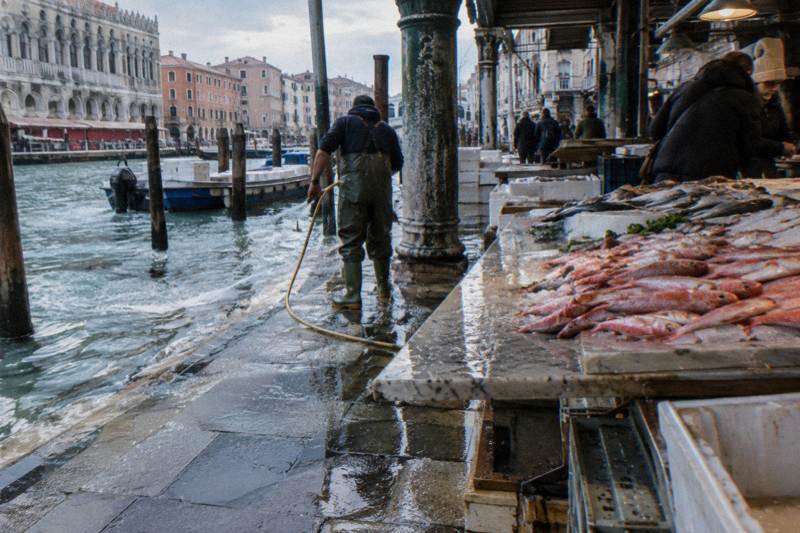
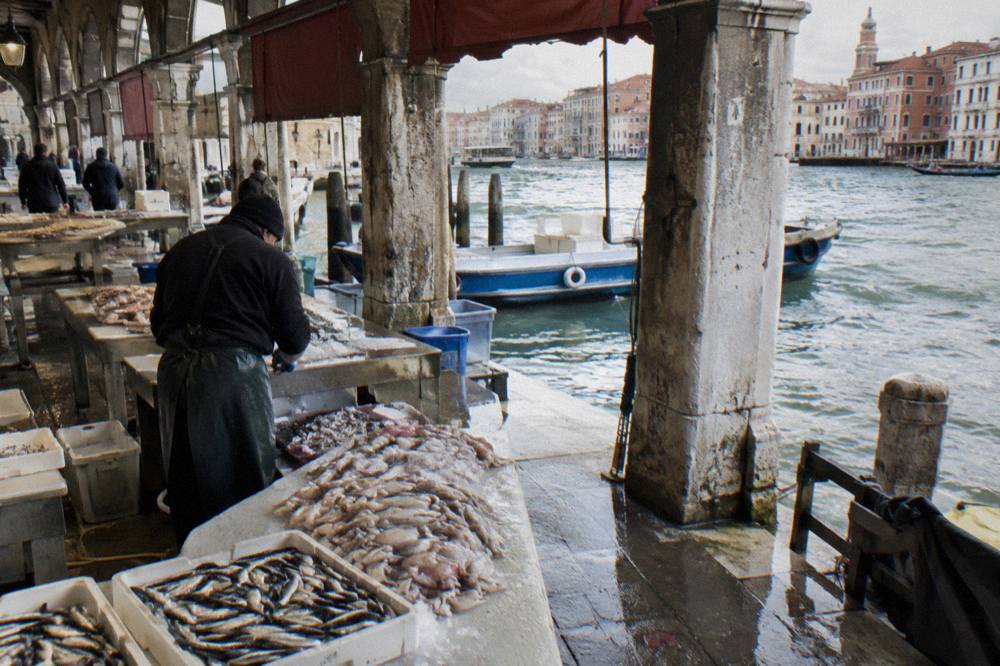
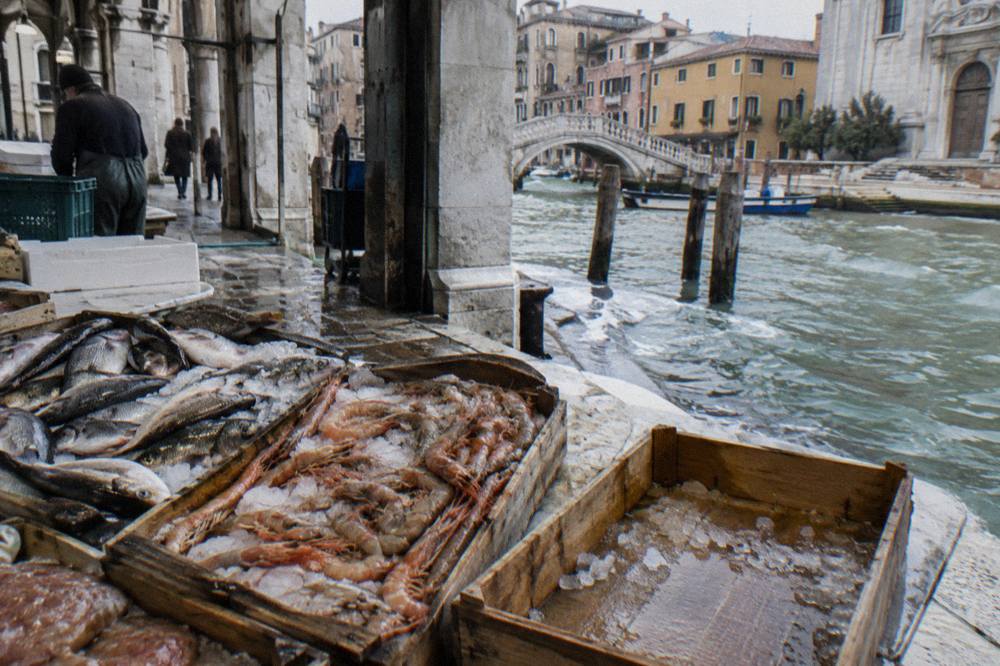
Expect crates of whole fish and shellfish laid out on ice at waist height, priced by hand-written or printed cards, with sellers cutting, weighing and packing at speed, and a rotation of catch that follows the lagoon seasons rather than a fixed catalogue. No two mornings look alike, and it would be wrong to promise any particular species on any particular day. What is consistent is the format: whole fish, not fillets, because Venetian buyers cook fish whole and judge it by the eye, the gills and the smell. Molluscs and shellfish sit in shallow trays. Larger fish are laid out flat. Everything is kept cold and damp, and the stone and marble of the old counters still do part of the work.
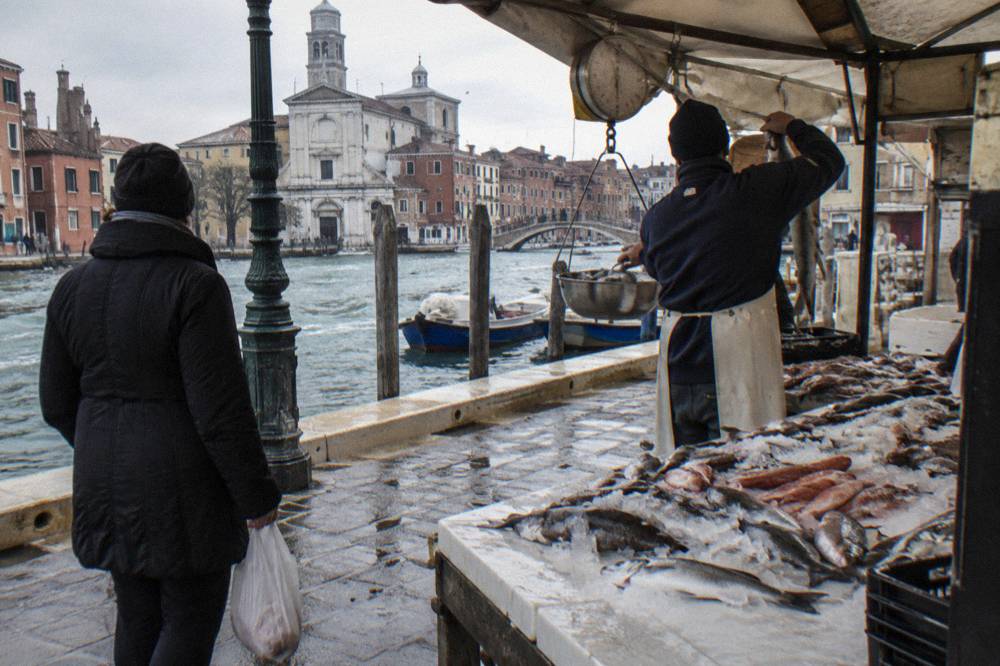
Photography deserves a word of restraint. The market is a workplace, and while walking through and looking is welcome, long lens sessions in the middle of the trading lane are not. Early mornings are tight: trolleys move fast, water splashes off the stalls, and the people working them have deliveries to make. Stand to the sides, keep gear close, and buy something if a stall catches the eye, which is the honest price of admission. Sardines, anchovies and cuttlefish are the kinds of things a visitor can plausibly cook or have prepared, though what is on sale on a given day is exactly the kind of detail no page can promise; check what the stalls show when there.
For visitors who want the catch decoded rather than just admired, this is where a guide earns the fee.
The lunchtime market tour watches the stalls with a guide who names what is on the ice, then continues to tastings, a sit-down lunch and local wine. The operator's listing carries the current price, meeting point and inclusions.
Lagoon Fish And The Names Worth Knowing
Venetian fish names come from the lagoon and the Adriatic trade, and a handful of terms explain most of what the stalls and the menus nearby show: go, the lagoon goby behind Burano's famous risotto; moleche, the soft-shell crabs that appear only in moulting seasons; and sarde, the sardines preserved as sarde in saor. Recognising five or six names turns both the market and the bacaro counters nearby from noise into narrative. The list below sticks to species and dishes this site's food guides cover in depth, and none of it is a promise of what any stall holds on a given morning.
| Venetian name | What it is | Where you meet it |
|---|---|---|
| Go (ghiozzo) | Lagoon goby, a small fish | Risotto di gò, the Burano specialty |
| Moleche | Soft-shell green crabs in moult | Fried, in season only, spring and autumn windows |
| Sarde | Sardines | Sarde in saor, sweet-and-sour with onion and pine nuts |
| Baccalà | Salt cod | Baccalà mantecato, whipped with olive oil on polenta |
| Seppie | Cuttlefish, ink and all | Risotto al nero di seppia |
| Canoce | Mantis shrimp | Grilled or in risotto, an Adriatic item |
The deeper story these names tell is that Venice's cooking is a lagoon cuisine first and a seafood cuisine second. The classic dishes on the counters around Rialto, from whipped baccalà to sardines in saor, exist because they solved preservation and transport problems for a trading city, not because someone wanted a delicacy. The guide to baccalà mantecato and polenta and the one on sarde in saor unpack those histories. At the market, the same logic is visible in the split between lagoon species, small and cheap by origin, and the larger Adriatic fish that command higher prices.
Seasonality is the other layer. The Venetian calendar of food moves in narrow windows, and the seasonal food guide tracks the main ones. Moleche appear when the crabs moult, and outside those weeks they simply do not exist. What the market sells in June is not what it sells in November, which is the single best argument for visiting more than once, or for letting a guide point out what is special that week.
The Produce Side: The Erbaria Next Door
The produce market, the Erbaria, runs along the streets by the Grand Canal side of Rialto, Monday to Saturday from 7:00 to 20:00, closed Sunday, selling fruit and vegetables rather than fish, and its longer hours make it the reliable half of the pair on a Monday or a late morning. The official hours come from the same Venice tourism source as the fish market's, and the contrast between the two schedules is worth internalising: produce all day until 20:00, fish only until 14:00 and never on a Monday. Visitors who hit the Pescheria too late can still salvage the morning here, and the stalls make an easy photographic subject with their tilted crates and handwritten signs.
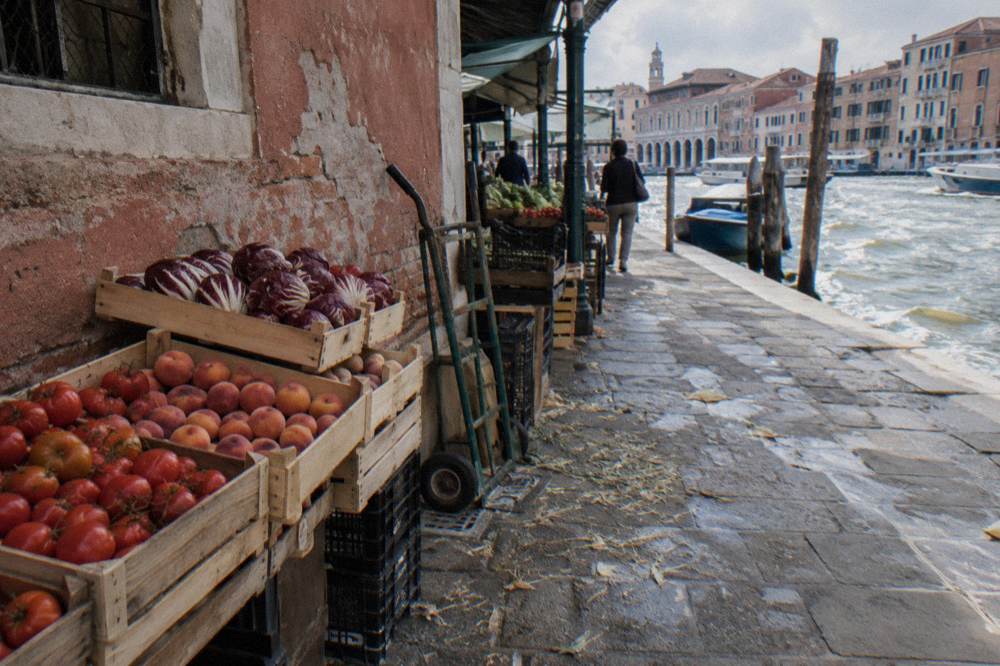
The Erbaria also shows the island agriculture behind Venetian cooking. Sant'Erasmo, the lagoon's market-garden island, supplies much of the city's produce, and its most famous crop, the small violet artichokes called castraùre, appears only briefly in spring. That connection between island soil and city stall is one of the quieter facts about Venetian food, and it shows up on the counters without labels. The Rialto fish market's produce counterpart is covered in the district guide, which maps which stalls and streets do what around the market square.
Practical browsing rules are the same as at the fish side: look freely, touch nothing without asking, and buy if staying anywhere with a kitchen. A bag of whatever is in season costs little by Venetian standards and turns a market visit into a picnic. Reported prices for produce are not something this site quotes, since stall prices change daily, but the general price level of Venetian street snacking, from cicchetti to a small glass of wine, is covered below.
What To Eat Near The Rialto Fish Market
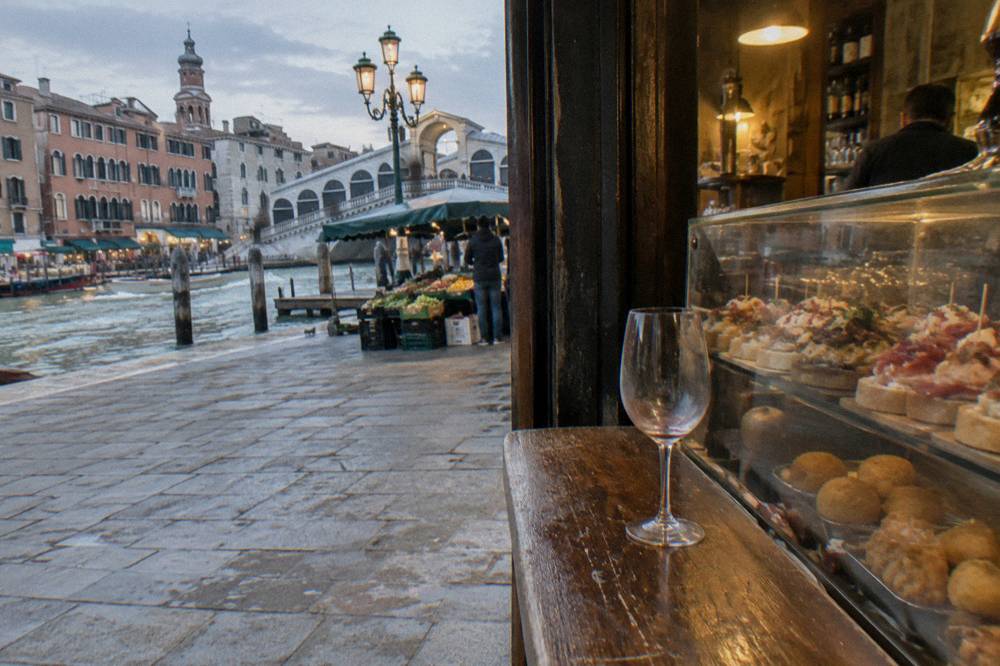
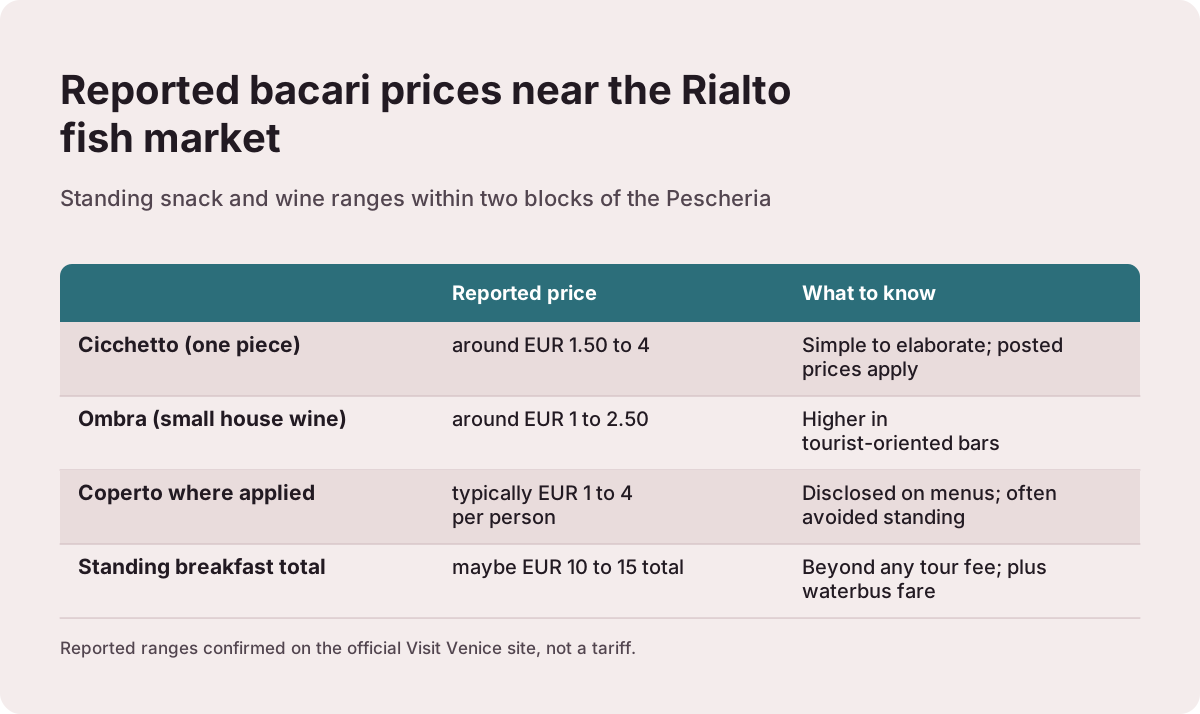
Within two blocks of the Pescheria, standing bacari sell cicchetti, small snacks on bread or polenta, at reported prices of around EUR 1.50 to 4 a piece, with an ombra, a small glass of house wine, at around EUR 1 to 2.50, so a market morning converts naturally into a crawl. Those figures are reported ranges for local bacari, confirmed on the official Visit Venice site, not a tariff: posted lists at each counter apply, and tourist-oriented bars charge more. Coperto, the cover charge, typically runs EUR 1 to 4 per person where applied and is disclosed on menus, though standing at the counter usually avoids it. The standing snack culture around Rialto is old, cheap by the standards of Venetian restaurants, and exists precisely because the market trade needed fast food.
| Item | Reported price | Notes |
|---|---|---|
| Cicchetto (one piece) | around EUR 1.50 to 4 | Simple to elaborate; posted prices apply |
| Ombra (small house wine) | around EUR 1 to 2.50 | Higher in tourist-oriented bars |
| Coperto where applied | typically EUR 1 to 4 per person | Disclosed on menus; often avoided standing |
The natural pairing after the market is a crawl through a few of the alleys off Campo de la Becarie and toward the bridge, trying baccalà mantecato, fried fish and a sarde in saor with a glass of whatever the bar pours. The guide to the best cicchetti bars in Venice covers how a bacaro crawl works and what to order, and the bacari etiquette guide explains the ombra ritual without which the whole thing is just snacking. Visitors who prefer the same loop with a guide, tastings counted and arranged in advance, have a ready-made option.
The semi-private market and cicchetti format keeps the group small and combines the stalls with a tasting circuit, which suits travellers who want the crawl without negotiating counters alone. Current pricing and the exact inclusions sit on the booking page.
Rules And Practicalities For Market Visitors
Venice caps guided groups at 25 people in the historic centre and the lagoon islands, bans loudspeakers, and no longer charges a day-visitor access fee as of 27 July 2026, so a market morning costs nothing to enter beyond whatever is bought or booked. The group cap and loudspeaker ban are standing rules, reported as in effect since 2024, which is why guides in the market lanes use headsets rather than raised voices. The access fee is the one that confuses people: the 2026 trial, which ran on 60 days between April and July at EUR 5 or EUR 10, has ended, and per the official page no fee applies from 27 July 2026 and no payment or exemption is needed to visit. It returns in 2027, with dates already listed and amounts not yet published, so check the official access-fee page before any 2027 trip.
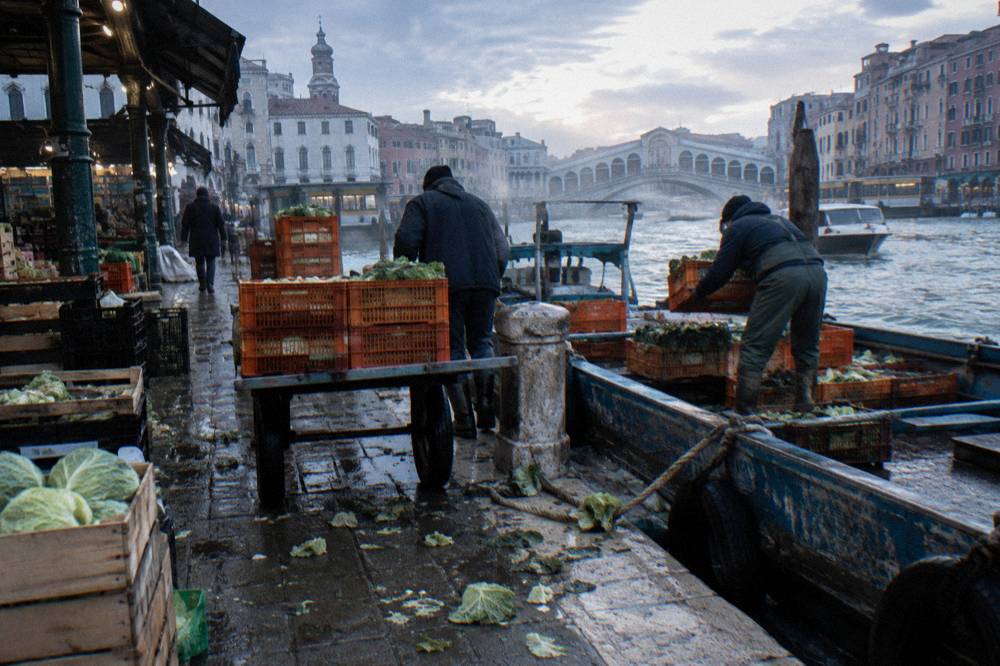
Getting to Rialto is short from almost anywhere in the historic centre on foot, and the waterbus network covers the rest. A single ACTV ticket valid 75 minutes costs a reported EUR 9.50, and a 24-hour pass a reported EUR 25, per the operator's current fares; check the official ACTV pages before travel since fares shift. The market's own hours, the standing reference for this page, are published by the official Venice tourism site's markets page, and the city lists both Rialto markets among its daily historic-centre markets without giving hours, so the tourism site's figures are the ones to trust.
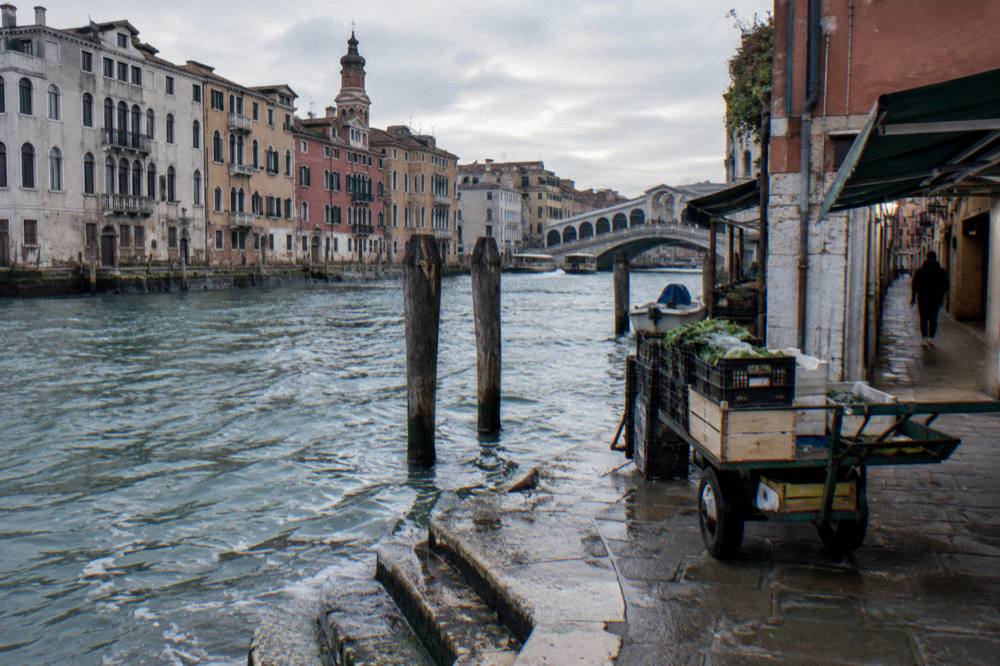
A few more practical notes. Mornings can be wet underfoot around the fish stalls, so smooth-soled shoes are a poor choice. Dogs and large bags complicate the narrow lanes at trading hours. And the market is a food-safety-regulated workplace, so touching the catch is off limits, however tempting a photo arrangement looks. None of this is enforced harshly, but all of it is obvious to the people working, and respect reads as respect.
Market Tours That Add Context: Are They Worth It?
A guided market walk is worth booking when the goal is decoding the catch, the history and the neighbourhood in a single morning, because the stalls explain little on their own, while a self-guided visit suits anyone happy to simply look and then snack independently. The honest gap between the two is context: species names, which dishes grew from which fish, why the market sits where it does, and which of the surrounding bars carry the tradition forward. A guide compresses hours of reading into ninety minutes of walking. Against that, the market itself is free, the produce stalls are self-explanatory, and a confident visitor with the cicchetti guide linked above can build a good morning alone.
The format that goes furthest is the market-plus-cooking-class combination: shop the stalls with a chef, then cook and eat what was bought. It is the fullest version of the market's logic, turning the morning's catch into lunch with instruction attached, and the listing carries the current price and schedule. For a straight comparison between a walk and a class, the food walk or cooking class decision guide works through the trade-offs, and the guide to what a Venice food walk costs breaks down what the price of a walk normally covers.
One scheduling note belongs here rather than repeated later: book any guided market walk for a Tuesday to Saturday morning, since a Monday booking loses the fish market entirely and an afternoon booking loses most of the neighbourhood's momentum. The best tours of this area run early for exactly that reason, and their listings show start times clearly.
A Self-Guided Morning Plan Around The Pescheria
A strong self-guided morning runs: the Pescheria between 7:30 and 9:00, the Erbaria stalls after 9:00, one or two bacari before 11:00, and the Rialto bridge last, once the market lanes have emptied of trade, all doable on foot in under three hours. The order matters because the fish stalls are the time-sensitive part and the bridge viewpoint never closes. Starting early also puts the visit ahead of the day-trip crowds that thicken the alleys from late morning, which changes the character of the whole walk. Anyone using this plan on a Sunday or Monday should swap the Pescheria for more time in the bacari, since the fish market will be closed.
Budget for the morning is modest. Beyond any tour fee, a self-guided visitor is spending reported cicchetti and ombra prices, maybe EUR 10 to 15 total for a serious standing breakfast, plus waterbus fare if coming from afar. The tourist tax, EUR 0.10 to 5.00 per person per night depending on the accommodation, is collected by hotels, not at the market, so it does not touch the morning itself. Visitors with dietary restrictions should note that none of the market's guided experiences can be assumed adaptable without asking; message the operator before booking, as the listings do not state vegetarian, vegan or gluten-free options.
For anyone who would rather fold the morning into a wider food itinerary, Venice Food Tours covers the full decision map, from which tasting walk suits which traveller to how the cooking classes compare. The short version: the market morning is the cheapest, most flexible piece of Venice's food scene, and every guided format simply layers expertise and convenience on top of it.
Each listing shows its own price, duration and inclusions, and availability moves with the season, so the live listing is the deciding document. Whichever way the morning is built, the Pescheria rewards the early start more than any other stop in the district.
Common Questions About The Rialto Fish Market
What Are The Rialto Fish Market Opening Hours?
The fish market opens Tuesday to Saturday, 7:00 to 14:00, and is closed Sunday, Monday and Italian holidays. The produce market next door runs Monday to Saturday, 7:00 to 20:00, closed Sunday. These are the official hours as reported by the Venice tourism site.
Is The Rialto Fish Market Open On Monday?
No. The fish market is closed on Sundays and Mondays, and on Italian holidays. Tour listings warn the same. On a Monday, the produce market is still running and the bacari around Rialto are open as normal.
What Is The Best Time Of Day To Visit The Pescheria?
Between roughly 7:00 and 10:00 on a Tuesday to Saturday. Trading is busiest early, and the stalls wind down well before the 14:00 close. Late-morning visitors find the market thinning out.
Can You Buy Fish At The Rialto Market As A Tourist?
Yes, the market is a public commercial market and anyone can buy, though stalls sell mostly whole fish and shellfish rather than prepared food. Whether cooking is possible depends on accommodation. Standing and watching is free.
How Much Does It Cost To Visit The Rialto Fish Market?
Nothing. Walking through the market is free, and the day-visitor access fee no longer applies as of 27 July 2026 per the official page, though it returns in 2027 with amounts not yet published. Only what is bought, eaten or booked as a tour costs money.
What Food Is Near The Rialto Fish Market?
Bacari within a few blocks sell cicchetti at a reported EUR 1.50 to 4 a piece with an ombra of house wine at around EUR 1 to 2.50. Classic items include baccalà mantecato, sarde in saor and fried fish, and standing at the counter usually avoids the coperto.